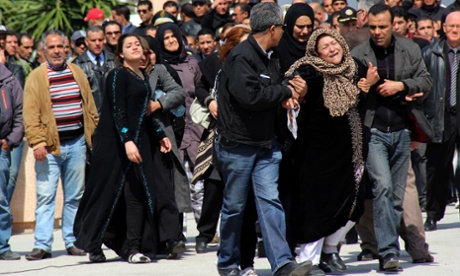
Troops have been deployed on the streets of Tunisian cities in the aftermath of the Bardo museum attack, as a young curator was hailed as a hero on Thursday for hiding a group of terrified tourists from the terrorist slaughter.
Authorities in the north African country have raised the death toll to 23, 20 of them tourists, after the attack in which two gunmen stormed the museum – one of Tunisia’s top visitor attractions – on Wednesday.
Armoured cars and roadblocks appeared across the streets of the capital, Tunis, while security forces announced nine arrests in a sweep of terror suspects. In an online audio recording praising the pair of gunmen, Islamic State was reported to have claimed responsibility for the killings.
Facing the prospect of a collapse in tourism, a pillar of Tunisia’s troubled economy, President Beji Caid Essebsi ordered troops onto the streets for the first time since the 2011 Arab spring revolution. “The president has decided large cities will be secured by the army,” his office said in a statement.
Shock and sadness spread among survivors, meanwhile, as the full extent of the slaughter became apparent. British solicitor Sally Jane Adey, 57, from Shropshire, was named among the dead, who included five Japanese, four Italians, two Colombians, two Spaniards and citizens from Australia, France and Poland. Three Tunisians were also killed in the attack and the two gunmen were shot dead by security forces.
A missing Spanish couple, Carlos Sanchez and four months pregnant Cristina Rubio, emerged at dawn, having hidden in the museum basement. “We spent all night there and we thought the terrorists were still outside,” Sanchez told Associated Press.
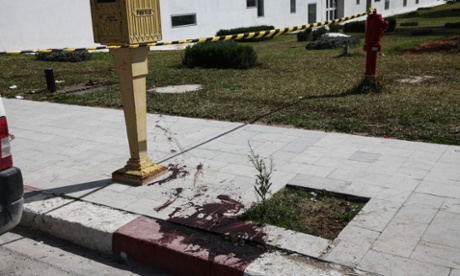
At the museum, signs of the havoc wreaked by the two terrorists was easy to find. Outside, pools of blood, congealed in the hot sun, marked the places where some of the tourists lost their lives.
Inside, the white pillars in the big empty atrium were spattered with blood, and splintered wood and broken chairs hinted at the violence of the three-hour battle.
Witnesses said the attack came without warning, as two buses bringing Italian tourists to the museum stopped by the main entrance. The two gunmen, named by the authorities as Tunisians Yassine Laabidi and Hatem Khachnaoui, had been waiting in the forecourt near the wrought-iron front gates. They opened fire on the buses with machine guns, then sprinted for the glass doors of the museum.
While the adjacent military base and national parliament are the most heavily guarded sites in Tunisia, there was no police presence in the museum itself, and the gunmen burst into the big entry foyer and began shooting.
Ali Eddine Hamadi, the 22-year-old curator of the Christian relics department, was coming downstairs to the foyer when he heard shooting. “I was on my way to go and eat something, I hear firing and a bomb,” he said.
He turned and sprinted back up the stairs, the walls echoing to machine-gun fire and screams of victims below. Cresting the stairs, he was confronted by the terrified faces of 19 tourists, some French, some Tunisian.
Hamadi made a snap decision to hide the tourists in the warren of rooms housing priceless antiquities, which he knew by heart. As firing continued below, he shepherded the visitors, including a pregnant woman, through a wooden door. “I stay with the group and I close the door, I try to save these people,” he said.
Once they were all inside, he closed the door softly, then shushed the tourists as they clustered by the wall. “I told the people to be quiet, not to say anything,” he said.
Then he crouched by the door, listening to the sounds of fighting from other parts of the complex. After the firing stopped, Hamadi carefully inched open the door, whispering for the tourists to stay put. He closed the door and went downstairs, coming face-to-face with balaclava-clad police.
After tense few moments convincing them he was not a terrorist, he led them upstairs to the tourists still hiding in the room. “I am not a hero, I am doing my job,” he said. “It was a terrible scene, I am like a zombie in my country, I didn’t sleep last night.”
For ordinary Tunisians, the attack is a massive wake-up call, with terrorists attacking civilians for the first time after months of battles with security forces. Jihadi forces, many infiltrating the country from neighbouring Libya and Algeria, have been a persistent threat to security forces for months.
Last October, on the eve of national elections, the army raided a house in the capital where a terror cell was preparing a bombing campaign, killing six jihadis – five of them young women who had recently been radicalised. More militants were killed in anti-terrorist sweeps in the Nebeur region close to the Algerian border throughout November and December, while jihadi groups killed five soldiers in an attack on a bus on a remote road.
Wednesday’s attack came after the latest announcement by Tunisia of the seizure of jihadis and weapons, and may mark an escalation in the terrorist campaign in the country. Despite being hailed as the great success story of the 2011 Arab spring, with democracy having been established, Tunisia has seen thousands of home-grown jihadis head to Syria, Iraq and Libya to fight for Isis.
There are fears that the attack will wreck tourism: two Italian cruise companies have already announced that future visits will be suspended. The tourist industry employs 400,000 Tunisians and is is an important earner in a troubled economy.
“The peak tourism season is right around the corner,” said Dr Imad el-Anis, a North Africa expert at Nottingham Trent University. “If tourists are scared away as a result of the Bardo museum attack, then a lot of people in government and business look set to lose out.”
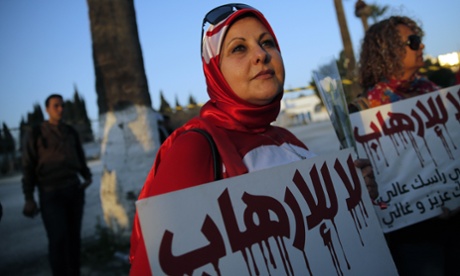
For a second day, anti-terrorist demonstrations were staged in Tunis. Among protesters chanting, singing and blowing whistles outside the museum, three students stood with home-made placards bearing the slogans “Je Suis Tunisien, Je Suis Charlie” – a reference to the terrorist killings at Charlie Hebdo magazine in Paris earlier this year.
“We are against the terrorism, we are against Isis: it is a problem shared with France, shared with all the world,” said one of the students, Joseph Missy. “We want to show what we feel.”