Trinity Mirror is to cut 25 jobs in its Midlands operation: 19 jobs will go in Birmingham and six in Coventry.
In a letter to staff, the company explained that the changes “are based on an evaluation of the rate of growth of our digital audiences, demand for digital content and the level of content we need for our printed editions”. In other words, fewer staff are required to produce online content.
The letter continues by saying that “in the restructured newsroom, each and every member of the team will be fully focussed [sic] on building their digital audience and therefore their contribution to our digital growth”. In other words, newsprint decline means that it will be allowed to wither on the vine.
And the letter concludes: “The emphasis will be on a flatter management structure, multi-skilled teams and more agile ways of working”. In other words, every journalist, regardless of seniority, will be expected to do everything.
None of this is in the least surprising of course and, if we overlook for a moment the human drama of those who will lose their jobs, it is a rational response to the crisis in Trinity Mirror’s Midlands division.
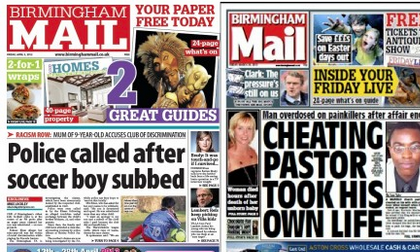
The reality is that the Birmingham Mail, which used to be one of Britain’s biggest selling regional papers, has been losing sales for several years.
In May this year, its print version sold an average of 26,936 copies a day. That was more than 10,000 copies fewer than the same month in 2014, a fall of 27.3%.
The story is not dissimilar at the Coventry Telegraph. It sold 20,709 copies in May, down 9.9% on a year ago. Its digital edition sale is negligible.
Alongside the circulation declines has been a commercial decline. The print advertising revenue for both titles has been slipping away. Trinity Mirror was bound to take action.
In the words of TM’s Midlands managing director, Simon Edgley, the cuts are “necessary” to enable the publisher “to adapt to commercial challenges and provide a structure that gives longer term sustainability of the business”.
It is understood that the cuts will be achieved through voluntary redundancies but that’s precious little comfort to the staff, whether they are taking up the offer or staying.
This news http://t.co/iTAHq4et69 sadly reminds me of @GreensladeR's prediction http://t.co/T533k6wXRf of a digital-only @birminghammail
— Steve Dyson (@stevedyson) June 4, 2015
The National Union of Journalists’ organiser, Chris Morley, is right in saying that the decision will be “devastating and demoralising” for the editorial workforce.
And he makes a good point in asking that if content is king in this digital world why are fewer journalists required?
That, of course, is the problem in a nutshell. Trinity Mirror has to balance its budget needs against editorial needs. It is less labour-intensive to put up content online than it is in printed form. Fewer people can provide more.
But the danger is in confusing quantity with quality. If the online versions of the Mail and Telegraph are to have a viable future, then the journalists have to provide the people of Birmingham and Coventry editorial material of real value.
If there are too few genuine news-gatherers, then the audience will not bother.
Meanwhile, as Steve Dyson noted in a tweet last night, the axe surely hangs over the Mail’s newsprint version, as I suggested in March this year. At some point not too far off, Trinity Mirror could well decide that it no longer makes commercial sense to print the Mail.
Sources: NUJ/HoldTheFrontPage