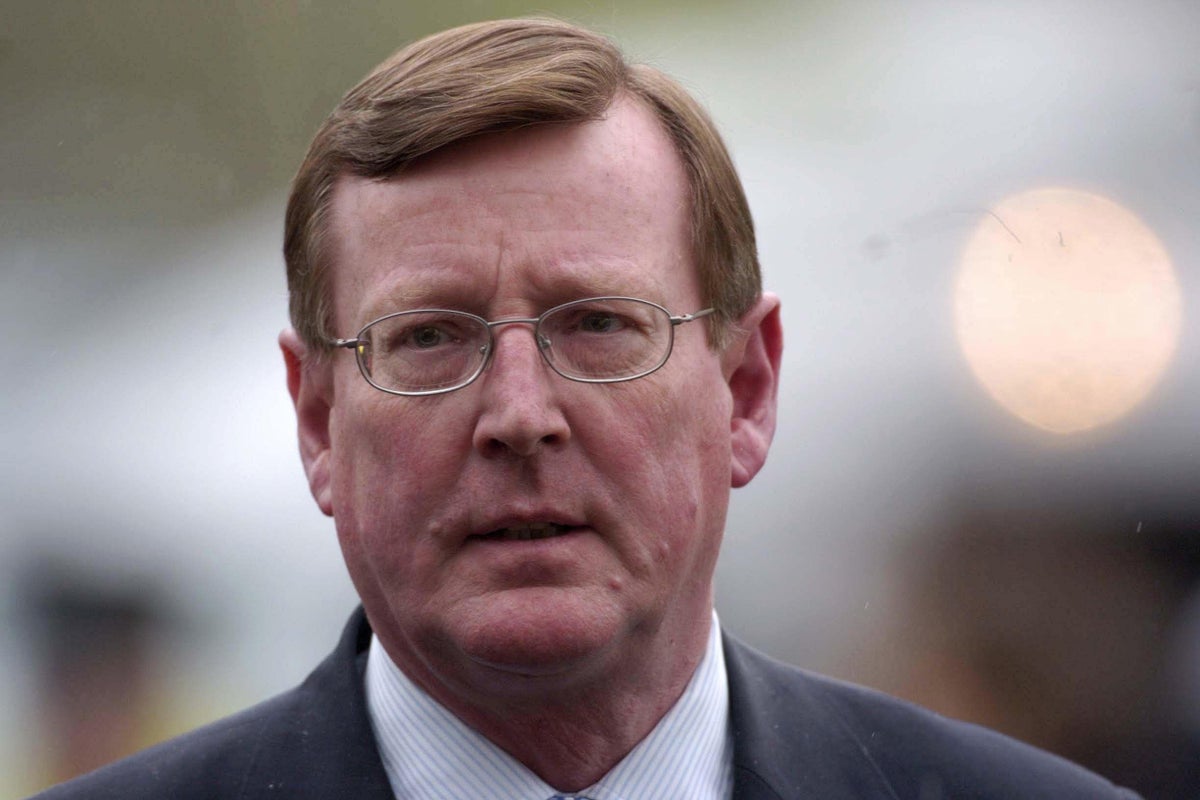
Any review of the early years of the Stormont political institutions had to focus on the lack of paramilitary decommissioning, former Ulster Unionist leader David Trimble warned the UK Government in 2003.
Newly declassified files show Mr Trimble stating his “incredulity” that a letter from the UK and Irish governments proposing a conference to discuss progress in the workings of the Assembly did not mention decommissioning.
The 1998 Good Friday Agreement largely ended decades of violence in Northern Ireland and established the Stormont Assembly and powersharing Executive.
However, the institutions collapsed in October 2002 after police raided Sinn Fein offices at Stormont as part of an investigation into an alleged IRA spy ring.
During the subsequent period of direct rule, then Northern Ireland secretary Paul Murphy and Irish foreign minister Brian Cowen wrote to the Assembly parties setting out their intention to host a conference to discuss and report on the political institutions four years after they had been established.
Mr Trimble responded to Mr Murphy in a letter on December 23.
He said: “At the time of the Agreement it was assumed that the paragraph 8 review would be held after four years’ experience of the operation of the Assembly to see if the somewhat novel ideas in the Agreement had worked satisfactorily and amend or fine tune them if they had not.
“We have not had four years’ experience of the operation of the institutions.
“There has been less than three years’ experience, punctuated by crisis and suspension.
“This then begs the question of whether there should be a review at all.”
Mr Trimble accused the government of giving priority to concerns raised by the Alliance Party, Sinn Fein and SDLP.
He said: “It is entirely characteristic of the Government’s approach to matters, which approach has led directly to the current debacle, that the Government is quick to cater to the needs of these parties, even to the extent of stretching the terms of the Agreement, while ignoring the more important concerns of the Unionist community.”
He said any review should look at the “failure to vest power in the Assembly, the low level of collectivity in the Executive, the emasculation of the Assembly committees”.
Mr Trimble added: “There is, however, one overriding issue, namely, the issue which has produced the instability in the institutions, the issue which was the direct cause of all the suspensions, but which, to our incredulity, is not even mentioned in your letter.
“I refer, of course, to the problem of continuing paramilitary activity and the failure, three and a half years after the due date, to achieve the decommissioning of all paramilitary arms.
“It is quite inappropriate to conduct the ‘nuts and bolts’ paragraph 8 review while ignoring the real problem.”
He said any review should be short and “focused on the real issue”.
He added: “If that is sorted out, then the Assembly can be resumed and a paragraph 8 review held in the manner and context envisaged by the Agreement.”
Then SDLP leader Mark Durkan wrote to Mr Murphy and Mr Cowen, stating that any review could not be a renegotiation of the Agreement.
He said: “We also seek a commitment from the two governments that that is their position also.”
In his letter, then Sinn Fein president Gerry Adams said: “Both governments must continue to make clear that the review will not be a renegotiation of the Agreement, nor can it act as a substitute for working political institutions.”
Then DUP leader Ian Paisley wrote to Mr Murphy on December 29.
He said: “Our position and attitude to Sinn Fein is well known and set out in our Assembly election manifesto.
“We will not be talking or negotiating with Sinn Fein.”
Following the St Andrews Agreement in 2006, devolution was restored in May 2007 with Mr Paisley as first minister and Sinn Fein’s Martin McGuinness as deputy first minister.
How U2 ticket u-turn put diplomats in ’embarrassing situation’
Stormont ministers received legal advice on ‘royal command’ to fly Union flag
Northern Ireland was on ‘cusp of new beginning’ with Stormont return in 2000
McAleese husband’s contacts with UDA took on ‘life of own’, ambassador was told
Blair refused to share intelligence with Ireland over Sellafield threat - archives
Emergency departments in ‘big trouble’ as corridor care ‘normalised’ – expert