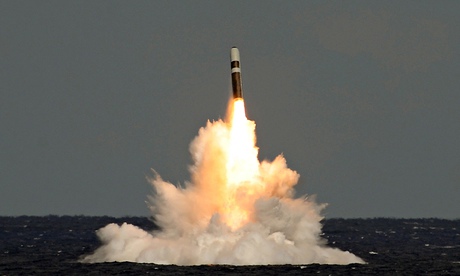
If, as Patrick Wintour thinks, Labour “shadow cabinet ministers believe that conference agreed not to change existing policy” (The long read, 25 September), I’d suggest they’re mistaken. The last time the national policy forum met to discuss the issue it was unanimously agreed to include nuclear in a strategic defence review. No ambiguity whatsoever. Trident replacement is not a done deal, so I’d suggest that when Maria Eagle carries out her review, then the parameters of that review and the purpose of nuclear missiles all need to be clearly laid out.
We should decide exactly where nuclear missiles sit in the scheme of things. Many military chiefs see Trident as an unnecessary burden of no value and a drain on the defence budget. I’d suggest that Trident is an instrument not of defence but of foreign policy. Britain’s security is a key priority for the British people. So I was delighted to hear Jeremy Corbyn say that Britain’s security requires a modern, well-equipped military. I don’t hear anyone saying the RAF go back to flying Spitfires. The army would be insulted to be provided with Lee-Enfield repeating rifles. So the navy should see its systems modernised and the obsolete Trident confined to the history books.
Trident is not strategic. Neither is it independent nor a deterrent. Corbyn is correct to say he would not press the nuclear button. It certainly never deterred General Galtieri when he invaded the Falklands. Replacing Trident is being proposed as a sop to the US and as an ego trip for those who believe that Britain is still a superpower. Those days are gone.
Labour must now develop both a foreign policy and a military fit to defend us against the challenges of the 21st century not those of the cold war. Corbyn Corbyn’s vision of a nuclear-free Britain is worthy of consideration and shows, once again, that while his views chime with the public, many MPs are behind the curve. Maybe it’s some of our shadow ministers who need to stop living in the past and not the Labour leader.
George McManus
Labour national policy forum, Britain’s Global Role Policy Commission
• We know the SNP objects to Trident but the majority in the UK would prefer to maintain an updated nuclear deterrent with several threats still around and growing. Some areas of England and Wales are suffering from closures in the steel industry, due to the China slowdown in particular. How about refitting those English and Welsh plants to work on Trident-related upgrades, and move it away from Scotland once and for all? The SNP can redeploy people on other industries which may start to contribute to the UK overall and replace the diminishing oil revenues.
Lynne Jones
London
• Have I got this right? The man who has no problem giving the order to kill millions of civilians in a nuclear attack is considered fit for the highest public office, while the man who cannot foresee any circumstances under which he would be prepared to do that is considered “unfit” (Divisions over Trident, 1 October)? Britain’s so-called nuclear “deterrent” has already failed if it were ever to be used, so what exactly would be the point of pressing the button at that stage? Surely the deliberate act of killing millions of civilians would be the ultimate crime against humanity and no sane person would ever do it. Why then do we have a defence policy based on the assumption that a British PM would be willing to do so?
This policy was MAD (mutually assured destruction) when it was invented in the 1950s, and it is madder still now that our enemies are not even nation-states but terror groups who probably couldn’t care less if we dropped an atom bomb on Raqqa or Kunduz. Nuclear weapons provide us no protection whatsoever against such groups and to think these weapons protect us at all is a dangerous delusion that makes the whole country less secure, not more. A serious reconsideration of this insane policy is long overdue.
Dr Timmon Wallis
London
• In the name of workers’ solidarity across the board, I must write in defence of the pro-Trident stance of Unite (I am a member of Usdaw). Much of defence spending – and Faslane is an obvious example – represents a rebalancing of the economy away from London. Thousands of unionised livelihoods and their communities depend on defence projects and then there are the feeder industries. And HM Treasury rakes in revenue from taxes on people employed. A more creative solution is to fund the entire Trident renewal/maintenance from central Treasury sources, given the commitment is implicit in our “permanent five” UN status. That way the normal defence budget will go further on the imperatives of everyday conventional military capabilities.
John Barstow
Pulborough, West Sussex
• Control was handed to Washington when the decision was made to use a missile delivery system designed, manufactured and overhauled in the US. Even submarine-launched test-firings are conducted in US waters near Cape Canaveral under, needless to say, US navy supervision. It is inconceivable that No 10 would fire Trident in anger without prior approval from the White House.
Persisting with Trident and its proposed replacement in order to retain a permanent security council seat is to reject British pragmatism in favour of la gloire. At least the French, to their credit, went to the trouble of developing their own submarine launched missile delivery system. They own it, hence control it.
Yugo Kovach
Winterborne Houghton, Dorset
• In the light of the Labour party’s current discussion about Trident, it may be of interest to recall the party’s 1964 manifesto: “We are not prepared any longer to waste the country’s resources on endless duplication of strategic nuclear weapons. We shall propose the renegotiation of the Nassau agreement [to buy Polaris, the predecessor of Trident]. Our stress will be on the strengthening of our conventional regular forces so that we can contribute our share to Nato defence and also fulfil our peacekeeping commitments to the Commonwealth and the UN. We are against the development of national nuclear deterrents … We believe in the inter-dependence of the western alliance and will put forward constructive proposals for integrating all Nato’s nuclear weapons under effective political control so that all the partners in the alliance have a proper share in their deployment and control.”
Labour won that election on a promise to give up the “independent” nuclear deterrent – despite a vigorous campaign by Alec Douglas-Home to discredit the policy. Sadly, Harold Wilson reneged on the commitment. Let’s hope Prime Minister Corbyn will stick to his principles.
Robin Paice
Southsea, Hampshire
• Surely the best way Jeremy Corbyn can tackle the Trident “problem” is to follow the excellent advice of Andy Hamilton on BBC’s News Quiz, where he advocated “scrapping Trident but not telling anyone that it has been scrapped”.
Ivor Mitchell
Wellington, Somerset