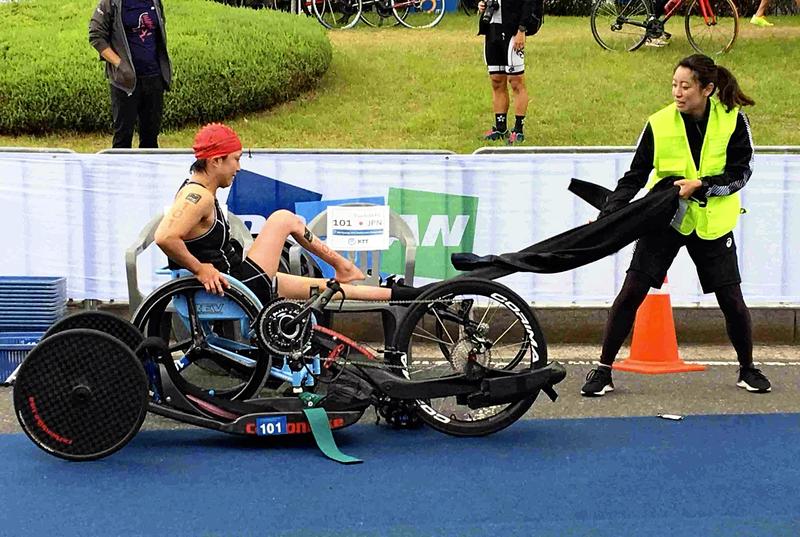
Paralympic triathlon consists of three segments: a 750-meter swim, a 20-kilometer cycling portion and a 5-kilometer run for a sum of 25,750 meters.
Each athlete has support from a sports partner called a handler. Aoi Oiwa is one of those handlers.
The 26-year-old official of the Japan Triathlon Union said she is serious about her role.
"What I do can shift the results one way or the other, so my work carries a huge responsibility," she said.
Handlers assist wheelchair-bound athletes who have disabilities of the lower extremities or other areas of the body. For instance, after the swimming section, handlers help the athletes remove their wetsuits and mount their handcycles ahead of the cycling portion.
Once the bike segment is completed, handlers assist athletes in making the transition to a "racer," a wheelchair built for competition, and get them going into the final running portion.
The minutes spent in these transition areas -- changeovers between triathlon segments -- is included in the overall time of each athlete.
Oiwa described her task as "perhaps something similar to that of an Formula 1 pit crew member."
Sometimes athletes can lose or gain race positions in the transition areas, and that is why these phases are called the sport's "fourth element."
The fact that Oiwa was also a triathlete makes her work harder to produce good results.
When Oiwa was a student at Okazaki Nishi High School in Aichi Prefecture, she was on the Japanese national team at the World Junior Championships.
After graduating from Tokyo Women's College of Physical Education, she began coaching a local club team.
In the spring 2018, she moved on to join the Japan Triathlon Union and accompanied veteran athlete Wakako Tsuchida on a trip to Australia.
The 45-year-old Tsuchida, who won gold medals in the women's wheelchair 5,000 meters and other events, is aiming to participate in the Para triathlon at the Tokyo Paralympics. Oiwa was deeply impressed by watching Tsuchida battle in a difficult race in Australia as the athlete expanded her competitive profile.
"I still remember what I said in the meeting after the race. I expressed the fact that I wanted to gain additional knowledge and support all of you more," Oiwa said.
Becoming a full-fledged handler wasn't easy. Oiwa felt pressure not only by the impact on her charges' results, but also by a fear of getting the athletes injured.
Oiwa could not fully grasp the range of motion Tsuchida, who had a spinal cord injury, was able to perform in her lower body. Oiwa recalled being "cautious."
Subsequently, she took video of training sessions and built up a trust with Tsuchida by having lunch and doing other activities together.
She managed to cut the time in the transition areas by a sum of about 1 minute in May 2019, a year after her debut.
Medals are awarded to guide runners of visually impaired athletes, but not to handlers. But that's not Oiwa's focus.
"It's rewarding. Our chemistry is directly linked to the time," Oiwa said with a smile.
A commemorative photo taken at every race with a smile is a better gift for Oiwa than a medal.
Read more from The Japan News at https://japannews.yomiuri.co.jp/