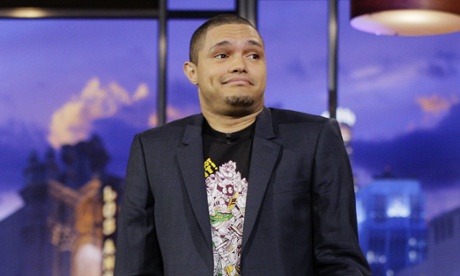
In a sequence of events which may confound the mythographers of the distant future, comedian Trevor Noah became a new iteration of an old archetype this week. But the contemporary Noah’s predicament bears more resemblance to that of the prophet Jeremiah than to his namesake’s. The future prospects of the South African stand-up seem suddenly compromised, just as they were for Jeremiah and his people, by past actions. The 31-year-old funnyman may soon come to suffice as a specific sort of exemplar for our times where biblical figures, Greek tragic heroes and Arthur Miller protagonists no longer do – because those lucky lads weren’t on Twitter.
If you missed the story – which I likely would have, had the Guardian not asked me to write about it (presumably deeming me an apt spokesman for beleaguered, mistake-prone comedians everywhere) – here’s the synopsis. On Monday, Noah, a comedian renowned internationally for routines about race, politics and, according to Wikipedia, “human sexuality”, was named as Jon Stewart’s successor as host of The Daily Show, a programme which has become a bastion of topical satire for youngish people the world over. “Less than 24 hours” (which in internet time is roughly two aeons) after the appointment, Noah was deluged with criticism about a number of his tweets which until that day had been sitting deep and fossil-like in his timeline. But now helming one of satire’s biggest ships, he discovered they had been extracted and were fuelling a backlash against his appointment, founded on an accusation of mass bigotry, including misogyny and antisemitism.
About a dozen of Noah’s tweets have come under serious scrutiny, but here are the ones getting most screentime in the thinkpieces:
“So she gets fat? RT @missdanibagel: When a woman is loved correctly, she becomes 10 times the woman she was before”
“South Africans know how to recycle like israel knows how to be peaceful.”
“Almost bumped a Jewish kid crossing the road. He didn’t look b4 crossing but I still would hav felt so bad in my german car!”
Some responses, such as this one from heavy metal singer David Draiman, were angry: ‘WTF DID YOU SAY @Trevornoah? GOT ANYTHING ELSE SMART TO SAY ABOUT JEWS LITTLE #AntiSemite?’ Others were more incisive, for example Kelsey McKinney of Vox who criticised Noah for repeatedly shaming minority groups. And many levelled criticism of an almost aesthetic rather than moral tenor: “The most depressing thing about Trevor Noah’s Twitter timeline, other than how bad he is at Twitter, is how often he replies to @UberFacts.” That one’s from Tom Gara, business editor at BuzzFeed. When someone from BuzzFeed is calling you lame, you know you’re in trouble.
But Gara’s point is convincing. And so is Kinsey’s. She puts it thus: “If Trevor Noah wants to be the next Jon Stewart, he certainly can’t do it like this.” These tweets are, at least to my mind, disappointing not because they are truly offensive, but because they are boring. The second one is a pseudo-satirical joke about Israel and should be added to the backlog of other pseudo-satirical jokes about Israel waiting to have their ethical-comedic validity determined by the International Council of Satirical Objectivity. The others are just rubbish. And there are several even more rubbish tweets which you can find for yourself if this story still seems to have any pertinence by the time you read this.
I don’t think Noah is churning out tweets like these because he is consciously misogynistic or antisemitic, but because they’re fashionable, exemplary of the kind of easy-to-come-up-with, taboo-tickling humour that thrives on Twitter. It’s pretty pervasive in stand-up too. Every night, in horrible subterranean rooms across the funnysphere, (mostly innocent) men and women say things you’re not supposed to say and often people will laugh at them and think: “You’re not supposed to say that and that’s why it’s funny ... I think, that’s probably why everyone else is laughing anyway.” But this is The Daily Show we’re talking about. A beacon of light in a largely dark media landscape, with a quality benchmark which, to most stand-ups, is hidden by the clouds.
Have Comedy Central messed up? Well, they’ve defended him, John Stewart has defended him, and apparently so too have about 73% of the people who decided to get involved in the debate on Twitter. Many acknowledge that the tweets are unfunny but ask Noah’s critics to respect the comedian’s license to defy political correctness, and to balance these trifling infelicities against his immense talent and his proven progressive track record. For he certainly has one of those, as his previous Daily Show appearances attest. But that second load doesn’t outweigh the first as significantly as many would have it. How can it be that a man who over a sustained period of years has devoted himself to the kind of route-one shock comedy slowly consuming the industry, can now be installed as The Official Face of Satire?
It’s because Twitter does bad things to people, especially comedians. There’s a consensus that comedians “have to be on Twitter” to “promote” themselves. “Promote”, in this sense, of the word, usually means “pop the odd tweet about an upcoming show and the odd good joke amidst an avalanche of inanity and earnest RTs”. It’s all good fun, until it goes wrong, as it almost has for Noah. Because in addition to merely being on Twitter, one is compelled to tweet. A lot. To put content out there! To gain followers. For some comedians that means tweeting all the time. The content must not stop! People get lazy, desperate. You’ll see political comedians tweeting puns. Punsmiths tweeting about politics. It’s good to experiment and some people really make Twitter into an art form, but Noah isn’t one of them. Talented stand-ups like Noah probably recognise their time is better spent working on routines than agonising over tweets, and consequently don’t think that hard about them. And what happens when you don’t think hard enough about something? This kind of thing: “Messi gets the ball and the real players try to foul him but Messi doesn’t go down easy, just like Jewish chicks #ElClasico.”
Can we draw a moral from all this? “Think before you tweet” seems a simple and apposite one. Noah has distanced himself from the tweets and stated that they “did not land”. Perhaps he’ll be once hounded, twice shy. But is that a positive outcome? Will some people read a frustrating subtext in that moral – “Comedians should censor themselves online now lest they incur complaints at some indefinite point in the future”?
The problem isn’t specific to Twitter either. Chris Rock has proposed that camera phones will kill live comedy by deterring the comedian’s impulse to experiment, knowing that your every word may be recorded will likely inhibit you. Presumably his fear is that before a comedian has perfected a routine and is still working out its tone and import, it will end up on the internet and people will complain. It’s a reasonable assumption, but what’s the solution? Confiscate all camera phones at the door, or accept that the world has changed and that you need to think a little more carefully about what you say if you’re uncomfortable with being criticised? If you say something on stage or on Twitter and people don’t like it, they have a right to publish a (probably futile) response to it on the internet. It’s a perverse misappropriation of the right to freedom of speech to claim: “I can say whatever I like but you’re not allowed to say anything about it.”
As for Trevor Noah, it looks like he’s weathered the storm, and will soon embark on a new, exciting phase of his life, probably a stronger man. So, not that different from his namesake after all.