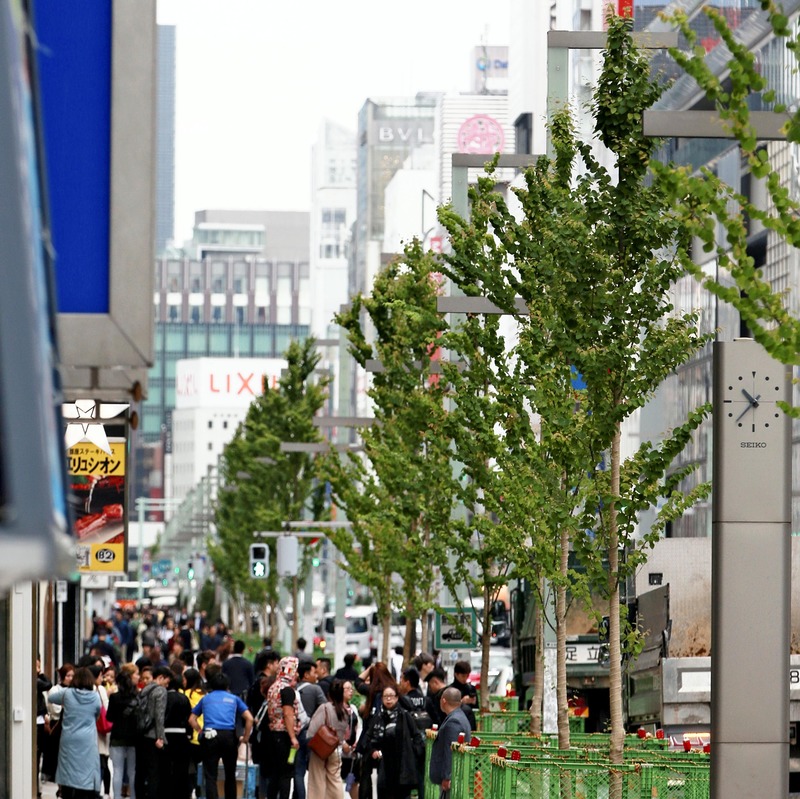
Rows of trees will make a comeback for the first time in 50 years along Chuo-dori street in the Ginza district of Tokyo. Ahead of the 2020 Tokyo Olympics and Paralympics, people involved in the tree-planting project hope they will be a new symbol of the Ginza district.
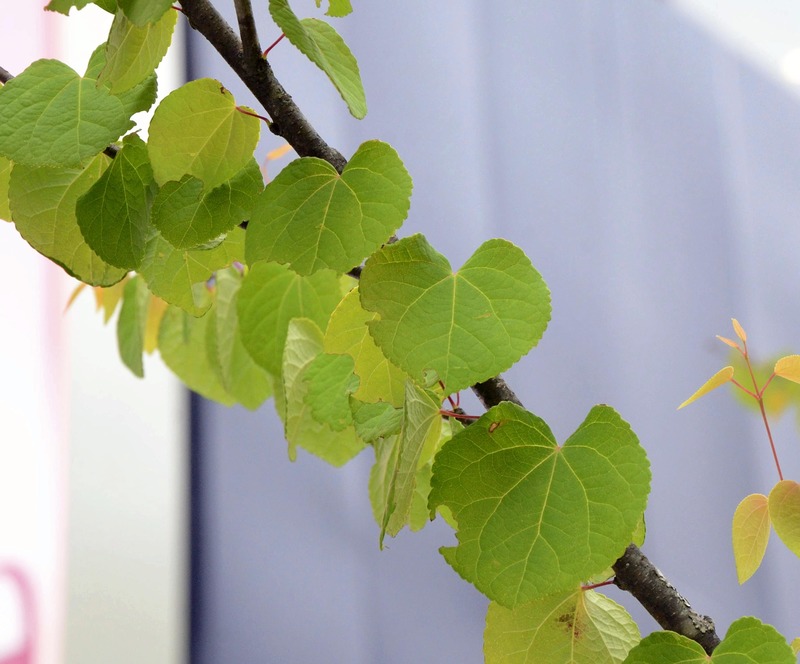
Planting started in January this year of katsura, or Japanese Judas trees. They are about eight meters tall and feature heart-shaped leaves.
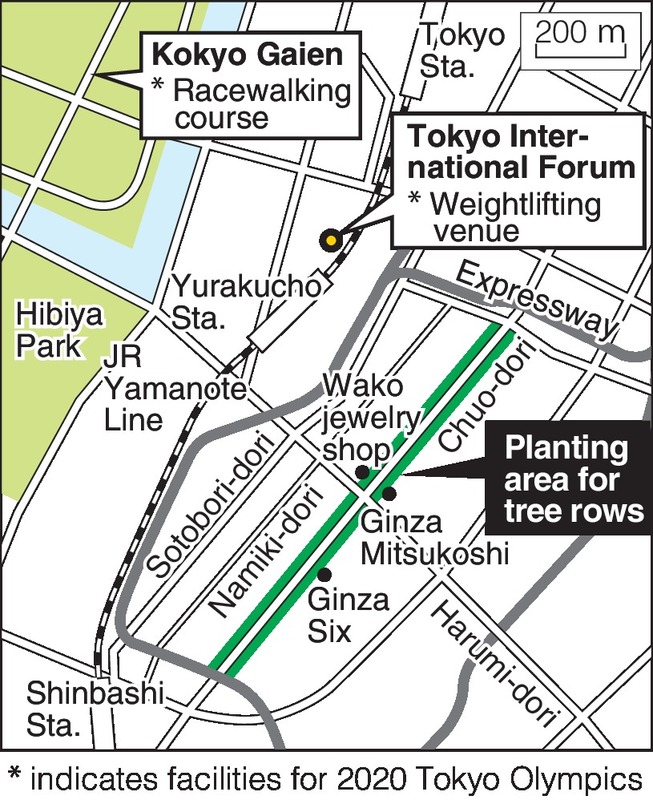
The trees will be planted along the about one-kilometer section of National Highway Route 15 between Ginza 1-chome and 8-chome. This section is Ginza's main street, with department stores and luxury brand shops lining both sides. The Tokyo National Highway Office, which supervises the street, plans to plant 139 katsura trees there by the end of this fiscal year, in response to requests from people in the area.
The street was once known for its rows of willows and ginkgo trees, which were later replaced with shrubs. According to the office and local people involved, the planting of willows along the street began in about 1877. In the Taisho era (1912-1926), the willows were replaced with ginkgo trees, but rows of willows made a comeback at the beginning of the Showa era (1926-1989).
The rows of willows in Ginza were familiar among locals and other people at that time, and included in the lyrics of songs such as "Tokyo Koshinkyoku" (Tokyo march).
However, the rows of willows disappeared in 1968 due to the underground installation of power lines and telephone wire. Waist-high Japanese hawthorns and other trees were planted in their place.
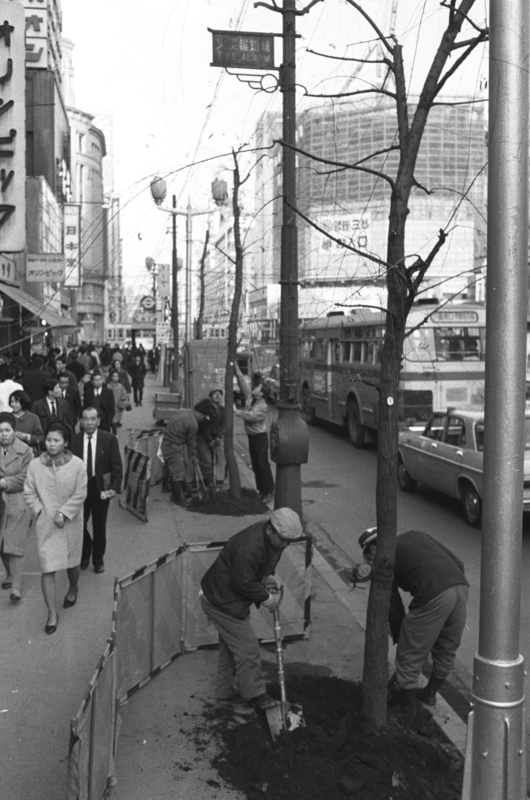
"The Toden tram line was discontinued and its overhead wiring was removed in Ginza at that time. To 'open up the view,' trees that do not grow very high were selected to be planted," a Tokyo National Highway Office official in charge said.
A group centered on local shop owners has been considering which tree species to plant and other issues for about 20 years. Their discussions began after shoppers who visited the street complained of there being no shade to rest in during summer.
Some people wanted the willows back, but it is difficult to grow them in the Ginza district, which has few watering places. Attention turned to katsura instead.
Deciduous katsura present beautiful fresh green leaves in spring and yellow leaves in autumn, and are resistant to pests. From January to March this year, 46 trees were planted, and they already have fresh leaves.
"Bright, heart-shaped leaves give us shade in summer. I'm sure visitors from home and abroad will enjoy the rows of katsura in Ginza," said Eriko Takezawa, head of the secretariat for Ginza-dori Rengokai, associations comprised of people involved in commerce in the district.
Kyoto, Yokohama replanting
Tree rows are also being replanted in other municipalities.
The Kyoto city government replaced plane trees with 206 tulip trees along an about two-kilometer section of the Karasuma-dori street, which extends north from JR Kyoto Station.
The street was developed for emperors' trips to the Kyoto Imperial Palace and tulip trees were planted in 1912. After World War II, they were replaced with planes, which grow faster. However, it has been pointed out in recent years that planes pose a risk of people tripping, because their roots grow and push up sidewalks.
The Kyoto city government launched a project to bring back rows of tulip trees in fiscal 2012. It finished the planting in two years with a budget including about 38 million yen in donations from citizens.
The Yokohama city government also began removing aged someiyoshino cherry blossom trees in areas around Tama-Plaza Sstation on Tokyu Corp.'s Denentoshi Line in fiscal 2015.
The city government kept some of them, but most were replaced with shorter cherry blossom trees such as kanzan and amanogawa in narrow spaces and around crossings.
"This project will maintain both the specific characteristics of this area, which has long been a popular site for cherry blossom viewing, and an environment through which people and cars can pass easily," a city government official involved in the replanting project said.
Read more from The Japan News at https://japannews.yomiuri.co.jp/