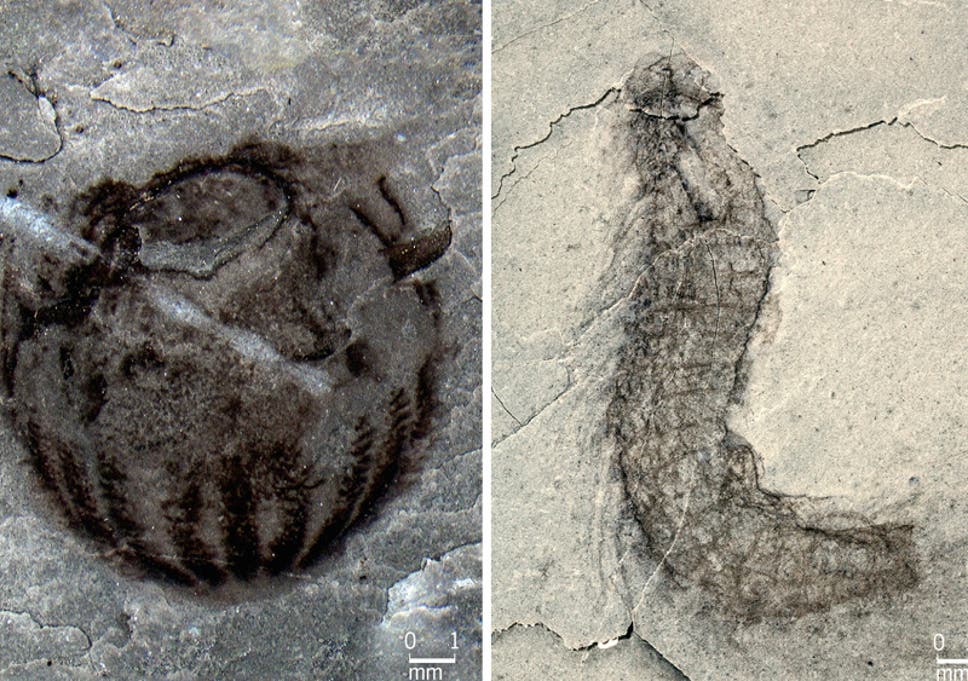
A “treasure trove” of new species have been discovered in a newly-unearthed fossil site in southern China that dates back 518 million years, according to a new study.
More than half of the remains found at the Qingjiang site, in Hubei province, were previously unknown to scientists.
They include a range of prehistoric animals, from corals and sponges to jellyfish and tiny invertebrates called mud dragons. They have been so well preserved their muscles, guts, eyes, mouths and other openings are still visible.
Researchers said the discovery, which will help fill in gaps in the fossil record, was comparable in importance to the Burgess Shale site in the Canadian Rocky Mountains - famous for its exceptionally well-preserved fossils.
In a study published in Science, they said the site revealed a "treasure trove of Cambrian secrets" that should "help to elucidate biological innovation and diversification during this period".
Both sites feature fossils from the so-called Cambrian Explosion, considered by many experts the most important evolutionary event in history, when an immensely diverse aquatic animal population exploded into life around 542 million years ago.
Scientists at the Qingjiang site believe their discovery may eclipse other similar sites because it has the highest density of species diversity.
"[This is an] excellent preservation of so many Cambrian creatures," Xingliang Zhang, study author and a geology professor at Northwest University, told CNN. "Some are weird, some exactly look like what we have today."
The fossils were found in rocks on the bank of the Danshui River after they became entombed in an ancient underwater mudslide. The 4,351 fossils uncovered so far represent 101 different species – 53 of them new.
Ms Zhang and her co-author, Dongjing Fu, found the site in 2007 while searching the rocks around the river bank for fossils. They and other scientists are already in discussions with the local government to protect the site.