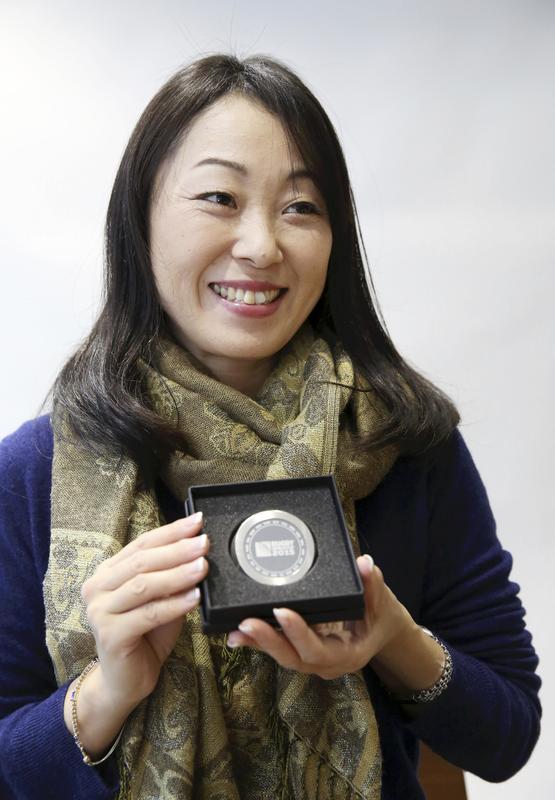
What Kaori Araki holds in her hands is a commemorative medal from the 2015 Rugby World Cup in England. Araki served as a sports psychologist for the Japanese national team from 2012-15 and one of the players, Toshiaki Hirose, presented the medal to her before a match against South Africa.
The medal is usually given to players and the head coach, among other team officials, but the sports psychologist usually does not receive a medal -- until this instance.
"I wondered for a long time who decided to give me the medal," Araki said.
In one of the matches during the group stage, Japan clinched a come-from-behind victory over South Africa and was said to be "the biggest upset" in the history of the Rugby World Cup. Araki's psychological support for the players was commended, putting her in the spotlight.
Araki finally found out who recommended her for the medal when she appeared on a talk show with Hirose last year. He revealed that head coach Eddie Jones "asked me to give it to Kaori."
"I was surprised to find out it was Eddie Jones, whom I deeply respect," Araki said.
Araki went to the United States for her doctorate in psychology but could not find a job after returning to Japan.
"At that time, the importance of sports psychology was not yet appreciated [in Japan]," she said.
After working as a lecturer at a Singaporean university, she became the sports psychologist for Singapore's national yacht team at the 2008 Beijing Olympics. However, Araki pushed herself to the point of exhaustion, causing her to fall ill and have to return to Japan.
The turning point for her came when she was brought on as a part of the support staff for the Brave Blossoms and met Jones, she said. Araki took notes while observing the players and compiled a report titled, "The importance of leadership skills," and it caught Jones' attention. As a result of her discussions with Jones, it became the team's objective to teach leadership skills to all the players.
As a part of the leadership training, she encouraged every player to think for himself the challenges the team would be facing. While conducting the training, the question that many of the players had was "whether all of us feel we are respected [for what we bring to the team]."
The players were asked to praise and compliment each other to improve the morale of the team and as a result of these cumulative efforts, everyone developed a sense of independence and began taking initiative.
All of the training sessions led up to the match against South Africa. Going into injury time, Japan was trailing by three points and Jones told the players to go for the penalty kick, but the players chose to scrum and eventually scored three points in a comeback against South Africa. This was the moment when the team leaders overruled the coach's decision.
The environment created by Jones' coaching style was intense because players and coaches who could not follow his orders were replaced. However, Araki said that she did not feel that he treated her any worse because she was a woman.
"[Jones'] coaching style was very clear and logical. I did everything I could for the team," she said.
What Jones brought to Japan was not just a dramatic victory, he also "taught the Japanese sports world that when it comes to training and psychology, thinking scientifically is vital."
After the 2015 Rugby World Cup, Araki sent Jones an email expressing her gratitude, writing, "You have literally changed my life." He replied jokingly, saying, "Kaori, you changed on your own."
Currently, Araki is busy working as a consultant for athletes and singers and as a university professor as well. As she looks over at the medal on her living room shelf, she remembers Jones' piercing eyes. She gives herself strength by saying, "I need to keep working harder."
In the Japan-hosted 2019 Rugby World Cup, the Brave Blossoms advanced to the quarterfinals. "I want the Japanese national team to aim for the finals and play against Eddie and his English national team," she said with a smile.
There was no miracle comeback victory this year, but Araki's wish is not just for a commemorative medal, but a championship trophy.
Read more from The Japan News at https://japannews.yomiuri.co.jp/