OSAKA -- As fewer animal specimens are being used as educational materials in schools nowadays, specimens with transparent skeletons are becoming popular on social media for their natural beauty that is normally concealed.
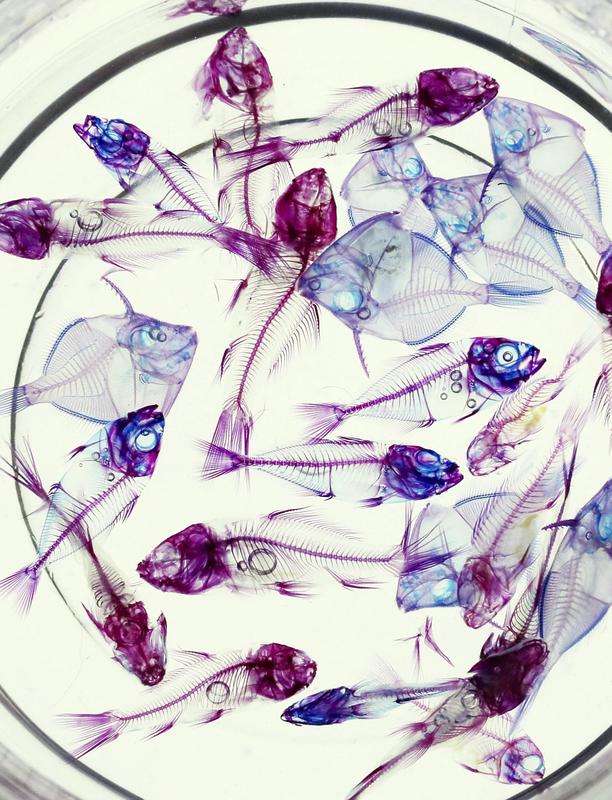
These specimens are created by applying certain chemicals to fish so that their bones become see-through. They are even purchased to serve as decorative pieces and are now attracting attention for educational purposes such as becoming a part of exhibitions at museums.
In small bottles, even smaller fish with transparent bones are suspended in a liquid. The elaborate nature of the bluish bones gives them the appearance of artifacts.
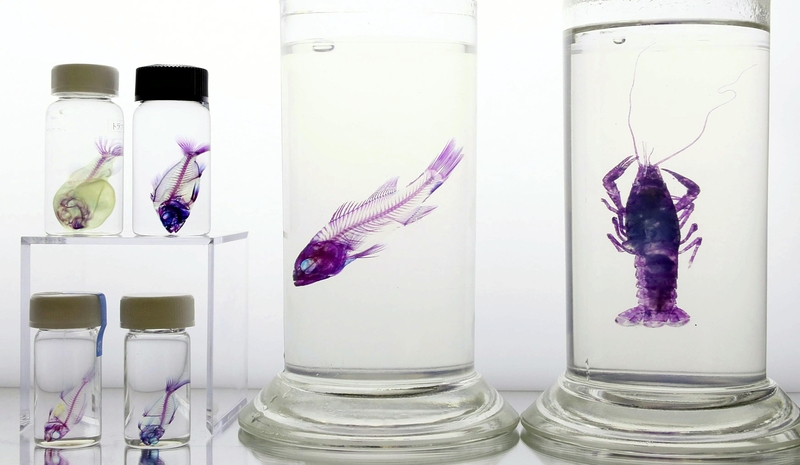
Aquatainment is the Miyakojima Ward, Osaka-based company that produces and sells such specimens. The company collects fish that are to be discarded by farms for reasons including slower than normal growth rate and by applying transparency technology normally used for research, it creates the specimens for sale as decorations and sundry items.
Founded in 2010, the company's products did not attract much attention. However, after receiving praise on social media from people who found them to be "fantastic and beautiful," they eventually garnered more attention. Now, the products are available at general stores operating nationwide, as well as aquarium and museum gift shops. The company also makes specimens from exterminated non-native fish such as the bluegill.
"Back when I was a fisheries science student, I often wondered if it was possible to make use of the fish that had been discarded, and that gave me the idea for starting my business," said Aquatainment President Satoshi Matsumae, 44.
"I believe that in addition to admiring the specimens' beauty, more people also take away the message that we should waste life as little as possible," he added.
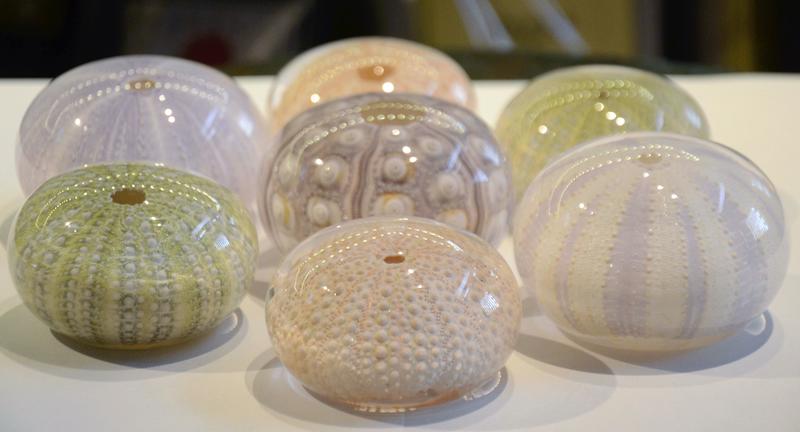
Usagi no Nedoko Inc. in Nakagyo Ward, Kyoto, sells skeletal specimens of sea urchins. The fist-sized spherical skeleton of a sea urchin, from which the edible parts and spines have been removed, is coated with an acrylic resin. The bones are light pink and yellow, and the surface is covered with fine-lined protrusions. The sea urchin specimens have become popular as some people find them to be "like modern art" and can "feel the mathematical beauty" in them.
One customer said: "The gap between [the specimens'] outer and inner appearance is amazing. The skeletal structure is completely different depending on the type of specimen, giving me an opportunity to gain a deeper knowledge of them."
Now that there are fewer opportunities for students to see specimens in schools, there is a movement to utilize the popular transparent specimens for educational purposes.
Under the law for the promotion of science education enacted in 1953, elementary, junior high and high schools can receive subsidies for the purchase of human skeletal specimens and head models and formalin-preserved animal specimens, making such specimens widely used in education. However, these days they are no longer commonly used out of consideration for children who may find them scary, while some schools discard them once they become old.
According to a nationwide sampling survey conducted by the Tokyo-based Japan Association for Promotion of Science Education and Equipment, more than 80% of junior high and high schools no longer own such conventional skeletal specimens.
Under these circumstances, a private company held a special exhibition featuring transparent specimens in Fukuoka in 2018, hoping that more people will become interested in the organic structure of animals. Subsequently, the organizer received inquiries about the exhibition from various regions in the nation. The exhibition toured the Tohoku and Kyushu regions last year, and the company is considering holding it again this year.
A company that facilitates mobile aquariums at kindergartens and other institutions has also added transparent specimens, which are popular with the children. A public museum is also considering holding a special exhibition.
"The specimens are used for the observation and research of living things in their natural forms," said Hajime Matsubara, a specially appointed associate professor at The University Museum of the University of Tokyo, who is well-versed in the specimens.
"What is interesting [about transparent specimens] is that they expose invisible parts and emphasize the mystique of nature while maintaining the basics [of what specimens are for]. They also stimulate intellectual curiosity, making viewers wonder how and why the shapes are this way. So it is to be expected that they will also be used in education," added Matsubara, an ethology specialist.
Read more from The Japan News at https://japannews.yomiuri.co.jp/