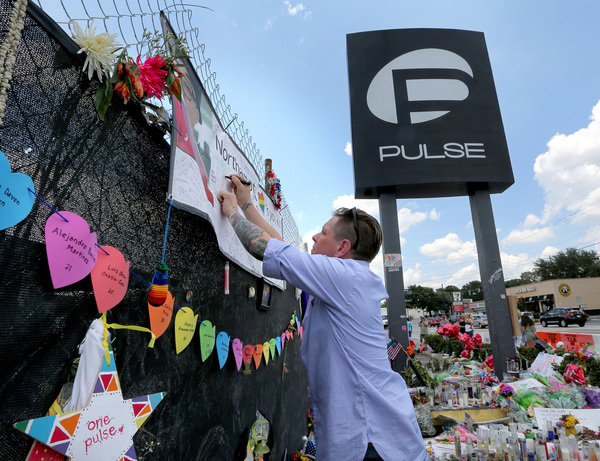
ORLANDO, Fla. _ "You have to tell America to stop bombing Syria and Iraq. They are killing a lot of innocent people," Pulse nightclub shooter Omar Mateen tells a crisis negotiator in transcripts of 911 calls released Friday.
The transcripts show a first glimpse of the investigation into Mateen after he called 911 to pledge allegiance to Abu Bakr al-Baghdadi, who is considered the leader of the Islamic State.
"This is Mateen," the shooter tells dispatchers during his first call at 2:35 a.m. "I want to let you know I'm in Orlando and I did the shooting."
Mateen then goes on to "pledge of allegiance to Abu Bakr al-Baghdadi of the Islamic State."
An Orlando Police crisis negotiator then attempts to placate Mateen.
"I completely get what you're saying," the negotiator said. "What I'm trying to do is prevent anybody else from getting _ "
But Mateen interrupts before the negotiator can finish.
"You need to stop the U.S. airstrikes. They need to stop the U.S. airstrikes, OK?"
The negotiator then explains to Mateen that he is "not a politician" or government.
"All I can do is help individuals and I want to start with helping you," the negotiator said.
That's when Mateen indicated he had bombs in "some vehicles outside." This claim was later determined to be false.
"Your people are going to get it and I'm going to ignite it if they try to do anything stupid," Mateen said. "They can take out a whole city block almost."
Mateen then likened himself to other terrorists behind recent violence, telling the negotiator he was committing the attack because the "U.S. is collaborating with Russia and they are killing innocent women and children."
"My homeboy Tamerlan Tsarnaev did his thing on the Boston Marathon," Mateen said. "My homeboy (unidentified name) did his thing, OK, so now it's my turn, OK?"
The first call lasted about nine minutes, according to a timeline by the Federal Bureua of Investigations.
In the second negotiation, the Orlando police officer calls Mateen by his first name.
Mateen responds by talking about an airstrike that killed Abu Waheeb, a leader of the Islamic State.
"That's what triggered it, OK?" Mateen said.
"OK," the negotiator responded.
"They should have not bombed and killed Abu (Waheeb)," he said.
The negotiator then asks if Mateen is injured and if there's anyone with him.
"That's none of your business," Mateen responded.
Mateen also said there are going to be more of this "type of action" going on in the next few days.
"Just let it be known it's going to be done in the name of the Islamic State, even though it's not (expletive) airstrikes, it's (expletive) strikes here, OK?"
As the call neared its end, Mateen kept talking about U.S. airstrikes.
"You see, now you feel, now you feel how it is, now you feel how it is," he said
The negotiator tries to get Mateen to come out, but Mateen stopped talking and the call ended.
The last time negations spoke to Mateen was in a three-minute conversation that ended with Mateen hanging up at 3:25 a.m.
"You're annoying me with these phone calls, and I don't really appreciate it," he told the negotiator.
In the bizarre exchange, Mateen told the negotiator that "airstrikes need to stop" and repeatedly answered questions saying "No. no. no. no. no."
The negotiator asked Mateen to come outside and explain his views in person so they would be better received. He insisted Mateen was being treated like an adult.
"I've heard that and I want you to come outside and tell us that yourself so the message rings true from you without me passing along your message," the negotiator said. "I'm doing that, but I need you to come outside with no weapons."
"Omar?"
The line clicked off.
The city did not release the 28 minutes of the audio recorded conversation between Mateen and OPD's crisis negotiation team.
The city was ordered to release any calls that were not exempt under Florida law. The last batch of calls, 77 recordings from the Orlando Fire Department and 62 other files from the Orlando Police Department, were released Thursday.
The city has said they would release 142 of 161 fire tracks and 73 of 284 police recordings "soon," but only part of those were released.
The city is still withholding another 230 tracks from the June 12 massacre, citing an exemption in state law for audio depicting the killing of a person.
The Orlando Sentinel and two dozen other media organizations have been involved in a legal battle to have all the calls released.