
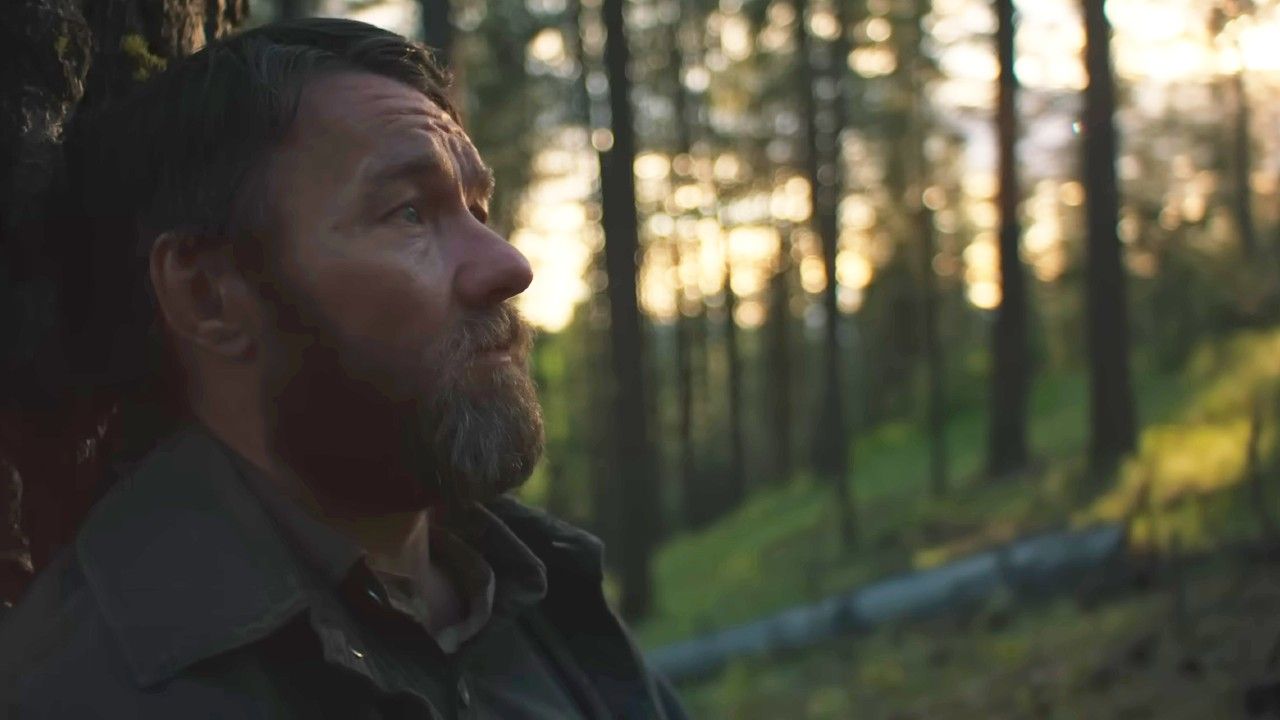
We live in a vast and complicated world, and it is easy to feel lost within it. In a population of 8.3 billion people, what is the value of an individual life, and what makes a life significant? In the face of this scale, one can easily develop a sense of purposelessness – but art can be a remarkable eye-opener, and I recently found myself floored while watching director Clint Bentley’s Train Dreams and hearing a very special line of dialogue: “The world needs a hermit in the woods as much as a preacher on the pulpit.”
Without sharing any spoilers (as it comes from toward the end of the film), the line is delivered by Kerry Condon's Claire Thompson, an agent of the United States Forest Service, to Joel Edgerton's protagonist Robert Grainier, and I was struck by its beautiful philosophy: though you may at times find yourself feeling insignificant, the reality is that each and every one of us have our own part to play in our world. It’s a wonderful and optimistic idea, and I felt compelled to ask the stars of Train Dreams about it when I spoke with them at the film’s Los Angeles press day last month.
In the Golden Globe-nominated film, the aforementioned Robert Grainier is simple 20th century man, living in the Pacific Northwest working as a logger to provide for his wife and child, but Joel Edgerton stressed that he as a seemingly ordinary man is no less extraordinary than the men and women whom our society holds up as heroes or in higher classes. We all have a special and equal part to play in our world, or in his words:
The idea that nothing is more important than anything else, I think in that same scene, the idea that everything's connected and the dead tree is important as a living one. But, you know, the hermit in the woods is an ordinary life that we celebrate in this movie. And at the end of the day, that is dignified, that is heroic, and that is special as much as scientists and astronauts and all these other, you know? Everyone has their place in the ecosystem of the world... And most of us, I think, view ourselves as part of the ordinary mass.
Train Dreams explores the full adult life of its protagonist, seeing him through struggle, bliss, tragic loss, new vocations, age, and societal change. His relationship with the world around him constantly evolves, and co-star Felicity Jones (who plays Robert’s wife) sees his depicted journey as a search for and understanding of purpose. Said Jones,
I think that's part of what's so magnetic about Robert Granier, is that, you know, it is, 'what is the purpose?' That's what none of us really know. We are just trying to figure it out day by day. The film is a kind of exploration of, 'Well, what is it that really matters in the end? What is it that you are gonna remember?' And probably it is fleeting moments of happiness that really constitute a life.
And one could argue that we are each at our happiest when we feel as though we are contributing to what we view as our purpose.
When I asked Kerry Condon about the special line in question, she added an extra dimension to the idea: understanding one’s own stresses about purposelessness should come part and parcel with understanding the universality of that feeling. Building on Joel Edgerton’s commentary about personally recognizing individuality, she added that there should be an abolishment of judgement. She explained,
I've always been very understanding of people going through hard times mentally and I'm not really like shy about that. I feel like it's kind of part of life. I think there might be something wrong with you if you're not down sometimes. And just to not be holier than thou I suppose, that's very important. Ultimately, we're all very flawed... And I think that's what I drew from that line, just not to be judgmental, that everyone's entitled or allowed to live however they choose.
There is a beautiful simplicity to the tale in Train Dreams that comes with a somber energy. But its message ultimately isn’t downbeat, and William H. Macy, who plays one of Robert Grainier’s fellow loggers, doesn’t believe that the film is overwhelmed by its darker and sadder moments. He added,
It's not a sad film. At the end of it, I didn't feel sad. I felt so happy to be alive and so proud to be a homo sapien. We're just astounding critters.
If you haven’t already experienced the amazing film for yourself, Train Dreams is now available to stream with a Netflix subscription, and given the buzz around it, you can expect to hear quite more about it in the coming weeks and months of awards season.