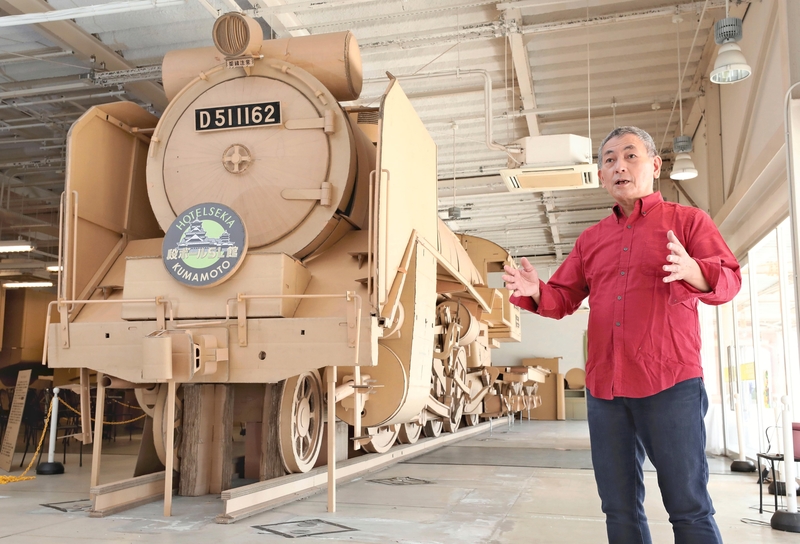
With a driver's compartment that sits high above the rails, a length comparable to two buses, and an appearance as magnificent as a castle wall, a model train on show in Kumamoto Prefecture boasts quite a unique feature: it isn't made of steel, but instead cardboard.
This model of the D51 steam locomotive was constructed by Hideo Shima, 71, a cardboard craftsman, using 4,000 boxes as material. As extraordinary as the project's scale is, the reason behind its creation is also a bit absurd.
"The fastest way to get people to understand the potential of cardboard is to wow them by making something with it that they'd never think was possible," the craftsman said.
Once an architect, he turned to working as a cardboard craftsman at the age of 45 after being diagnosed with a serious illness. After receiving advice from his physician to "not leave anything unfinished," he thought, "Well, I guess I'll try my hand at making a steam locomotive."
Seven years later, he recuperated from his illness and returned to work as an architect. At the age of 60, he gave up his position as the owner of an architectural firm and began construction on his cardboard locomotive model.
As a child, Shima was obsessed with steam locomotives. He often went to a locomotive depot and would look at the trains for hours. He was especially enthusiastic about measuring everything. "I measured every nook and cranny, from the wheels to the couplers, with a bamboo ruler."
One of his happiest memories is from back when he was an elementary school student. A model train contest was frequently held at a transportation museum that was located in Tokyo at the time. This contest was always won by adults who brought elaborately hand-made trains made from brass. He knew that he had no chance of winning if he competed squarely, so he came up with the idea of making a full-scale coupler. Based on the data he'd collected through his measuring, he re-created the coupler faithfully using only wood and thick paper. After showing his work to a staff member of the locomotive depot, the staffer offered to paint his creation using the oil used for real couplers. His creation looked so genuine that, of course, it won him the contest.
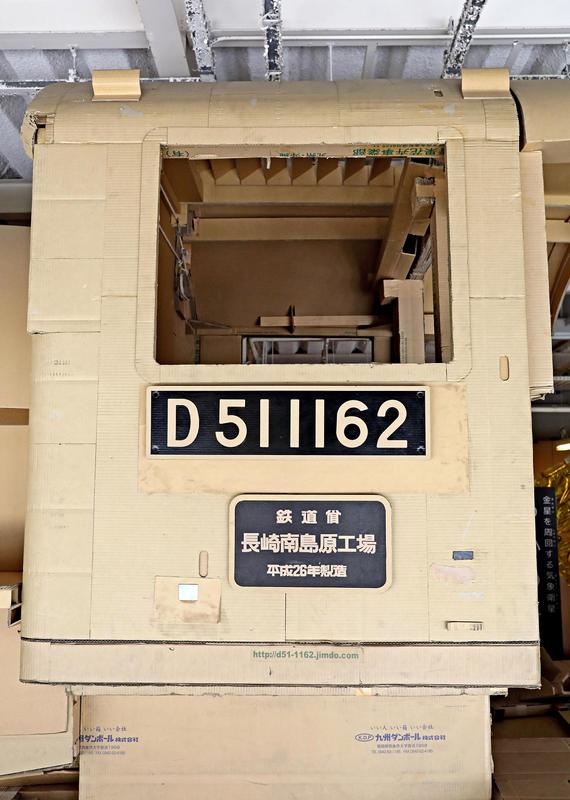
Making a model steam locomotive using cardboard as a material was an easy decision for Shima. During his days as an architect, he often manufactured life-size experimental reproductions of portions of buildings using cardboard, so the material was one that he was familiar with. Before drawing the blueprints, Shima would measure D51 models on display in parks and museums. He decided to make his structure of the inlaying type to allow it to be disassembled, transported and stored.
A now-closed fruit and vegetable market in Minami-Shimabara, Nagasaki Prefecture, offered to provide a great deal of the cardboard boxes used. To cut down on transportation costs, he moved his operation to the city and began production.
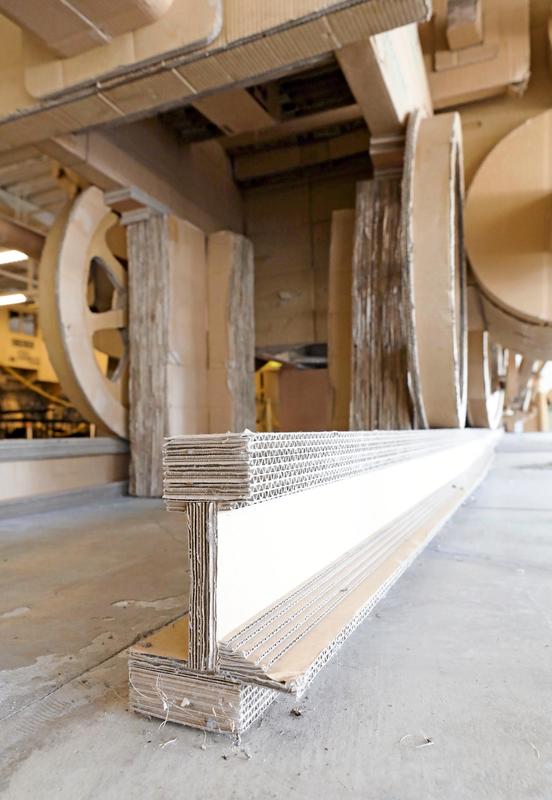
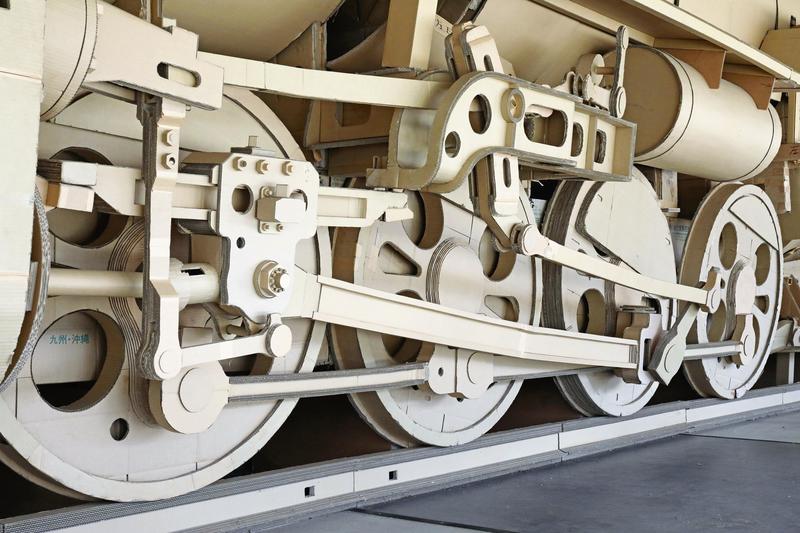
After opening and flattening the cardboard boxes using a box cutter, he cut out the individual pieces. This process was completed in December 2013, 10 months after the project's launch. The parts were then assembled at a warehouse near his workshop where the 20-meter-long and 4-meter-high model was completed. The cardboard itself was formed in such a way that it was able to depict the smooth curved surface of a boiler and the complicated mechanisms around the locomotive's wheels, which were designed to be able to move in the same way as authentic ones.
Thanks to his work being displayed at a hall in the town of Higashi-Sonogi, Nagasaki Prefecture, requests to exhibit the piece came from municipalities and commercial facilities nationwide. As a result, a traveling exhibition was held in about 70 locations, including Chiba and Hiroshima.
In May 2016, Shima launched the production of his second locomotive model of the C62. Having assisted with the traveling exhibition, Kyushu Danboll Co., based in Chikugo, Fukuoka Prefecture, provided Shima with a workshop and brand-new sheets of cardboard. A total of 3,000 intricate parts were cut out via machine -- nearly twice the amount used for the D51 model. Even though the locomotive model weighs about 3 tons, scrupulously conducted structural calculations have kept the creation from being crushed under its weight. A construction technique used when building temples was used to allow the locomotive to maintain its body shape -- which gets wider as it gets taller.
As of last year, Shima has crafted four steam locomotive models. However, due to a decline in his eyesight as a result of his illness, he can no longer continue his craft. His four works into which he poured all of his passion are on display in a hotel in Kumamoto Prefecture, surprising visitors to no end.
"Light and durable cardboard is a superior material, so it is an absolute waste to use it only for boxes," Shima said. "I would love it if my locomotive models are able to provide viewers with new outlooks on the possibilities cardboard has to offer."
Read more from The Japan News at https://japannews.yomiuri.co.jp/