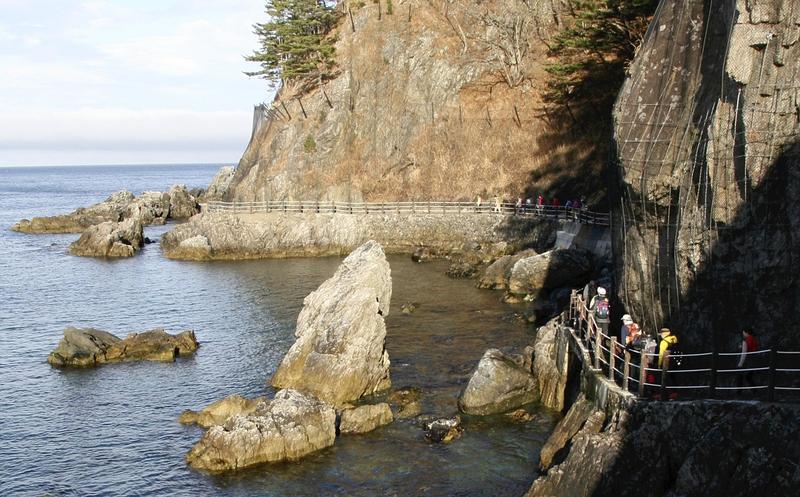
Roads do not make any sense unless they are connected. Nature is merciless but humans are indomitable.
The Michinoku Coastal Trail was built through the collaboration of organizations including the Environment Ministry in the hopes of reconstruction from the Great East Japan Earthquake. It's a roughly 1,000-kilometer-long natural trail that follows the Pacific coast from Hachinohe in Aomori Prefecture to Soma in Fukushima Prefecture, an area that was damaged by earthquake-triggered tsunami in 2011. The trail opened in its entirety last June, only to become impassable in various locations four months later as the area was hit by Typhoon No. 19.
In the village of Fudai, famous for its majestic landscape and located between Kuji and Miyako, both in Iwate Prefecture, flooding and landslides wreaked havoc on communities and damaged the trail route. With the trail restored at long last, I decided to join a previously postponed walking event.
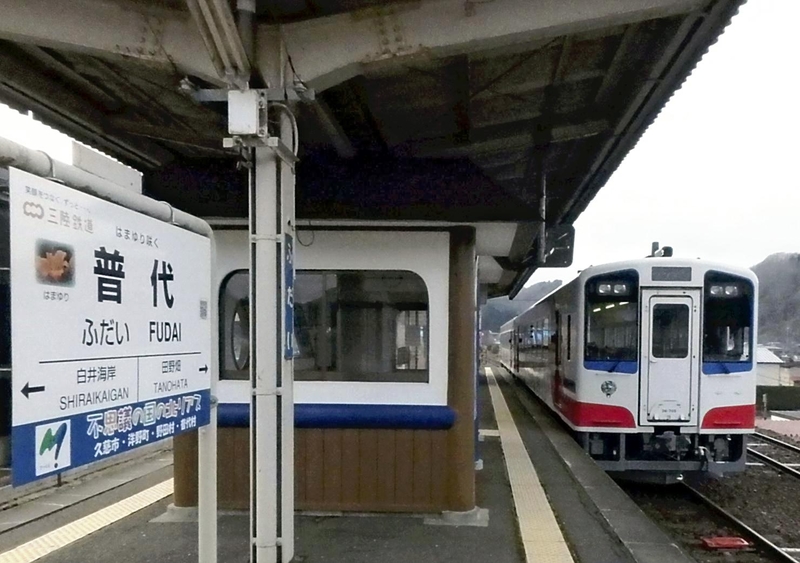
"I just want to let everyone know that the trail can be walked," said Masaki Maekawa, 34, an official tasked with the promotion of tourism and networking by the Fudai municipal government, the event's organizer. The village has focused its energy on public relations activities for the trail since the village section of the route was opened five years ago. Roughly 70 people from Iwate Prefecture and beyond joined the event. Participants included TV personality Nasubi, 44, who walked the entire distance of the route, 27 kilometers, over the span of two days.
Beginning at Sanriku Railway's Fudai Station, the participants walked northward to Horinai Station in the morning, passed through a shopping district and climbed a mountain with a difference of 180 meters in elevation. As I waded through a stream that appealed to my adventurous spirit, Maekawa said: "This was once school route that we restored after collecting information from local residents."
Scars left by the typhoon, including traces of mudflows and collapsed trees, remain. The Michinoku Trail Club in Natori, Miyagi Prefecture, a nonprofit organization in charge of the management and utilization of the trail, cooperated in the restoration work. Fallen trees were removed and stepping-stones were placed to mark the trail. Hiromitsu Seki, 46, general manager of the nonprofit organization, said: "Leaves fall in winter, brightening the forest and making it possible to see the ocean. I recommend walking along this route in winter." We walked through the forest to a small fishing port where the construction of a seawall was ongoing.
The highlight of the excursion came in the afternoon when we went back to Fudai Station by bus and began walking across the Fudai Floodgate. The floodgate has a height of 15.5 meters, higher than the tsunami that occurred after the 1896 Meiji Sanriku Earthquake. It is the "miracle floodgate" that protected the village in the 2011 Great East Japan Earthquake. We treaded on the white sand of Fudai Beach and trekked in a line on the Nedari Beach Nature Trail along a cliff.
In contrast to the southern part of Sanriku coast, marked by ria inlets, the northern part is characterized by towering rocks and cliffs. As we moved on from the Nedari Beach and approached a steep staircase to climb the cliff's slope, Seki said, "You can experience 800,000 years of the history of the Earth here."
The cliff's topography shows that it was formed as the seabed slowly rose. "The seabed rose at a pace of 20 centimeters in nearly 1,000 years, a distance almost equivalent to one stairstep," Seki said. The precipitous cliff was created as waves eroded the slope. After climbing to the top of the cliff, drenched with sweat, we arrived at the Kurosaki Viewpoint at 180-meter elevation. Indeed, I felt as if time was eternally etched in my body. A superb view overlooking a vast expanse of the blue sea was ample reward for the efforts made to trek up there.
The following day, we trekked from Kurosaki southward to Kita-Yamazaki of Tanohata, a village renowned for its beautiful cliffs. Nasubi, who encouraged other participants along the way, hails from Fukushima Prefecture. With the determination to "cheer up the Tohoku region by displaying my nature of working hard," Nasubi scaled Mt. Everest and experienced the Shikoku Henro pilgrimage of 88 temples. "Residents of Fudai cherish the trail as a treasure of restoration," he said. "I'm glad I can cooperate with them."
The Sanriku region has been devastated by natural disasters many times but recovered each time. I came to know that we could even gain a sympathetic understanding of disaster victims by walking along the trail. Therefore, roads can connect our hearts, as well.
Sanriku Railway's Rias Line to once again resume full service
Sanriku Railway's Rias Line resumed train service last March after a hiatus of eight years. But the line was cut off again by the typhoon that hit the area last October. Train services were cut off over roughly 70% of the 163-kilometer line due to reasons including the collapse of roadbeds. Ichiro Nakamura, 64, president of Sanriku Railway Co., called for the central and local governments to provide support in carrying out restoration work, saying that "damage threatening human lives should be avoided as much as possible." He emphasized, "The railway is indispensable to the revitalization of the region." Service was resumed in February for the section between Tanohata and Fudai stations. The line resumed full service on March 20.
There is a shopping district and an accommodation facility along the trail route. Shops cooperating in the promotion of the trail hoist what they call "trail angel" pennants and welcome hikers with various local dishes and snacks. A recommended dish at the Nakamura Mitsugu Shop is "Satchan Dengaku," a variation on tofu dengaku, a soul food in the northern part of Iwate Prefecture that consists of skewered pieces of tofu coated with miso and grilled. Satchan Dengaku is coated with garlic-flavored miso and cooked upright in a sunken hearth (shown in photo). It is named for the woman who created the recipe at the Nakamura Mitsugu Shop 50 years ago. Today, the popular dish is served there by Reiko Nakamura, 57. "Satchan Dengaku is made simply from tofu, soy sauce, miso and garlic," Nakamura said. Priced at 130 yen apiece, hot dengaku is really filling.
Read more from The Japan News at https://japannews.yomiuri.co.jp/