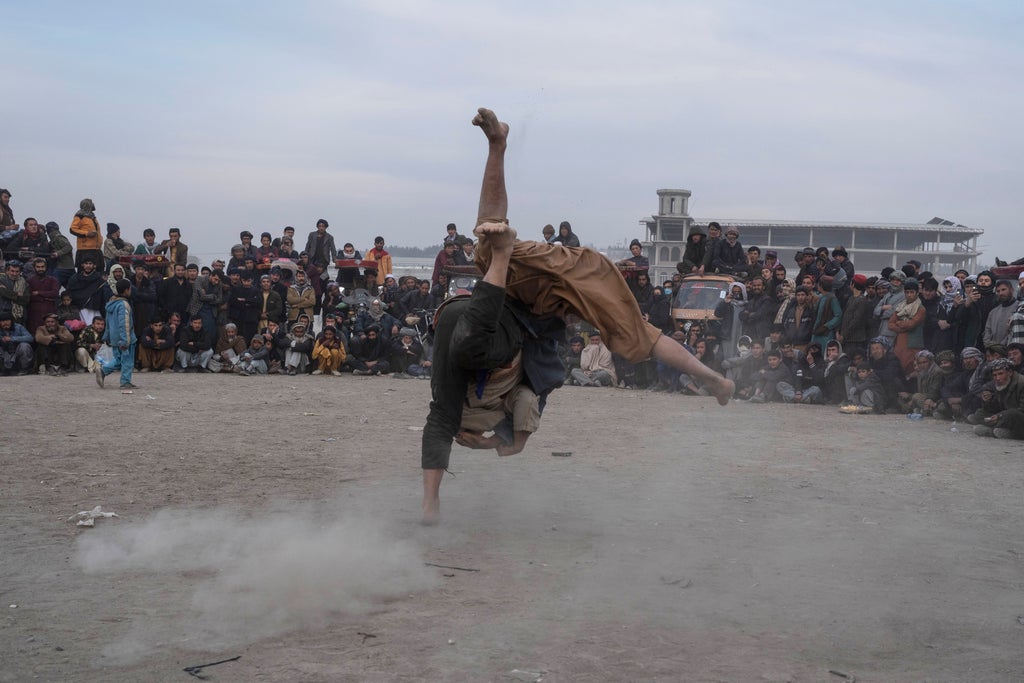
Through clouds of billowing dust, two men circle each other warily before one plunges forward, grabbing his rival’s clothing and, after a brief struggle, deftly tackling him to the ground.
The crowd, arrayed in a circle around them, some sitting on the ground, others standing or clambering onto the backs of rickshaws for a better view in a park in the Afghan capital, erupts in cheers. Victor and vanquished smile good-naturedly, embracing briefly before some of the spectators press banknotes into the winner’s hand.
The scene is one played out each week after Friday prayers in the sprawling Chaman-e-Huzori park in downtown Kabul, where men — mainly from Afghanistan’s northern provinces — gather to watch and to compete in pahlawani, a traditional form of wrestling.
Although the Taliban who took over Afghanistan in mid-August, had previously banned sports when they ruled the country in the 1990s, pahlawani had been exempt even then. Now, just over three months into their new rule of the country, a handful of Taliban police attended the Friday matches as security guards.
The matches are simple affairs. There is no arena other than the broad circle formed by the spectators. The competitors, barefoot in the dust, all use the same tunics, one blue and one white, passed from one athlete to the next for each match. Each competitor represents his province, with the name and province announced to the spectators by the referee.
Each match has four rounds, and the winner is the first who can flip his opponent onto his back. A referee officiates, while judges among the crowd deliver their verdicts in cases when there is no obvious winner. Many end in ties.
“We provide this facility so our people can have some enjoyment,” said Juma Khan, a 58-year-old judge and deputy director of last Friday’s event. A security guard at a market during the day, the former wrestling athlete has been judging competitions for the past 12 years, he said. Just like his father, and his grandfather, and his great-grandfather before him. “It’s our culture.”
Most athletes and spectators spend two to three months in the Afghan capital working — as manual laborers or in hotels, restaurants and markets — before heading back home to their families for a few weeks.
Pahlawani provides a few hours of much anticipated entertainment. The men gather in the dust-blown field that is Chaman-e-Huzori park at around 2 p.m. every Friday and stay until sunset, with around 10 to 20 young men coming forward from the crowd to compete.
Then, as the sun sets behind Tapai Maranjan hill in the background, the competitors are finished. In the blink of an eye, as billowing dust swirls around speeding rickshaws, their horns blaring, the crowd melts away for another week.