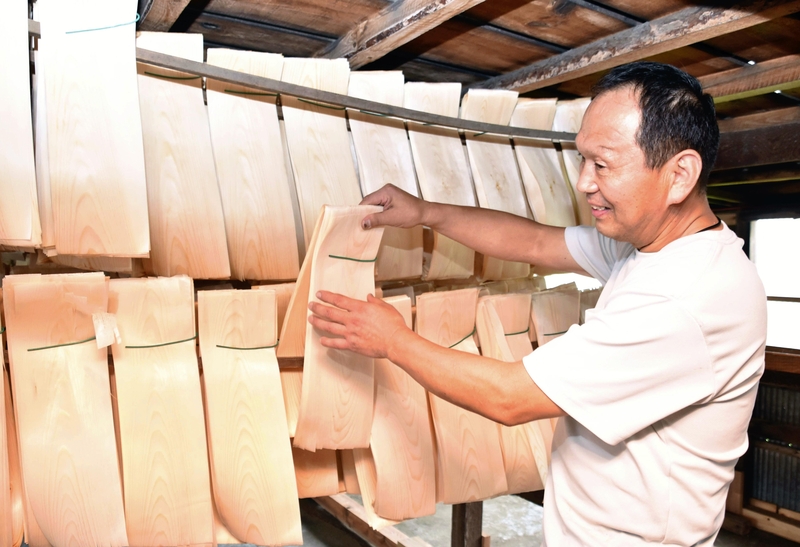
UTSUNOMIYA -- The use of kyogi, a traditional Japanese food wrapper made of paper-thin sheets of wood, is getting reassessed amid the coronavirus pandemic as a means to reduce plastic and improve the environment.
Distribution of food containers made of kyogi has sharply declined since the rise of plastic. Only two kyogi manufacturers currently operate in Tochigi Prefecture, where production once thrived. Shimakura Sangyo in Nasu-Shiobara city, founded 70 years ago, is one of them.
"I hope people will become aware of all the good things about kyogi with this opportunity," said Akihide Shimakura, the company president.
Suzue Seki, the proprietress of the Yunohanaso restaurant and ryokan traditional Japanese inn in the city, is a fan of kyogi.
"It makes food look more delicious than plastic containers," said Seki, 61. "It's also nice to embrace the spirit of 'local production for local consumption.'"
Since last summer, Seki's establishment has offered guests a meal packed in a bento box made of kyogi upon their departure, after some customers complained that the local restaurants were closed for lunch due to the pandemic and they had nowhere to eat on the way home.
Seki said she chose kyogi produced by Shimakura Sangyo to reduce the use of plastic.
Kyogi, which has an antibacterial effect, was widely used on a daily basis in the past.
The now-disbanded Nihon Kyogi Rengokai, which was a nationwide association of kyogi manufacturers, had 800 members in the 1960s, its peak years. Of the 800, 38 were in Tochigi Prefecture, and 18 of those were located in the now-defunct town of Nishi-Nasuno, which is part of Nasu-Shiobara today.
The town was a prefectural center of kyogi production, but manufacturers shut down one after another from the 1970s as the use of plastic bags and Styrofoam containers became widespread.
"In the 40 years I've been working for the company, things have never been easy," Shimakura said.
Currently, less than half as many people are employed at Shimakura Sangyo compared to the number who worked during its heyday.
Sushi restaurants and butchers use the company's kyogi, which is distributed by wholesalers, as plates and wrappers.
The company started making kyogi bookmarks and wrapping material and selling the products at roadside rest areas in Nasu-Shiobara about 10 years ago. Since last year, monthly sales of those products have been growing by 10% to 20% compared to an average year, which may be a result of society recognizing the problems associated with plastic pollution and its negative effect on the environment.
Shimakura Sangyo began supplying kyogi to a natto shop in Tokyo in February and a major hotel in the town of Nasu in July.
The company has also started discussions with the Nasu-Shiobara municipal government about using kyogi bento boxes at the National Sports Festival scheduled to be held across the prefecture next year.
"Environmental concerns and the increase in takeout due to the pandemic have given us the chance to reexamine new possibilities for using kyogi," said Hiroaki Shimakura, 39, who is set to succeed his father Akihide as the third-generation president in the future. "I'd like to inherit the manufacturing techniques and aggressively promote the appeal of kyogi so the product doesn't disappear."
Read more from The Japan News at https://japannews.yomiuri.co.jp/