A young craftsman is polishing his skills in making Edo wazao traditional fishing rods, hoping to convey to modern-day Japanese their elegant style that has been passed down from the Edo period (1603-1867).
Takahito Kamoshita, 30, who lives in Fuchu, Tokyo, is one of the few craftsmen making the traditional rods and is also believed to be the youngest. He is known for his scrupulous work in shaping the rods, and the beautiful finishing touches of his lacquerwork.
His sales revenue is limited, and thus it is not easy for him to make ends meet. But he said with a smile, "I feel nothing but joy from working every day."
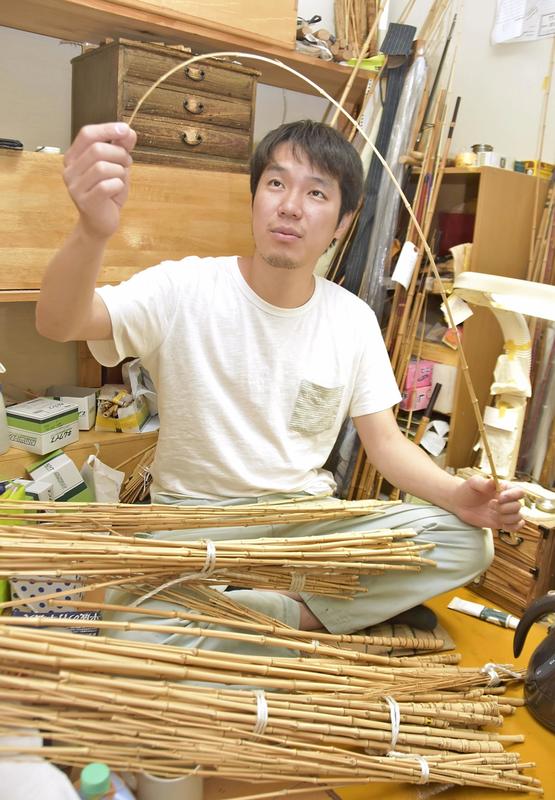
Kamoshita lives in an apartment with two rooms and a kitchen. One of the rooms is his atelier. It is full of bamboo, which makes walking around the room difficult.
"Every piece of bamboo is totally different," Kamoshita said while holding a pole with both hands to confirm its stiffness and flexibility.
It is believed that Edo wazao fishing rods began to be produced in the middle of the Edo period. They became popular among common people for catching fish such as crucian carp and goby.
The rods are characterized by their texture, which comes from being handmade, and the beautiful appearance of their lacquered surface.
Lovers of the traditional rods say the response they get from the rod when a fish has been caught is different from that of rods made from other materials, such as carbon fiber and fiberglass.
Kamoshita was born and raised in Fuchu. Under his father's tutelage, he went down to the Tamagawa and Nogawa rivers in his childhood to fish for carp, including crucian carp.
When he was a junior high school student, he learned about Edo wazao rods from a magazine, and was drawn to them. "They have something that captures my heart but it's difficult to explain," he said.
When he was a high school student, he asked Kazutaka Itoga -- an Edo wazao craftsman in Ichikawa, Chiba Prefecture, who went under the name Saoji IV -- to take him on as an apprentice.
Itoga advised Kamoshita to "enroll in a university, because it is hard to earn a living in this job." Kamoshita enrolled in a university and then began to commute to Itoga's atelier.
After Itoga died, Kamoshita became an independent craftsman of the fishing rods. Since 2010, he has called himself Saoki. Craftsmen of Edo wazao rods typically take on names including sao -- which means rod -- such as Saoji and Saoki.
The search for good bamboo
Dried bamboo is the material used to make Edo wazao fishing rods. Every winter, Kamoshita goes to sites in the Kanto and Kyushu regions to collect the material.
"Out of 10,000 stalks of bamboo, I may find no more than one that I think is good. When I get a good piece of bamboo, I become excited imagining how good a fishing rod it will make," he said.
The quality also differs depending on the bamboo variety, such as hotei-chiku and yadake.
Young bamboo is light but lacks strength. Aged bamboo has more strength but is heavy. From among various kinds and types of bamboo, Kamoshita carefully chooses those with the best thickness, length, hardness and joint shapes.
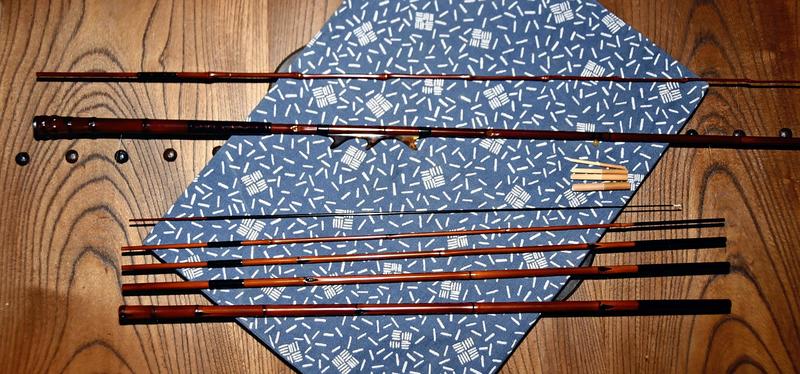
An Edo wazao rod is not simply one whole bamboo pole. Only some parts of a high quality length of bamboo are cut up and made into short rods. These short rods are then connected into one long fishing rod.
The bamboo is straightened by being heated over a charcoal fire. The joints that connect the short rods are processed in such a way so as to not become loose. Lacquer is repeatedly applied with a brush or even the fingers, to protect the rod against water and corrosion.
More than 100 steps are necessary to complete production; Kamoshita said it takes about four months to make one fishing rod.
Makoto Seki, 63, who runs Seki Tsurigu-ten, a fishing goods store, in Bunkyo Ward, Tokyo, and sells rods produced by Kamoshita, said: "The rods made by Saoki are graceful. His lacquering is also careful and neat, and he is a hard worker."
Currently, there are only about a dozen Edo wazao craftsmen across the nation. Many of them are in their 70s.
Seki said: "There are some customers who support [Kamoshita] because he is young. But I don't want him to depend on such people's favor but to establish his own style, so he can proudly say, 'These can only be made by Saoki.'"
Even though Kamoshita works from morning until late at night, his sales only come to about 150,000 yen a month. After paying for his food, rent and production costs, it is hard for him to make ends meet.
Sometimes, his meals consist only of a bowl of rice and an egg. He enjoys meeting and chatting with friends in his local community about various topics.
Kamoshita said, "I've never thought of it as a big thing like preserving Edo culture." Taking a rest from his work, he was relaxed about the big picture. "I do this job just because I love it," he said.
Read more from The Japan News at https://japannews.yomiuri.co.jp/