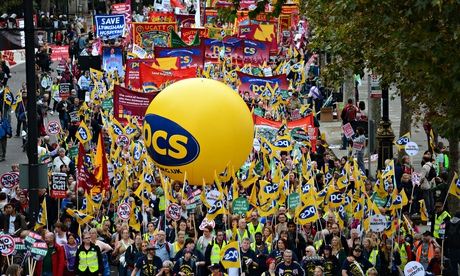
Sarah Kwei made a number of important and valid points in her comment piece (Comment). However, I believe a subhead declaring that “It’s the community, not work, that’s the new site of protest” did her arguments a disservice. Journalism and academia have been dominated by ideas of fragmented power and the end of workplace organisation for a decade and more. It is true that we can see a decline in union influence since the 80s but this is not because of the new character of work but because (sadly) of the character of too many trade union leaderships.
Business unionism, so encouraged by those who argued that the working class and workplace organisation have ceased to exist, has allowed big business and their political representatives in the three main parties to drive down real wages and shift the tax burden from the wealthy on to working-class people. My union, the Rail Maritime and Transport Workers Union (RMT), continues to organise successfully in the workplace. The £50K paid to train drivers by many train-operating companies is well publicised but RMT has also fought and ended zero-hours contracts for cleaners on the Tyne & Wear Metro and continues to organise subcontracted cleaners on London Underground behind a demand for £13 an hour.
Where trade unions get out and organise marginalised workers, victories can be won. But I also agree wholeheartedly that a new collaboration between trade unions and community movements is needed. Years ago, that collaboration manifested itself through the Labour party. Those days are gone.
Jared Wood
Political officer, RMT London Transport Regional Council
London NW1
Why I choose not to vote
Barbara Ellen describes me as “bone idle, ill-informed and immature”, (“Democracy matters – use your vote”, Comment).
Her wrath is directed at non-voters, a section of the community that I am very happy to inhabit for several reasons and is based on the assumption that, should I be unimpressed by all of the candidates I should choose one out of a sense of duty. She conveniently ignores the multitude of politicians who shamelessly abstain from voting on parliamentary debates and bills. I venture to suggest that a minority of these non-voters have genuine reservations, but the majority are abstaining due to nothing more than moral cowardice.
Rather than condemning those of us who weigh up the options and then act accordingly, perhaps she could reflect on the historical consequences of compulsory voting that have resulted in the plethora of elected monsters who have wreaked evil, misery and devastation on our planet.
Andrew Thompson
Cardiff
Landowners need to lay off
Catherine Bennett’s interesting article “The countryside is too vital to leave to its greedy owners” (Comment) argues that large landowners claiming special knowledge of the land are despoiling it with profitable ugly developments. However, as the accompanying picture shows, they have already ruined the landscape itself by ripping out beautiful old hedges and trees and cultivating huge, bleak fields of monocultural grass. Somehow, we need a radical and mandatory programme of land restoration for now and the future.
Tricia Cusack
Birmingham
The other face of Bristol
As a Bristolian born and bred, I did not recognise my city in your article (“Networked and superfast: welcome to Bristol, the UK’s smartest city”, News). I do get tired of seeing Bristol portrayed almost exclusively in pictures of the suspension bridge, and hearing how the small group of ex-Bristol University alumni, living in Clifton, are making the city swing. There are acres of deprived 50s council estates. The congestion in the city is worse than London and the air quality in many places fails to reach EU standards. Our public transport is a joke. Our council is among the worst in Britain. Our mayor is a tech whiz but he is also presiding over the wholesale destruction of green spaces and prime food-growing land to build an overbridge for the Metrobus scheme. This ill-planned scheme is opposed by most Bristolians except those who will benefit financially. As for super-connection, I live well within the city borders and have to go outside the house to get a mobile signal. The article reinforces the impression that Bristol is a wealthy city, making it hard to attract government help. In fact, there are huge inequalities in quality of life, housing and income.
Jane Ghosh
Bristol
Driven to heavy sarcasm
Your front-page revelation that the coalition “has helped the rich by hitting (the) poor”, News, has totally disillusioned me. I had imagined that the bedroom tax, cuts in benefits, tighter jobcentre rules, zero-hours contracts, increased VAT and the remorseless fragmentation of our national health and education services, were all part of the coalition strategy to improve everybody’s lot. We are, after all, all in this together, aren’t we?
John Merrigan
East Molesey
Surrey