‘The public will notice’

Dave Prentis, Unison general secretary: The consequences of Thursday’s shock election result will be stark and distressing for many of those that rely upon, and provide, our public services. While the last-minute pledge from the Conservatives to pump an extra £8bn into the NHS was welcome, it depends on making £22bn of cuts elsewhere. No wonder they didn’t want to tell us where the axe is going to fall.
The health service has been starved of cash. The scale of spending cuts coming down the track could mean that many council-run services completely disappear by 2020. Care for the elderly, the vulnerable, leisure services and libraries are all in the firing line, as are countless other non-protected areas, including policing.
By the time of the next election more than 1m public sector jobs will have been axed, putting massive pressure on those left behind to do more with much less.
The public will notice. With further pay restraint for NHS staff and council employees – who have already paid a high price under austerity – on the cards, the morale of those working in our under-valued public services is likely to sink yet further. No wonder the government plans further restrictions on the ability of public service workers to take industrial action.
‘We have to resist falling into despondency’
Frances O’Grady, TUC general secretary: Morale in the public sector was already very low before the election because of years of austerity, pay freezes, outsourcing and top-down reforms. Now these attacks on the public sector are set to continue.
The Institute for Fiscal Studies warned that Conservative manifesto proposals imply cuts of £30bn to departmental budgets and £10bn to annual welfare spending. This would have a devastating impact. Hundreds of thousands of jobs would be cut, and services that have already suffered, such as social care, will simply not be able to meet need.
We have to resist falling into despondency, so leadership and support in the public sector will be crucial in the coming years. Unions have a very important role to play. The government will seek to play off private sector workers against the public sector, but to use their own line we are all in this together. We need to relentlessly argue the case for the public service ethos, which puts family and community above profit, delivering benefits to society the market never can.
We must also remind politicians and the public that public services are essential to a strong economy. Businesses can’t run without a good transport system, healthy workers, skilled workers, and social cohesion.
‘Trade unions live longer than governments’

Brian Strutton, GMB national secretary: Public services, which have been squeezed near to death over the past five years, will start to collapse. Local government, schools, care for the elderly and the health service are all currently in crisis and this will become more obvious now those services know they have no respite. Fragmenting, localising and privatising more public services will not mask these crises.
Workers in public services will face more job losses, pay restraint and erosion of their terms and conditions. They can also expect renewed interest in their pensions as the promise of 25 years stability will be blamed on previous coalition partners.
The main trade unions will spend some time over the next six months helping to rebuild Labour, but the problems posed by a Conservative government seemingly hell-bent on anti-strike and anti-union legislation will be foremost in our minds. We will adjust to the attacks on our organisations because, as history shows us, trade unions live longer than governments. In short, it’s business as usual.

‘A world of insecure and low paid work’
Leslie Manasseh, Prospect deputy general secretary: Public services will face harsher cuts over the next five years than ever before. This will lead to job cuts, pay restraint, an accelerating rate of privatisation and an increasingly degraded public sector.
Investment in high-quality public services will fall, as will the morale of those providing them. This will not only affect the more obvious parts of the public sector. World-class institutions in the heritage and scientific sectors, such as the Environment Agency, Kew Gardens and the Imperial War Museum, which depend on public funding, could struggle to survive.
A policy of year-on-year pay freezes and caps drove professionals and specialists working in the Met Office to take strike action in 2015 for the first time in their history. There is a real risk that taking the knife even deeper into public services will fatally damage unique and vital organisations with a tradition of serving the public.
The Conservative party’s widely publicised plans to restrict even further the ability of trade unions to take industrial action speaks of their desire to ensure all power in the workplace lies with employers. We are moving towards a world of insecure and low paid work with few, if any, workplace rights, where the only option for millions of workers will be ‘take it or leave’. Is this the kind of society we want to live in?
‘We will have to unite like never before’

Mark Serwotka, PCS general secretary: Shock and dismay at the prospect of five more years of the Tories is quickly turning to anger and determination for many in the labour movement. David Cameron says he wants the Conservatives to be the party of working people. Yet with characteristic hypocrisy he is committed to making it harder for those people to organise themselves in a trade union.
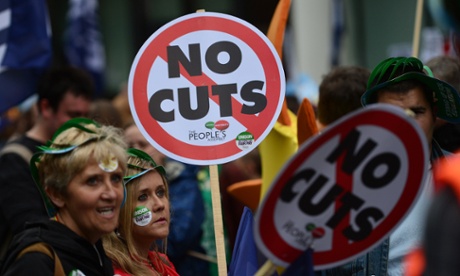
Next week, we will be the first union after the election to hold an annual conference, setting our priorities for the year ahead, which will undoubtedly include the need to step up co-ordinated industrial action. We are backing the People’s Assembly’s demonstration in London on 20 June and will be calling on the TUC to follow it up with another mass demonstration later in the year, not as a replacement for an industrial response but as part of it.
Our outdated and undemocratic voting system means the Tories have a majority in the Commons to try to force through more austerity, despite only 24% of the UK electorate voting for them. This clearly must change.
But, starting now, all opponents of this government of the rich, for the rich, will have to unite like never before to fight for the alternative to cuts, to protect our public services and our welfare state.
‘Cuts are now an unchecked reality’
Dave Penman, FDA general secretary: For the civil service, the next five years is clearly going to be framed by the spending cuts outlined by the chancellor in the autumn statement. What was aspirational before the election, and a bargaining position for a coalition, is now an unchecked reality for a government with a majority.
Despite nods to slowing the pace of deficit reduction during the election campaign, it is difficult to imagine that the chancellor will step far away from his ambition of eliminating the budget deficit by 2018-19. While £12bn in welfare cuts grabbed the headlines during the election, at least another £13bn is expected from departmental budgets. This takes us back to pre-war times for non-protected departments, as the Office for Budget Responsibility has already pointed out.
The government cannot simply treat the civil service as a tool for deficit reduction. It must outline how it will reduce spending while maintaining the world-class civil service ministers say they want. If the civil service is to be smaller but more able, the government needs a vision on skills and reward that is more than a diktat from the Treasury. Five more years of the same will be self-defeating.
Talk to us on Twitter via @Guardianpublic and sign up for your free weekly Guardian Public Leaders newsletter with news and analysis sent direct to you every Thursday.