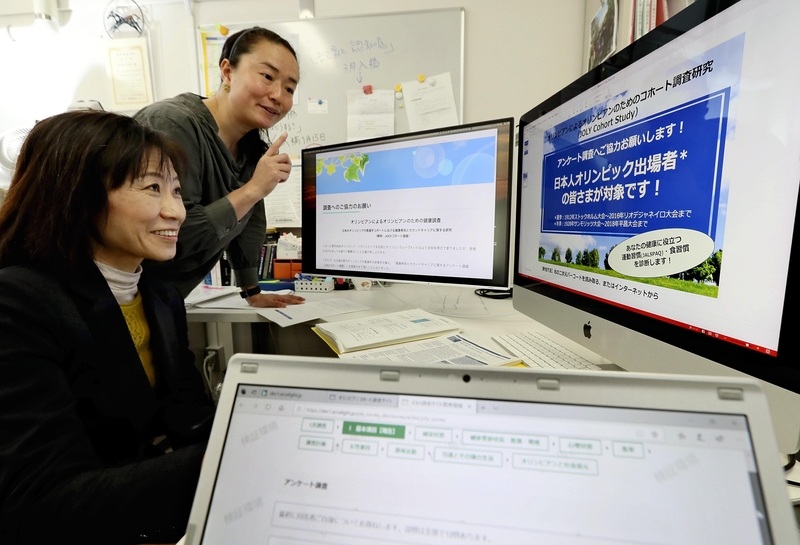
Japan's first large-scale survey was launched regarding the lives and health of about 6,000 former Japanese Olympic athletes, with an aim to find what kind of diet and exercise regimen are effective in maintaining good health, by comparing their data with that of ordinary Japanese.
The survey has been conducted by a team of scientists at Osaka University, Japan Institute of Sports Sciences (JISS) among others.
Despite having excellent physical abilities, top athletes, including Olympians, are often exposed to excessive stress and psychological pressure. Under the circumstances, many of them are said to have been concerned that their lives may be shorter. However, an international medical journal reported that in studies conducted overseas, such as in France, athletes tended to live longer than the average person.
As a result, the survey was proposed by several experts, including Dr. Yuri Kitamura, 55, a guest professor at Osaka University's medical department specializing in epidemiology, and Yumiko Kanemura, 44, who was known as Yumiko Suzuki when competing in canoe sprint in the 2004 Athens and 2008 Beijing Games. The study was adopted as one of the Japan Sports Agency's research projects.
The team set up Japanese Olympians Cohort Study and started an online questionnaire on June 1. The survey will be available for six months until the end of November, and mail-in replies will also be accepted.
The survey covered all athletes who participated in the Summer and Winter Olympics since the 1912 Stockholm Games, which was the first time that Japanese nationals participated in the Olympics, and asked about their activities, medical history, diet, history of smoking and their attitude toward exercising since they retired from actively competing in the Olympics. If the player is deceased, the family is asked to help fill in the information, including the date and cause of death.
The data will be compared to the lifestyle of an average person and their health conditions. The team will analyze differences among sports and changes over time as well.
Kanemura said many Olympic athletes are hyper-aware of their diet and sleep cycles and are very knowledgeable about how to move their bodies to avoid injury.
"We'd like to see how the athletes' lifestyles affect their longevity and apply it to improve the health and extend the life of the elderly and improve the physical fitness of modern-day children, who lack exercise," Kitamura said.
As for the athletes who represented Japan for the 1964 Tokyo Games, the Japan Sport Association among other groups have conducted health checkups and tested their physical fitness every four years, while keeping track of whether they were still alive.
Kitamura and her team used the data to check the longevity of the athletes and found that their average life span was about 15 years longer than an ordinary person, in provisional value. However, training methods and other factors have changed over time, and it is unknown whether that difference can be expected in the case of athletes who participated in other Olympic games.
Read more from The Japan News at https://japannews.yomiuri.co.jp/