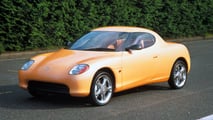
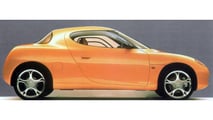
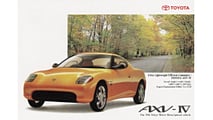
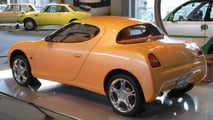
They say weight is the enemy of performance, but it also hurts efficiency. At the 1991 Tokyo Motor Show, Toyota wanted to demonstrate that you can do more with less. Enter the AXV-IV, the fourth vehicle in a series of experimental concepts that did things radically differently. The intent behind this oddly styled show car was to cut weight and size as much as possible without neglecting the fun factor.
Nearly lost to time, the AXV-IV took the form of a remarkably small, lightweight coupe. At just 133.8 inches long, it was a smidge bigger than the kei cars of the era, yet still tiny compared to almost every modern sports car. The diminutive two-seater was a masterstroke in lightness, tipping the scales at only 992 pounds.
For reference, a Miata weighed more than twice as much, at around 2,200 pounds. In fact, the quirky concept was only marginally heavier than today's BMW R 18 Transcontinental motorcycle. How did Toyota keep the weight so low? Beyond its adorably small footprint, the AXV-IV relied heavily on aluminum body panels. Engineers also used magnesium and fiber-reinforced plastics, slashing enough fat for the coupe to weigh less than half as much as a Corolla.
In its quest for lightness, Toyota even employed resin springs that doubled as suspension arms at both axles. The skinny 135/55R16 tires were designed with efficiency in mind, minimizing rolling resistance. While the car featured disc brakes and MacPherson struts up front, things were kept simple at the rear with drum brakes and a twist-beam suspension.

Toyota didn’t call it a sports car; instead, it described it as a “personal commuter with superior driving performance and comfort.” Despite its manual gearbox and rear-wheel-drive layout, it wasn’t conceived as an outright performance machine. After all, the 0.8-liter engine produced just 63 horsepower at 4,000 rpm. The two-stroke unit, featuring direct injection and multi-valve cylinders, delivered only 87 pound-feet of torque at 2,800 rpm. Both figures were well below those of the Miata NA’s much larger 1.6-liter engine.
Aerodynamics also played a key role in maximizing efficiency. Toyota claimed the car’s "aero-form is a result of a comprehensive study of aerodynamic balance to provide excellence in performance and fuel economy." A drag coefficient of 0.30 was achieved, an impressive figure by early-1990s standards.
Numbers aside, the smooth surfaces make it clear that the goal was to strip the AXV-IV concept’s exterior down to the bare essentials. Any aesthetic gimmicks would have compromised aerodynamic efficiency and, in turn, fuel economy. Toyota never published fuel-consumption figures, but it’s easy to imagine the car was remarkably thrifty given its ultralight construction. For context, the engine alone weighed just 183 pounds.
There’s also a sense of familiarity in this somewhat bizarre design. You can see where Toyota drew inspiration for the taillights of the 1994 RAV4, launched three years after the concept’s debut. There are also strong hints of a third-generation MR2, which arrived eight years after the AXV-IV.
Beyond previewing future design cues, the oddball concept did gain an indirect descendant. In 2015, Toyota unveiled the S-FR concept, a small, sporty coupe with a manual gearbox and rear-wheel drive. While that car never reached production either, the brand has remained committed to building cars for enthusiasts.
1991 Toyota AXV-IV concept



The recently launched GR GT, powered by a new V-8 engine, will be followed by the return of the Supra. The GR86 isn’t going anywhere, and Toyota has also dropped hints about reviving either the Celica or the MR2. The company is developing a new performance-oriented 2.0-liter gasoline engine for both front- and rear-engined applications, so the future looks bright for affordable sports cars. While a sub-GR86 model would be delightful, it’s unlikely to happen.
Since the AXV-IV premiered, all but one kei sports car has died. Honda discontinued the Beat in 1996 and the S660 in 2022. Mazda’s delicious Autozam AZ-1, complete with gullwing doors, was axed in 1994. The Suzuki Cappuccino bowed out in 1996 without a direct successor.
Suzuki still builds the Copen, but not for long: production ends next August, although the new K-Open concept hints at a comeback with a rear-wheel-drive twist.