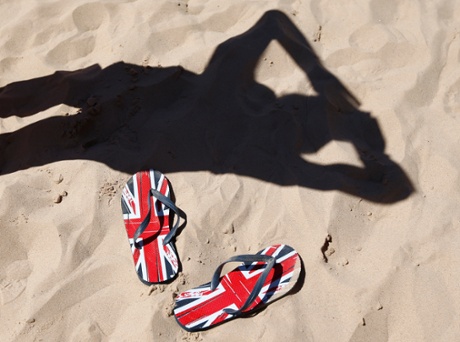
Have we stopped going to the beach? A National Trust survey says there has been a 20% reduction in visits to the coast. Apparently, people even prefer “urban beaches” – such as those in London and Sheffield. For a cyber generation, one can see how the fantasy or ersatz version might be better than the real thing. A blue screen is preferable to a blue horizon. All that sand in your sandwiches. Swarming jellyfish. Voracious, tortoise-murdering gulls. And cold water – I’ve lost count of the number of people who look at me as if I’m mad when I say I swim in the sea all year round, who proudly tell me they wouldn’t consider it even in the height of summer.
Maybe it’s an inverted class thing. The “hoi polloi”, used to flying off to European resorts or further afield, regard a British holiday as an admission of failure – leaving the coves of Cornwall to the likes of David Cameron and James Cracknell (who last weekend, along with his 11-year-old son, saved a grandfather and grandson from the Devonian waves).
Those who look askance at our littered beaches have a point. A recent academic book, The Last Beach, threatened to ruin the experience for me by reporting that the accumulation of pollution and sewage in the sea is now affecting the beach so severely that, in some places, the sand is toxic. The authors have a salutary shortlist of don’ts: “1. Don’t walk barefoot on the beach. 2. Don’t lie on the sand. Lie on a thick towel or blanket. 3. Never, ever get buried in beach sand.” The reason? New evidence suggests there are more faecal particles in the sand than in the muckiest sea.
Nor is the effect of the besmirched beach restricted to humans. On my local beach the other day, I came across a dog with a fishing line hanging out of its mouth, bleeding from the jaw. Birds, too, become victims: gulls are washed up with fishing lures piercing their webbed feet, having starved to death because of their shackles. And I once helped to save a swan trussed up in a similar length of monofilament, holding its serpentine neck in my hand like one of Alice in Wonderland’s flamingo mallets while it was cut free. I now take a plastic bag with me to pick up the trash – from beer cans to used nappies – that decorates the strand after a weekend’s use.
Part of the problem is part of the joy. The sea is a free place that suffers from its own ambiguity. To migrants arriving on southern Europe shores, it represents hope, the conduit to a new life. For an archipelago such as the British Isles, it represents historical migration, too – commerce, exploitation and recreation – and has done so for centuries. When Horatio Nelson pushed off from Southsea beach en route for Trafalgar, he had to negotiate bathing machines and their inhabitants besporting themselves on the shore. In the dog days of August, it would be unconscionable to consider that our beloved apron of sand might have become a counsel of despair to be cold-shouldered by all but the brave.