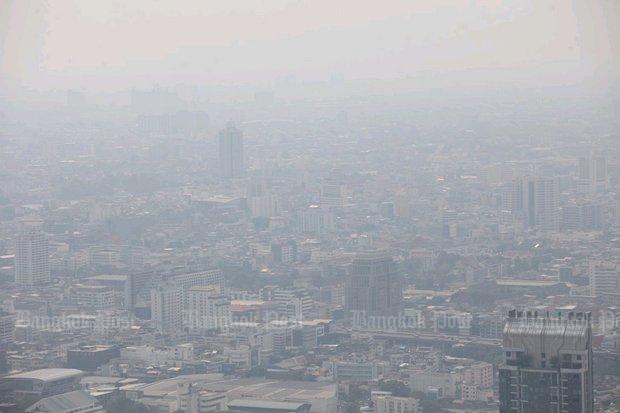
After a brief streak of blue sky and breathable air, PM2.5 dust has again returned to Bangkok and adjacent provinces this week, putting a damper on the Valentine's Day mood, while business forecasts warn the financial losses from the air pollution could reach 6 billion baht.
On Wednesday, city residents, who have been in the habit of checking dust levels each day, began to wear masks again.
The air quality indicator in parts of the capital returned to "orange" levels, meaning the levels are unhealthy for sensitive groups, according to the Pollution Control Department's Air4Thai application.
At 3pm Wednesday, levels of PM2.5 ranged between 53 and 57 microgrammes a cubic metre (µg/m3) in Kanchanaphisek, Rama IV Road and Wang Thong Lang areas, with the highest amount in crowded Lat Phrao and Din Daeng. Thailand's safety limit is set at 50 µg/m3.
PM2.5 in parts of Samut Prakan and Samut Sakhon were also measured at harmful levels similar to Bangkok's, the Pollution Control Department said.
The University of the Thai Chamber of Commerce's (UTCC) Centre for Economic and Business Forecasting revealed the financial loss caused by health-related expenditure and reduced tourism might be as high as 6 billion baht, based on a two-month estimation.
The PM2.5 particulate matter has shrouded Bangkok and surrounding areas since December last year.
With its size spanning 1/20th the width of a human hair, the fine dust can lodge in the lungs and blood veins, leading to respiratory and cardiovascular health problems.
The PM2.5 dust pushed private and state sectors to spend more money to manage the pollutants.
Meanwhile, Bangkok and surrounding areas are likely to lose tourism revenue as tourists go to other places with lower pollution levels.
The centre expects the city's population of 15 million will have spent 600 million baht in total to buy standard face masks over the course of two months.
It is expected that around 800,000 people will need visit a hospital because of the air pollution.
They are expected to pay around 800 million baht in total for hospitalisation and medical expenses combined.
Meanwhile, people in northern regions are also struggling against the dust.
The air quality indicator turned orange in many northern provinces and red in Chiang Mai's Chang Phueak area in Muang district, with PM2.5 surging to 94 µg/m3 on Wednesday.
The situation is, however, improving in Khon Kaen, which encountered the highest reading of PM2.5 levels in the country earlier this month.
According to officials, the dust decreased to 55 µg/m3, thanks to artificial rainmaking and attempts to curb the pollution by spraying water from high buildings.