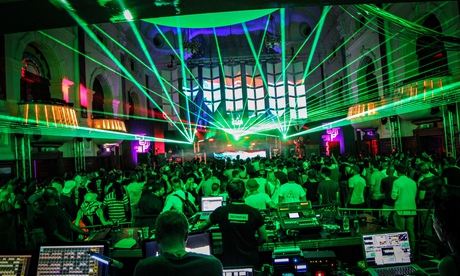
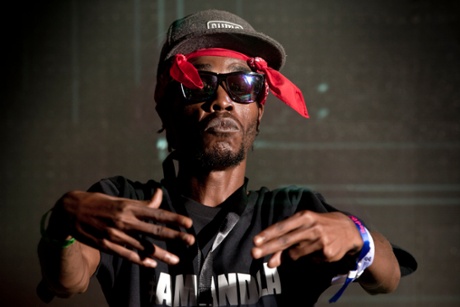
An apparition rises from the clouds of dry ice billowing through the humid Cape Town air, his pipe-cleaner limbs contorting wildly as he leaps and prances to a drum groove that sounds like hammers battering out a tattoo on a tin roof. DJ Spoko flashes a toothy grin from beneath his scarlet bandana and pokes a skinny finger towards the sky as his comrade Mujava teases out the wonky synth melody from one of South African electronic music’s biggest international hits, Township Funk.
Spoko and Mujava’s pandemoniac display was one of the highlights of this month’s Cape Town electronic music festival (CTEMF), which for the past four years has been seeking to channel the surging energies of the country’s diverse dance cultures and bring some of its disparate creative communities together. Spoko’s story illustrates how young South African producers and DJs have been employing a mixture of DIY inventiveness and entrepreneurial verve to make themselves heard. He started cutting tracks in his township home near Pretoria aged 12, using pirated drum-loop software to create the toughest sound he could. “I just banged those drums. Hard! No bass, just drums – bang!” he recalls. “I hate soft music, I just love noise.”
He tested out what he calls his “poison” at a neighbourhood shebeen, then spread his fame by giving his tunes to township minibus-taxi drivers to play to their passengers. “So when they go to town and come back to the hood, they’ll be pumping my shit. If they’ve got something they like, taxi drivers are going to turn it up. Schoolkids would overload in the taxi because the driver has my songs,” he says.
He also generated income by selling job-lots of 10 tracks at 100 rand (£5.65) a time to local “gangsters” as soundtracks for their parties. His patrons even gave his music its own name: Bacardi house, because it was perfect raving gear for dancers wired on white rum.
Spoko is one of many fascinating characters featured in the recent Future Sound of Mzansi documentary, a travelogue through the South African electronic dance music landscape. It was co-directed by iconoclastic Soweto-born producer/rapper Spoek Mathambo, whose delirious “township tech” reimagination of Joy Division’s She’s Lost Control brought him international acclaim. The film’s subtitle is “Welcome to the apartheid afterparty.”
“For the last 20 years, we’ve had a big reason to celebrate. Being a democracy for a first time, that creates a new culture all of its own. It’s not just any party, but a freedom party,” Mathambo explains. He is soon to release an album with his Fantasma collective that veers from traditional Zulu maskandi beats to hip-hop, postpunk and township house. “To mix all these elements up is a really exciting reflection of how vibrant South Africa is as a new society,” he says.
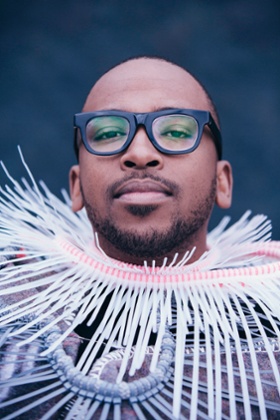
As South Africa’s superstar deep-house DJ Black Coffee points out in the documentary, this is a country with 11 different languages: “All these languages have different cultures and all these cultures have different sounds and different styles of singing.” The 2015 CTEMF offered a snapshot of that diversity: the raw jack-tracks of the Munnibrotherz, the exquisitely ethereal soundscapes of Felix Laband, Jumping Back Slash’s hypnotic tribalistic house, and the psychedelic fractal beats of Christian Tiger School, among others.
In recent years, South African producers have been twisting dance music into imaginative new shapes, with the emergence of idiosyncratic, localised electronic styles such as Durban gqom and Shangaan electro. But the biggest sound across this country of more than 50 million people is house music. House is ubiquitous, pumping out of minibus-taxis and shebeens, grill restaurants and parties in the townships, where thousands gather to dance to the kind of deep-house grooves that would be considered “underground” in the US or Europe. “House music is part of our culture here. It’s the music of the new generation in South Africa,” says Fosta, a DJ from Cape Town’s Langa township. “Kids as young as eight want to be DJs. It is the only thing people have to make themselves happy and allow them to express their feelings.”
The mood is certainly celebratory on a sultry Sunday at Mzoli’s, a popular grill joint in the Gugulethu township, where hordes of revellers come to chow down on steaming platters of meat and guzzle beer as DJs pump the latest local house anthems and pungent clouds of barbecue smoke swirl upwards into the summer sky. Max and Sello, a rap duo who call themselves Ruffest, are dropping off some new tunes for the Mzoli’s DJs to road-test. Ruffest mainly make kwaito, a low-slung party groove that swept the nation around the end of apartheid, taking influences from both house and hip-hop. “Kwaito started when freedom came, it gave people the freedom to say what they want to say, what changes they wanted to see and what they wanted to do,” says Sello.
Along with Johannesburg-based rap sorcerer Okmalumkoolkat, Ruffest featured on Sebenza, a sizzling 2012 album by London electronic beatmakers LV. They see themselves as an example of how township musicians can thrive despite adversity – in Max’s case, his legs were paralysed when he was shot during a gun battle between gangs. “I was caught in the crossfire, in the wrong place at the wrong time,” he says. “But I did not stop, I did not give up, I said this bullet that hit me will not stop my dream of being a musician.”
Ruffest were beneficiaries of a scheme started by veteran house DJ Oskido that provides basic studio equipment to nurture talent from deprived areas. Black Coffee, who DJs with one arm after losing the use of the other in a childhood traffic accident and now runs a foundation to help disabled youth, says musicians must try to play an inspirational role in their country’s development. “We are so traumatised by the past; people never believed in themselves, we were told not to believe in ourselves. That is why change is needed,” he explains. “We need to get out of that old cycle and believe we can do more.”
There is certainly no shortage of hedonistic raves in South Africa – the American-style EDM extravaganza Ultra also took place this month – but CTEMF tries to play a social-activist role by holding workshops in the townships for aspiring producers and DJs. In recent years, visiting headliners Four Tet, Skrillex and Richie Hawtin have all taken part by giving lectures.
“Music is the tool, but the end goal is trying to create social cohesion – connecting people, building communities and breaking barriers,” says festival director Duncan Ringrose, although he cautions that informal segregation persists in South Africa’s club scene, and elsewhere: “It’s still very segregated, in terms of class as well as race.”
That’s not to deny the genuine sense of optimism among some of the country’s DJs and electronic musicians that they can somehow be agents of change. “I think this is definitely a very special time,” says DJ Culoe De Song before throwing down an electrifying Afro-house set on the closing night of the festival. “This is a new society and you can create what you want, and that is what’s making it exciting.”