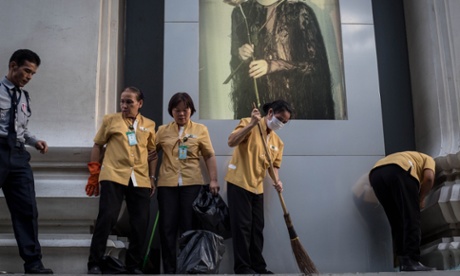
Foreign tourists have returned to a Bangkok street lined with tailors’ shops and overlooked by the Grand Hyatt hotel less than 24 hours after a bomb targeted a major shrine on its corner.
Brad Aldridge, a 20-year-old from Wellington, New Zealand, was on his way to a major shopping mall for the last day of his holiday.
“Well, it hasn’t fazed me,” he said at the metro station when asked if he thought the blast would affect Thailand’s vital tourism industry.
He heard about the bomb, which killed 22 people and wounded 123 when it ripped through the Erawan shrine on Monday night, from another guest in his hotel. “I was in the lift about to go out. But when I heard, I went back to my room.”
Aldridge stayed there for the night, reassuring panicked friends and family back home that he was OK. “If there are more attacks in the next year then it might affect tourism,” he said. “But I passed the scene on the way here.”
No group has claimed responsibility for the bombing of the Hindu shrine, a popular attraction for Thais and other Asian visitors. The shrine is dedicated to the Hindu god Brahma but is also popular among Thailand’s Buddhists and Chinese tourists.
The prime minister, Prayuth Chan-ocha, said the attack was “the worst incident that has ever happened in Thailand”, adding that those responsible “want to destroy our economy, our tourism”. He added: “They want to destroy our economy, our tourism.”
It is unclear if that will happen. Many tourists only stay overnight in the capital before heading out to the islands. But the stakes are high, with tourism accounting for 10% of GDP.
Chan Jin Lai, an Asia analyst at BMI Research, said the explosions at a tourism hotspot in the heart of Bangkok could undermine the recovery in tourism, deepening the country’s economic woes.
“The Thai economy is rather fragile and is still recovering from the impact of the political turmoil that ended following a military coup that was staged in May 2014,” Chan said.
“The acceleration in government spending and the recovery in the tourism sector are among the few bright spots supporting the economy.”
Tourists speak to media at the Bangkok bomb site pic.twitter.com/WDCpChNvL9
— Oliver Holmes (@olireports) August 18, 2015
At the scene of the blast on Tuesday, the streets were mostly empty except for police and journalists. A few tourists looked on from the above-ground walkway of the metro.
Opposite, the Central World mall was open and security officials were checking bags. Inside, the luxury clothing shops were open but there were few customers.
A few hundred metres up the road, however, the Siam Paragon mall was fairly busy. Thais and tourists were using its cafes and Sea Life Bangkok Ocean World was accepting customers.
Marik Foudijs, a 24-year-old backpacker from Holland, was searching for some breakfast on the last day of his six-week tour. He heard about the bomb when his brother texted to ask if he was OK.
“It won’t affect the backpackers but maybe families with small children will decide not to come,” he said.
Staying on the Khaosan Road, the epicentre of the country’s backpacking trade, Foudijs said he was surprised the bars and restaurants stayed open all night.
“It was kind of scary. The military were there, army vehicles. But locals just said it was safe.”
Zahi, 37, from Tel Aviv, walked through the mall pushing his son in a pram, a Sea Life bag hanging from the handle. He said his family walked directly into the blast site on Monday evening by mistake.
“As Israelis, we are used to bomb attacks. But the Thais are not,” he said. “It was not exactly clear what was going on. We were trying to get to the shopping mall but if we had known there had just been a bomb attack, we would have gone away.”
He saw wounded people in the street and said people in the nearby mall appeared oblivious.
Thailand has experienced increased violence in recent years. The military junta took over last year in a coup that followed months of bloody protests. Thousands have been killed in the south during a separatist insurgency.
However, Monday’s indiscriminate attack in the centre of the capital, with its high death toll of foreigners, is unprecedented in recent memory.
“If the attacks continue a second and third time, then the tourism industry will be affected,” said Zahi. “Otherwise, it won’t impact it.”