1) He survived where others fell apart
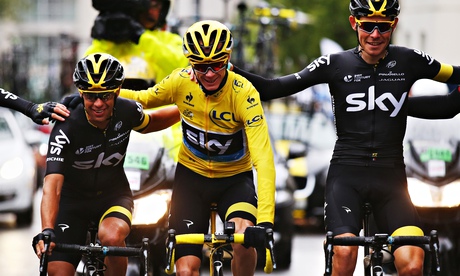
The Tour is not won on any single day but can be lost at any time and this year’s tough course – from the windswept start to the baking weather of southern France – meant it turned into even more of a race of attrition than usual. Chris Froome stayed upright and, apart from an attack of bronchitis towards the end of the race, healthy where others fell to bits. Alberto Contador fell off in the Alps but started below par after winning the Giro, Tejay van Garderen was put out by illness, Vincenzo Nibali was off the pace and Thibaut Pinot and Romain Bardet both had difficult second Tours after last year’s euphoria. By the final two days Froome, Nairo Quintana and Alejandro Valverde were the last men standing.
2) Movistar lacked ambition and allies
Once Geraint Thomas had paid the price of his ceaseless work for Froome on the penultimate mountain stage, it should have been easier for Movistar to isolate the race leader from his team-mates and tire him out. But at two moments when Froome was bereft of support – on the Col d’Allos on Wednesday and after the Col de Chaussy early on Friday – they failed to press their advantage or to seek allies to help them to do so. The Spanish team looked as if they were desperate to preserve what they had rather than gamble on winning the race, with Quintana leaving his attacks until late in Friday’s and Saturday’s stages. Froome’s revelation that he struggled going up the Croix de Fer on Saturday underlines that Movistar’s lack of ambition may have cost them dear.
3) Quintana found his form too late
The Colombian barely raced in the two months before starting the Tour and his form in the final week indicates that he was undercooked to begin with. He lost crucial time on stage two to Zeeland, more at the Mur de Huy the next day and, while Movistar rode superbly in the team time trial, he was off the pace in the critical finish at La Pierre Saint-Martin. He was able to produce incisive attacks only in the final two days of mountain stages. Additionally, the constant heat – 30C plus for the bulk of the race – favoured Froome, who makes no bones about the fact he struggles in the cold and wet, where Quintana is at his best when the mercury drops.
4) Winner planned his move
Sky have made their move on the first mountain-top finish in both their previous Tour wins, 2012 and 2013, so their rivals knew what was coming. Froome had looked at the finish at Pierre Saint-Martin a few weeks earlier and said he had planned exactly where to attack. “I knew that 10 kilometres at 10% would have everyone on the limit and I wanted to attack one kilometre before it flattened, then go into time-trial mode until the finish. If there was anyone chasing, especially a climber like Quintana, on a less steep finish, that would favour me more.” And that is pretty much what happened.
5) Sky’s support riders were always present
Dave Brailsford recruited cannily after last year’s debacle, hiring the pure climber, Wout Poels, and all-rounders in Leo Konig and Nicolas Roche, all of whom played key roles. Crucially, Richie Porte fought his way through illness to set the pace for Froome at l’Alpe-d’Huez along with Poels. But the key man was Geraint Thomas, whose transformation this year into a rider capable of challenging for the podium in a major Tour was completed in this Tour. With him alongside Froome for virtually every yard of four of the seven high mountain stages, the opposition seemed paralysed by the fact they had to deal with two Sky men at the top of the standings. When the Welshman finally cracked on Friday, the entire balance of power changed.