We go again. 24 hours after the frenzied finale on Alpe d’Huez, the Tour de France is going back up the famous mountain for its last dance before the transfer to Paris. However, stage 20 is a different proposition entirely to Friday’s antics.
The details
- Stage 20: Bourg d'Oisans - Alpe d'Huez
- Date: July 25, 2026
- Distance: 170.9 km
- Start time: 11:20 CET
- Finish time: 16:29 CET
First of all, we are not going back up the iconic 21 hairpins but approaching via the back roads of the rarely-visited Col du Sarenne, providing a welcome Tour debut for an absolute gem of a climb, and giving us a respite from the carnival atmosphere on those hairpins.
But it’s not really the Sarenne that makes this stage so different, but what comes before it, too.
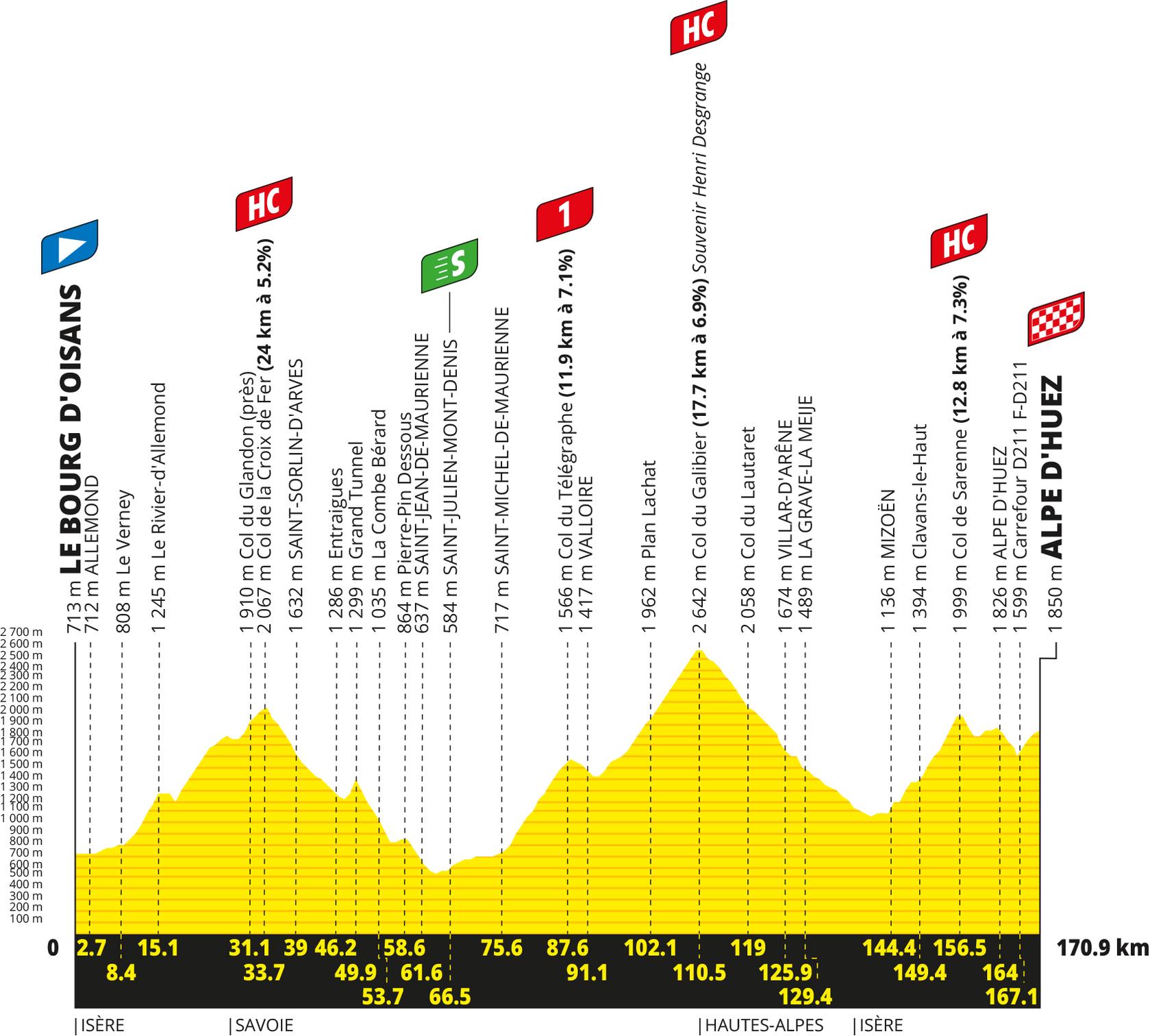
We have the Col de la Croix de Fer almost from the gun. We have the famous Col du Telegraphe and Col du Galibier partnership. And we have Alpe d’Huez via the irregular roughly-surfaced hors-categorie beast-beauty that is the Sarenne.
All told, that’s almost 5,500 metres of elevation gain across 170.9 kilometres.
“That’s astronomical,” says EF Education EasyPost director Tom Southam as he helps us dissect the stage.
When we pay a visit to his Ineos Grenadiers counterpart Geraint Thomas, the 2018 Tour winner adds: “In terms of those numbers, it could be the toughest Tour stage ever, even.
“And then with everything they’ve done so far, with the heat, you can tell it’s all taken its toll on the riders so to have the hardest stage ever in the Tour on top of that… I’m glad I’m on the bus and not on the bike.”
In pitching this Tour de France, the organisers repeatedly spoke of ‘suspense to the end’, aiming to go fairly light on set-piece high-mountain stages until we reached the Alps of the final week. But even in this final Alpine trio, this last stage stands head and shoulders ahead of the tame summit finish at Orcieres-Merlette and the first Alpe d’Huez instalment that came on the back of a relatively modest climbing load.
The problem is, this race is effectively already won. Tadej Pogacar has the yellow jersey with a five-minute lead and, despite the intrigue surrounding illness in his UAE Team Emirates-XRG camp, the Slovenian looks almost certain to add a fifth Tour de France title to his palmares.
And the other problem is that everyone is knackered after a Tour raced in searing temperatures and at soaring average speeds.
“It’s a bit of a death march,” is how Red Bull-Bora-Hansgrohe director Zak Dempster puts it.
“I see something quite similar to that,” adds Southam. “In terms of fatigue level, and people not really being able to make a difference on GC, and just crawling up the back of Alpe d’Huez.
“You can’t ignore how hard they’ve raced every day, and the heat. Everything is accumulative in a Grand Tour.”
The thing about death marches is that they tend to be quite slow and quite sombre - not the fireworks lighting up the sky in a big flashy finale.
“Any Grand Tour that tries to build up to a big culmination on the last weekend generally fails, because everyone is where they are, and the fatigue level is so high, that you rarely see things getting flipped these days.
“In terms of the fatigue levels, and people not really being able to make a difference on GC, I can see guys just crawling up the back of Alpe d’Huez.”
Although we might not see the sort of pulsating accelerations issued by Southam’s star rider Richard Carapaz on Alpe d’Huez on Friday, that doesn’t mean we won’t get drama. It might not be happening out the front, but riders can fall way off the back on days like this.
“On these stages, if you do crack, you lose big, big time,” says Dempster, who makes a pertinent reference that might keep a tiny hint of jeopardy alive in this Tour.
“Just remember Pogacar on Col de la Loze.”
The four-time winner lost several minutes on that wretched day in 2023, when he issued the immortal words over race radio: “I’m gone, I’m dead.”
The tactical picture
Pogacar’s record-breaking performance on Alpe d’Huez would indicate that he is in no state to crack, although illness has been plaguing his team, so it’s not quite a foregone conclusion.
As for the battle for second place, Remco Evenepoel pulled clear on Alpe d’Huez and made that position even more his own on Friday. The Belgian has really hit his stride in the back half of this race and looks more than capable of sealing that runner-up spot, but then again he has also endured several occasions in his young career where he has cracked and paid the price in minutes. It’s looking good, but it’s not over til it’s over for Evenepoel.
As for the final spot on the podium, and the fight for the white jersey, Isaac del Toro finished ahead of Paul Seixas once again on Friday. He looks the stronger of the two at the moment and Pogacar has also indicated that now he has his Alpe d’Huez win, he will work for his young Mexican teammate on Saturday. Seixas will need to produce something bold and extraordinary, at just 19 years of age.
While the war of attrition is taking place in the GC group, it’s very likely a breakaway will be fighting it out up the road. UAE have their Alpe d’Huez stage win and Pogacar is unlikely to make his depleted squad bury themselves two days in a row to set him up for the stage win - they only just managed it yesterday.
And so it’s likely to be another fast and furious start as the breakaway tussles to form itself on the Croix de Fer, which will only add to the pile of fatigue that has already built up over the past three weeks.
Roll up, roll up for the death march.
- First rider across the Col du Galibier wins the €5,000 Souvenir Henri Desgrange at the Tour's highest point.
- Points at finish: 20-17-15-13-11-10-9-8-7-6-5-4-3-2-1
The route
From Bourg-d'Oisans, the first challenge arrives quickly with the HC climb of Col de la Croix de Fer, followed by 42 kilometres of descent and valley roads before the Col du Télégraphe marks the start of nearly 30 kilometres of relentless climbing.
The Galibier follows with barely a descent in between, its summit at 2,642 metres.
After 33 kilometres of descent, the riders face the Col de Sarenne, used only once before in Tour history, in 2013, and then only as a descent.
From its summit, 14.5 kilometres remain to Alpe d’Huez for the second consecutive day, with the road dropping down before picking up the final 4km of the ascent to the ski resort.
Mountains
-
Col de la Croix de Fer (cat. HC, 24km at 5.2%), km. 33.7
- 20-15-12-10-8-6-4-2 pts
-
Col du Télégraphe (cat. 1, 11.9km at 7.1%), km. 87.6
- 10-8-6-4-2-1 pts
-
Col du Galibier (cat. HC, 17.7km at 6.9%), km. 110.5 - Souvenir Henri Desgrange
- 20-15-12-10-8-6-4-2 pts
-
Col de Sarenne (cat. HC, 12.8km at 7.3%), km. 156.5
- 20-15-12-10-8-6-4-2 pts
Sprints
-
Saint-Julien-Mont-Denis, km. 66.5
- 25-20-16-14-12-10-8-7-6-5-4-3-2-1 pts
Time limit
Est. Speed |
Est. Winner Time |
Limit % |
Max Time Cut |
|---|---|---|---|
36 km/h |
4:44:50 |
18%% |
0:51:16 |
35 km/h |
4:52:58 |
17% |
0:49:48 |
34 km/h |
5:01:35 |
16% |
0:48:15 |
33 km/h |
5:10:44 |
15% |
0:46:37 |
32 km/h |
5:20:26 |
14% |
0:44:52 |