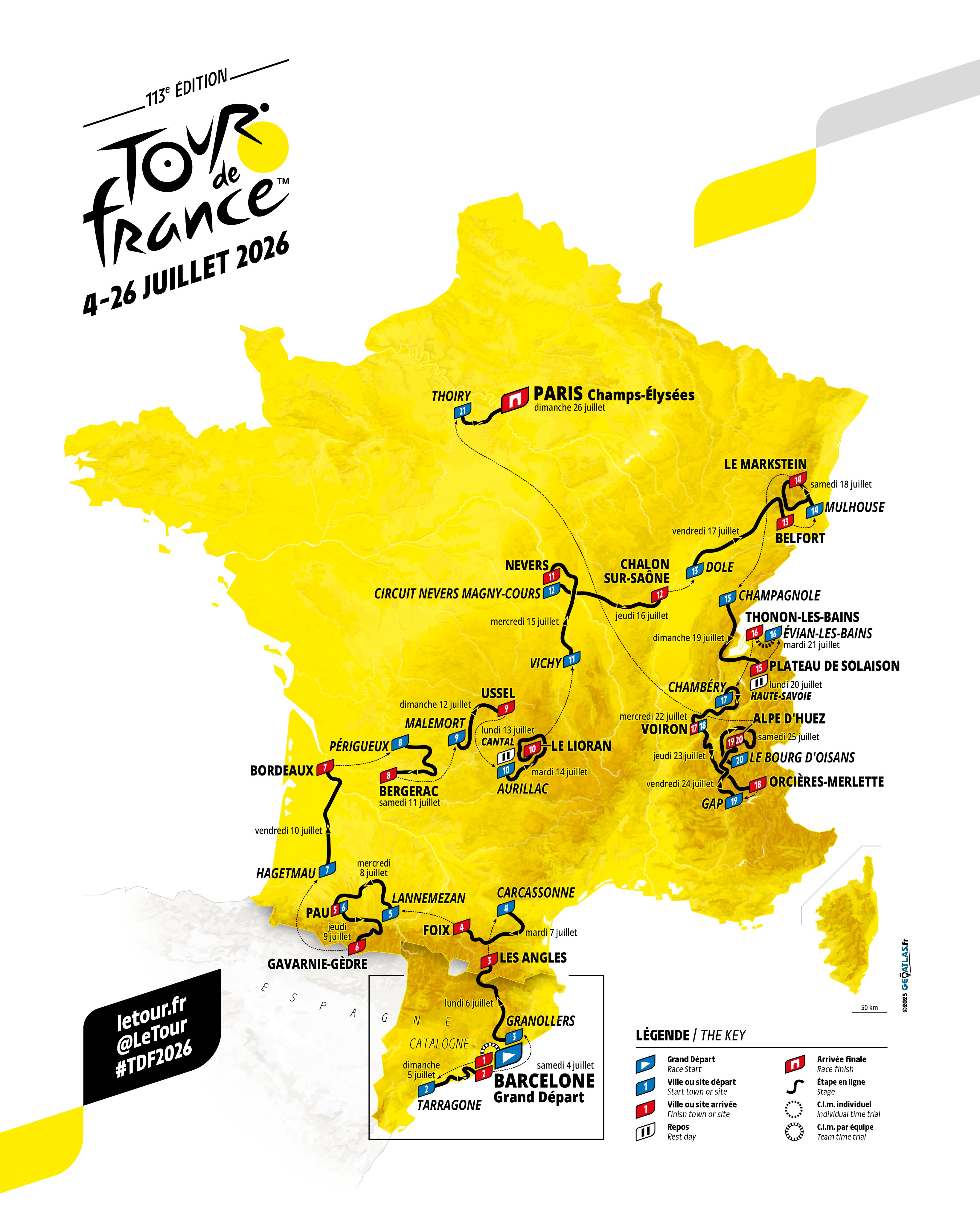
The 2026 Tour de France will begin in Barcelona, Spain with a team time trial, before heading north into France where it will enter the Pyrenees as early as stage three. Following that mountain range the race heads north to Bordeaux before cutting diagonally across the country, through the Massif Central, onto the Vosges, before heading down into the Alps and two stage finishes up Alpe d'Huez.
It will be the fourth foreign Grand Départ in five years, with three stages in Spain, before the race returns to France.
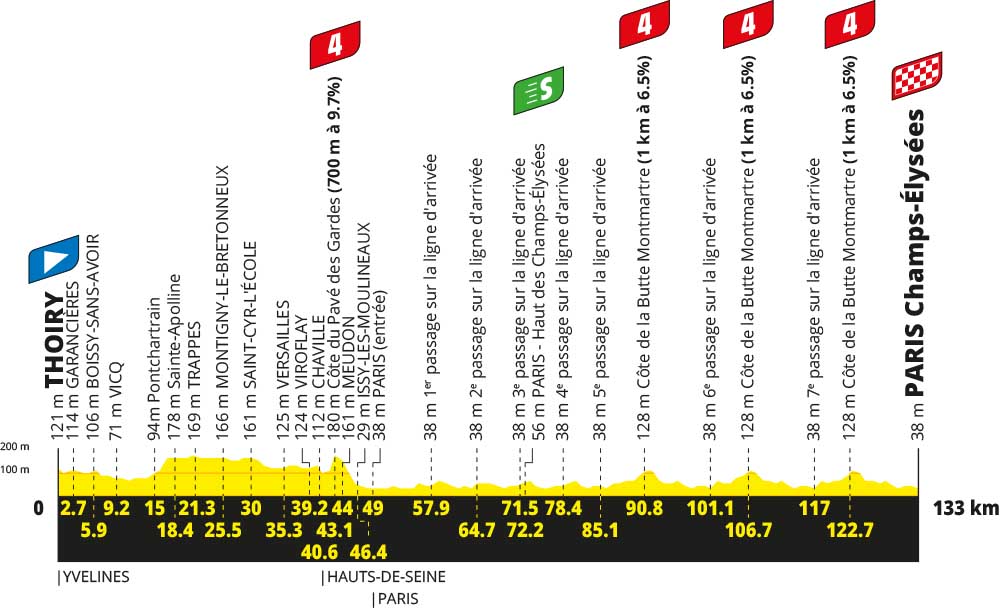
The Tour will finish in Paris once again, but it is once again using the Montmartre circuit that was an instant hit last year. The stage will still finish on the Champs Elysees in the shadow of the Arc de Triomphe.
There is one team time trial, an individual time trial, as well as eight stages classified as mountain days, including five summit finishes. There is only one stage over 200km, seven are designated as "flat", and four as "hilly".
Tour de France 2026 stage table
Stage |
Day |
Start |
FInish |
Distance |
Type |
|---|---|---|---|---|---|
1 |
4 July |
Barcelona |
Barcelona |
19.7km |
TTT |
2 |
5 July |
Tarragona |
Barcelona |
178km |
Hilly |
3 |
6 July |
Granollers |
Les Angles |
187.3km |
Mountains |
4 |
7 July |
Carcassonne |
Foix |
182km |
Hilly |
5 |
8 July |
Lannemezan |
Pau |
158km |
Flat |
6 |
9 July |
Pau |
Gavarnie-Gèdre |
186km |
Mountains |
7 |
10 July |
Hagetmau |
Bordeaux |
175km |
Flat |
8 |
11 July |
Périgeux |
Bergerac |
182km |
Flat |
9 |
12 July |
Malemort |
Ussel |
185km |
Hilly |
10 |
14 July |
Aurillac |
Le Lioran |
167km |
Mountains |
11 |
15 July |
Vichy |
Nevers |
161km |
Flat |
12 |
16 July |
Circuit Nevers Magny-Cours |
Chalon-sur-Saône |
181km |
Flat |
13 |
17 July |
Dole |
Belfordt |
205km |
Hilly |
14 |
18 July |
Mulhouse |
Le Markstein Fellering |
155km |
Mountains |
15 |
19 July |
Champagnole |
Plateau de Solaison |
184km |
Mountains |
16 |
21 July |
Évian-les-Bains |
Thonon-les-Bains |
26km |
ITT |
17 |
22 July |
Chambery |
Voiron |
175km |
Flat |
18 |
23 July |
Voiron |
Orcières-Merlette |
185km |
Mountains |
19 |
24 July |
Gap |
Alpe d'Huez |
128km |
Mountains |
20 |
25 July |
Le Bourg d'Oisans |
Alpe d'Huez |
171km |
Mountains |
21 |
26 July |
Thoiry |
Paris |
130km |
Flat-ish |
Tour de France 2026 full route map
Tour de France 2026 Stage-by-stage guide
Stage 1: Barcelona > Barcelona
Saturday, 4 July
19.6km
Elevation gain: 200m
Start: 15:05 Finish 17:15 (CET)
Team time trialFor the first time since 2019, a team time trial is back on the menu at the Tour de France, but now there’s a twist: times will be recorded individually, not as a team. It’s a start that could prove as spicy as patatas bravas sauce.
Today’s route
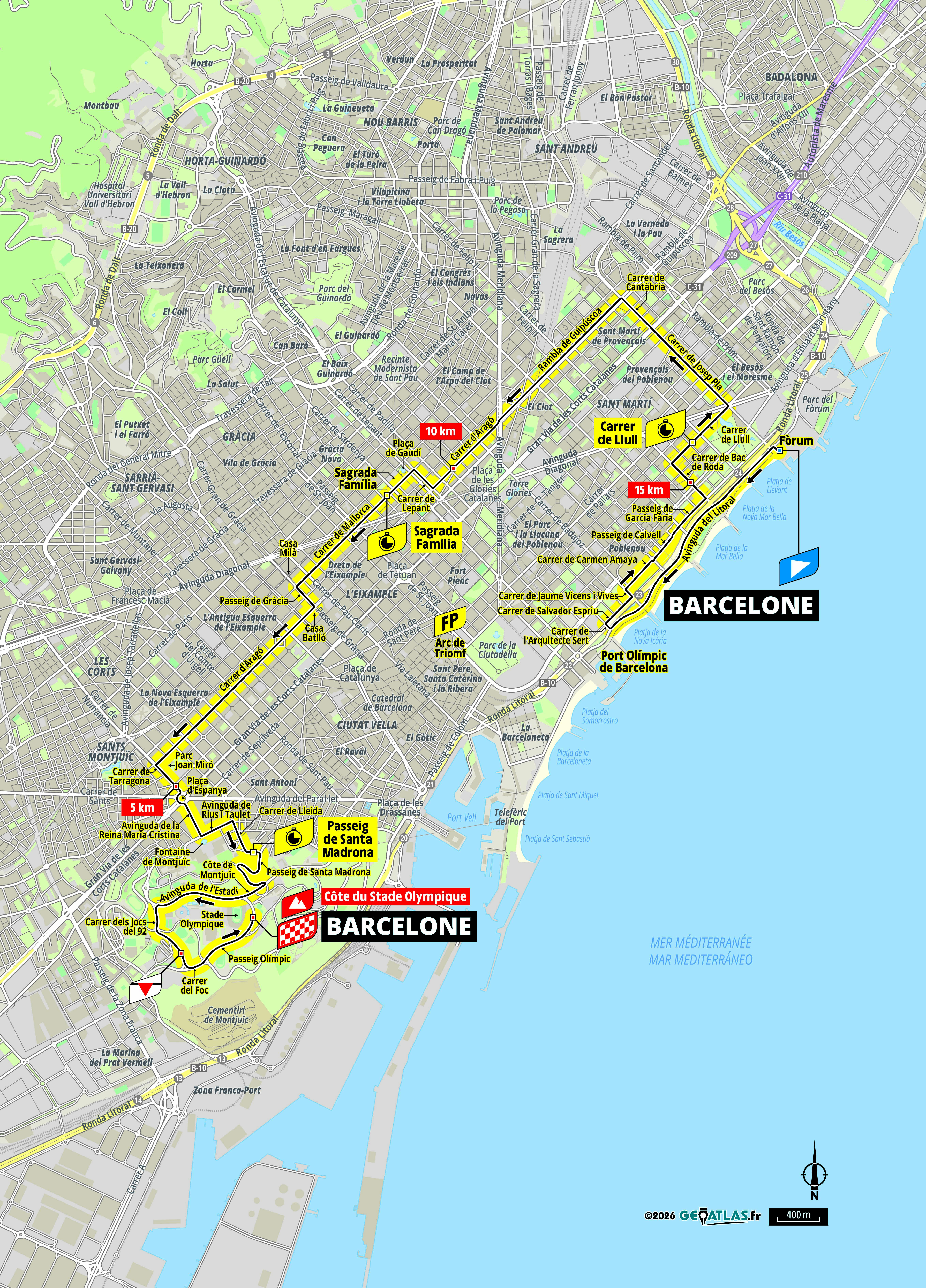
It might be an odd sight for the regulars at Barcelona’s seafront skate park when high-end time trial machines roll down their ramps, but as quickly as the Tour riders came, they’ll be gone, careering down the coast and into the bustling city centre.
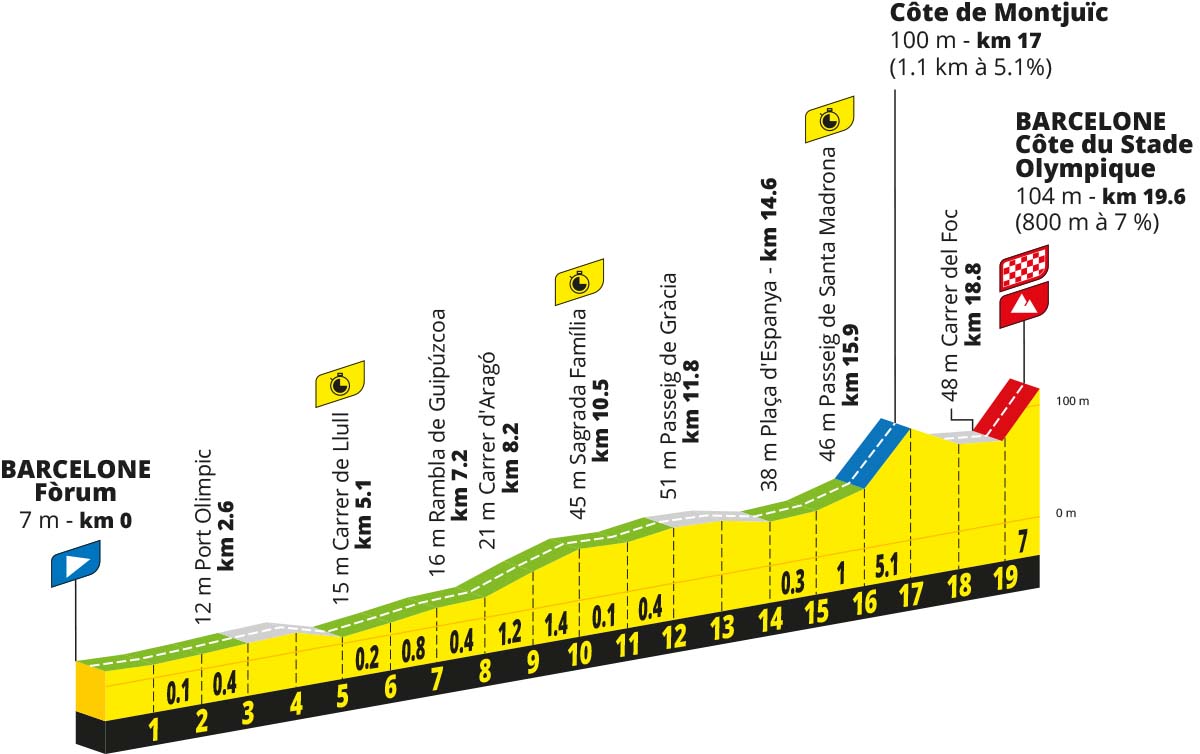
Most of the middle part of the course takes place on a wide, grid-straight road, with two tricky chicanes thrown in to swing by the Sagrada Familia, the work of Barcelona’s most famous son, architect Antoni Gaudí. From there, it’s out into the hills for a double helping of climbs: Côte de Montjuïc (1.1km at 5.1%) and Côte du Stade Olympique (800m at 7%), at the top of which the finish line is drawn.
Route highlights
Barcelona’s grandest landmark, the Sagrada Familia, waves the riders past at the midway point, acting as the second of three time checks. Construction began on the cathedral in 1882, and was only completed in February this year.
What to expect
Any rider who has competed in any of the last four editions of Paris-Nice will be familiar with the every-man-for-himself timing rules for this stage – ASO has been trialling it at the race since 2023. Barring disaster, teams will stick together until the final uphill, where the punchier finishers will fancy their shot at the first yellow jersey.
Stage 2: Tarragona > Barcelona
Sunday 5 July
168.5km
Elevation gain: 2,500m
Start 11:55 Finish 15:36 (CET)
Hilly
The fiesta continues in Barcelona on day two, with a stage for the puncheurs into the Catalan capital. Expect to feel a sense of déjà vu: the race is using the same finish line as it did for the opening time trial.
Today’s route
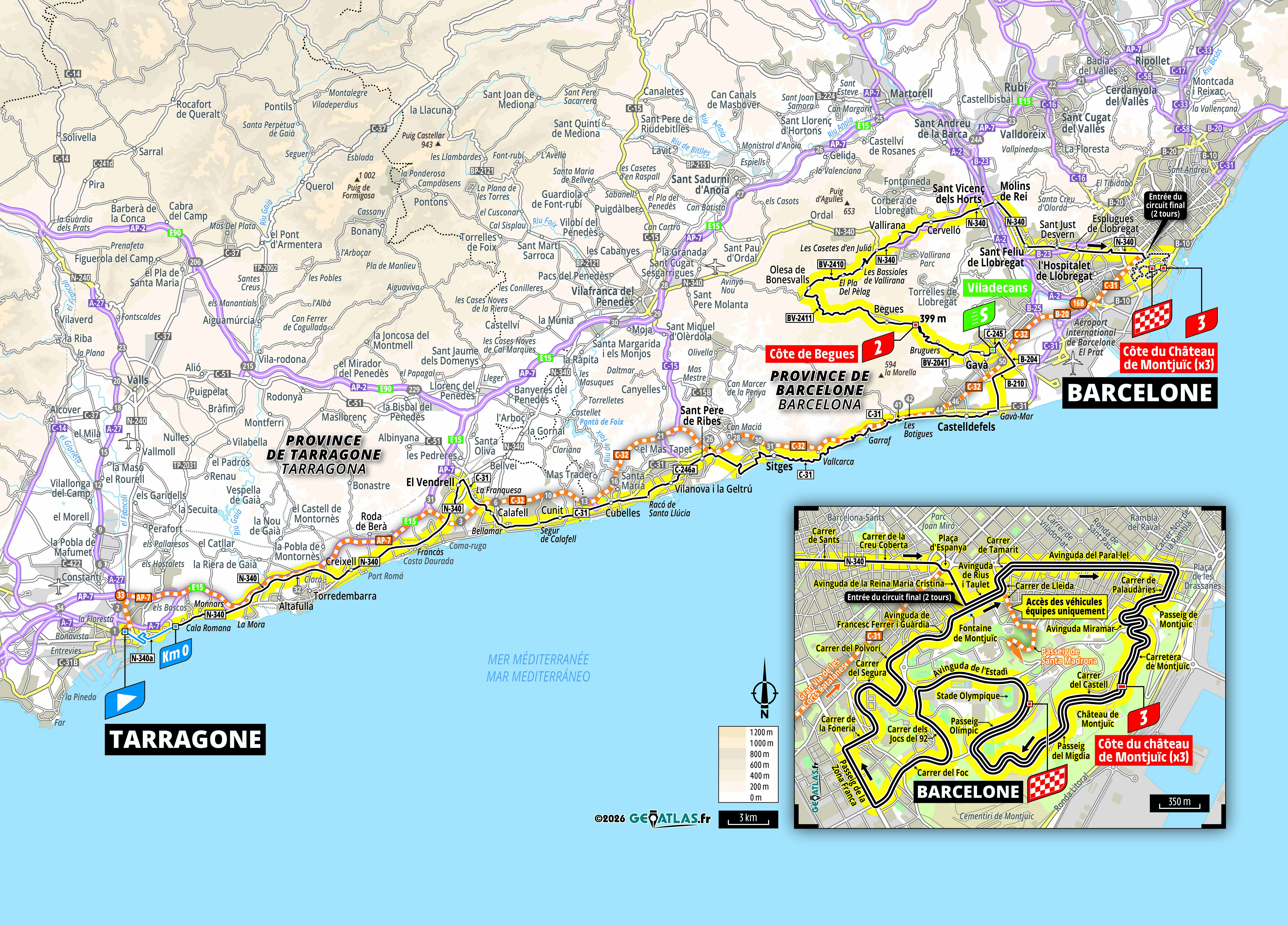
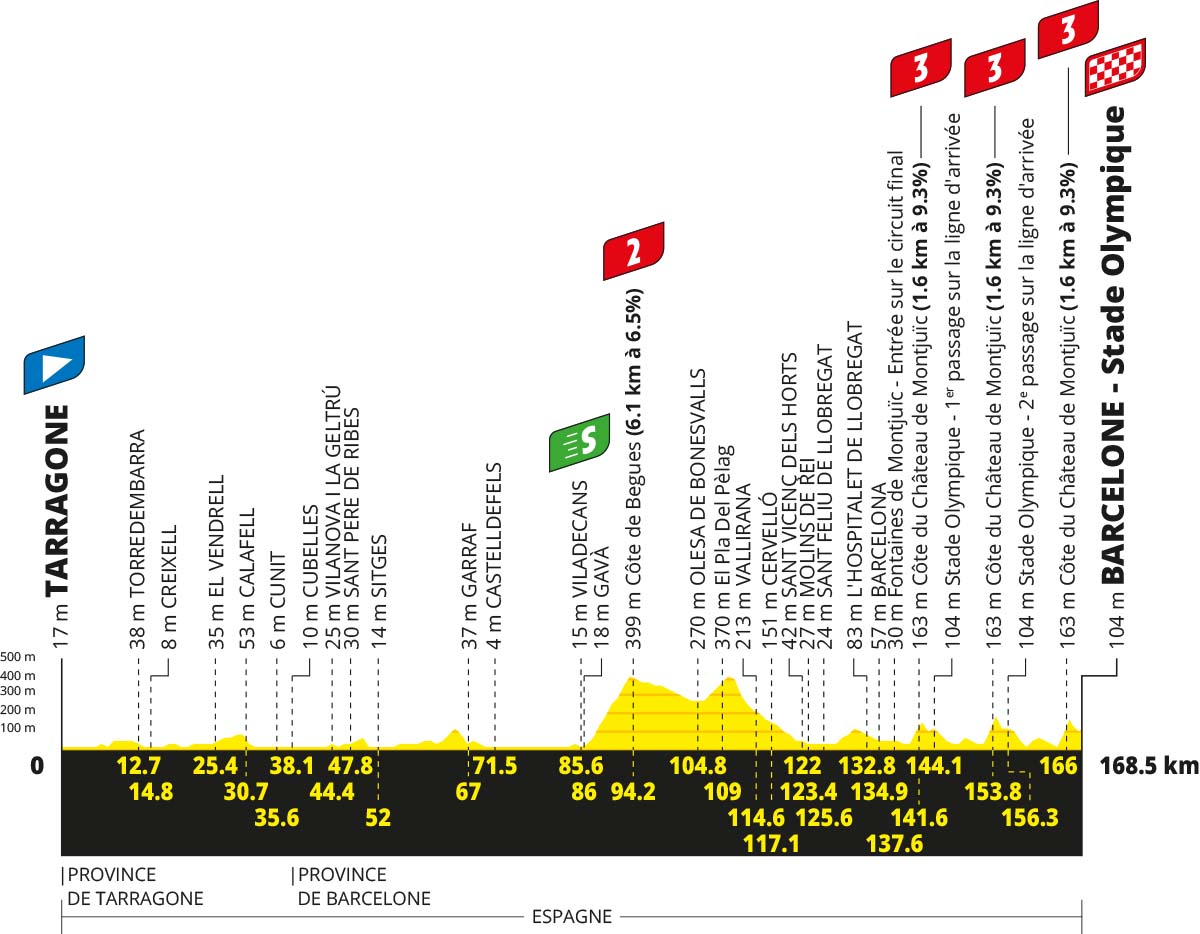
The Roman port city of Tarragona, 100km south of Barcelona, makes its first appearance at the Tour de France as it bids adéu (that’s Catalan) to the riders on their first road stage. Heading north along the Costa Daurada, there’s little to write about today’s stage in a postcard until the Côte de Begues, the race’s first categorised climb, pitched at a modest 6.5% over 6.1km.
The party truly begins when the riders enter the finishing circuit with around 30km to go when the team in yellow will have their work cut out to control proceedings. They’ll do the loop three times, dicing below the treeline, with three ascents of the punishing Côte du Château de Montjuïc (1.6km at 9.3%).
Route highlights
You might recognise the finishing circuit from the Volta a Catalunya, where it typically hosts the closing stage’s finale. This loop is slightly longer, but many of the roads are the same.
What to expect
A route like today’s carries the promise of Classics-style racing, with attacks in the final kilometres being inevitable on the circuit based on the city's iconic Montjuic park that sits above the city, giving 360 degree views. The short, sharp climbs and twisting route will invite attacks from all comers, perhaps even the GC contenders who will have to be attentive at the front and follow if a rival attacks.
Stage 3: Granollers > Les Angles
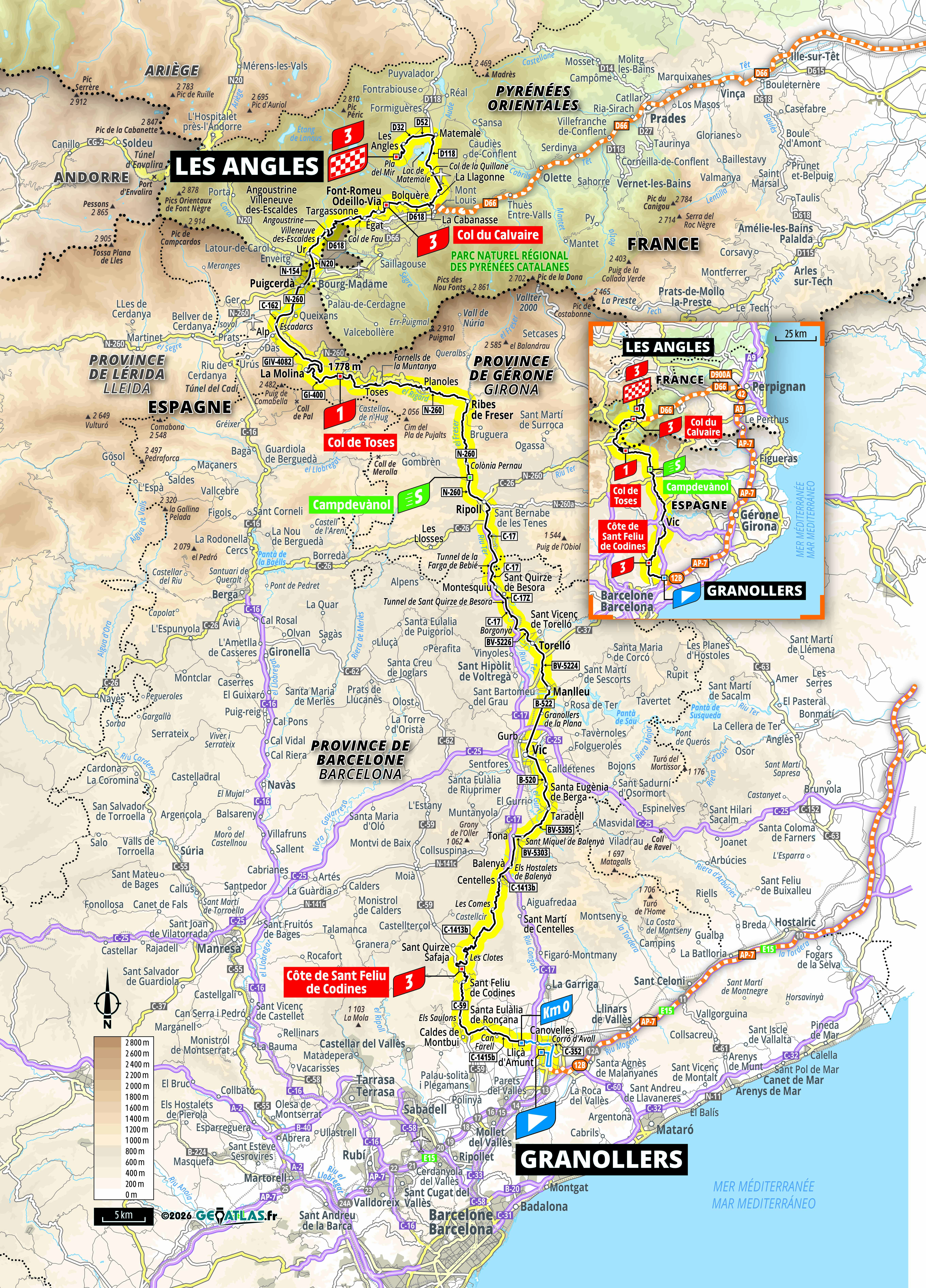
Monday 6 July
195.9km
Elevation gain: 3,950m
Start 10:20 Finish 15:08 (CET)
Medium mountains
As the race makes its way into France, the sprinters might have hoped for a flat foray along the coast. But gone are the slow-building days of sprint stages at the start of the Tour. Instead, we’re into the Pyrenees for an unusually early entry into the mountains.
Today’s route
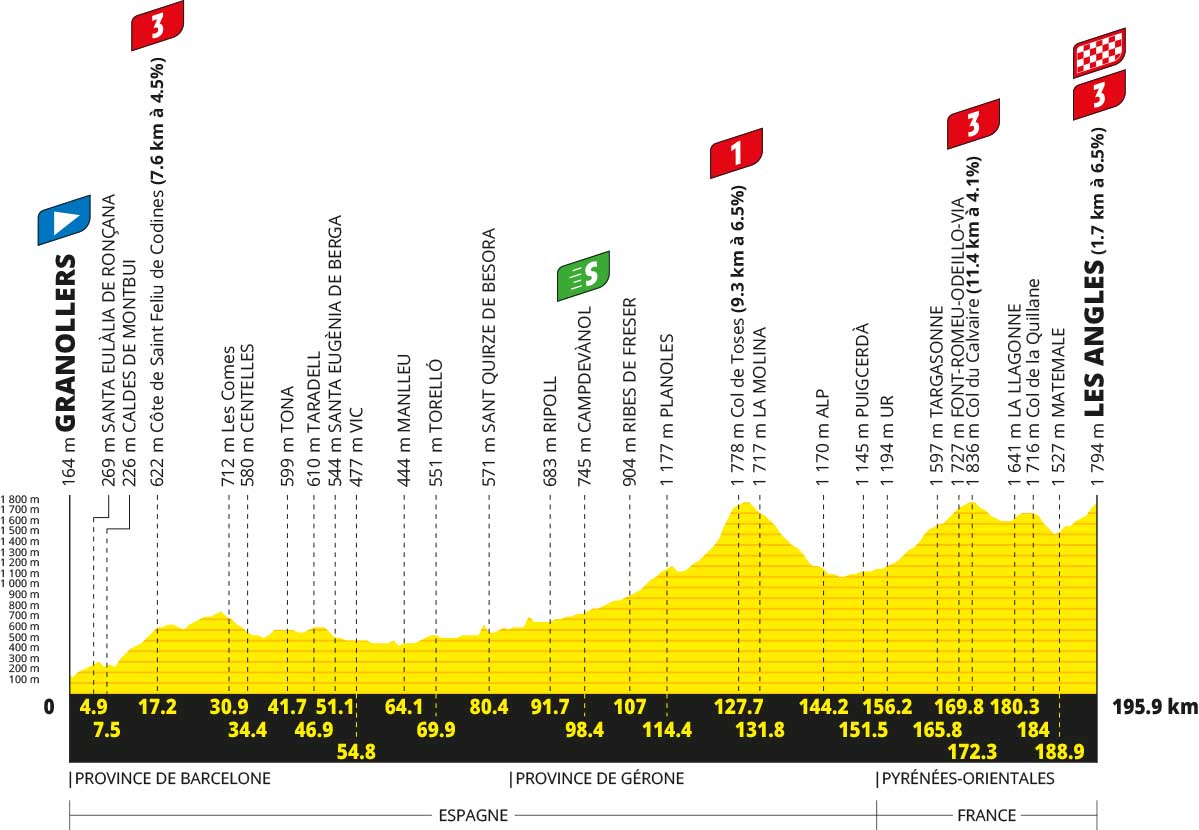
There are 10 new host towns and cities on this year’s route, and two of them come today in Granollers and Les Angles. The riders climb gradually from the flagdrop out of the former, up to the category-three Côte de Saint Feliu de Codines (7.6km at 4.5%). If the break is trying to escape on its slopes, it will make for a hard start to the stage.
Fortunately, there’s time to recover before the intermediate sprint and the race’s first category-one test: the Col de Toses – billed as a 9.3km slog, but the climbing starts well before – that acts as Spain’s parting gift before the border crossing.
Today’s finish in Les Angles swoops around the Lac de Matemale, but it’s the final ramp to the line the riders will be eyeing: don’t be fooled by the meagre 1.7km at 6.5% – it’s a category three climb and will open up time gaps in the peloton.
Route highlights
Les Angles may not have featured at the Tour before, but it was the site of a Michael Woods stage win at the Route d’Occitanie in 2022. The commune has a population of only 600 people – just over three Tour de France pelotons.
What to expect
This is a prime stage for the breakaway, depending on who is in yellow. If it’s a contender, they might not want their team to burn into their reserves to defend it, meaning a break could present one lucky rider with the chance of a stint in the yellow jersey. Back in the bunch, GC contenders will have to be alert over the final climbs, as no one wants to lose time this early in the race
Stage 4: Carcassonne > Foix
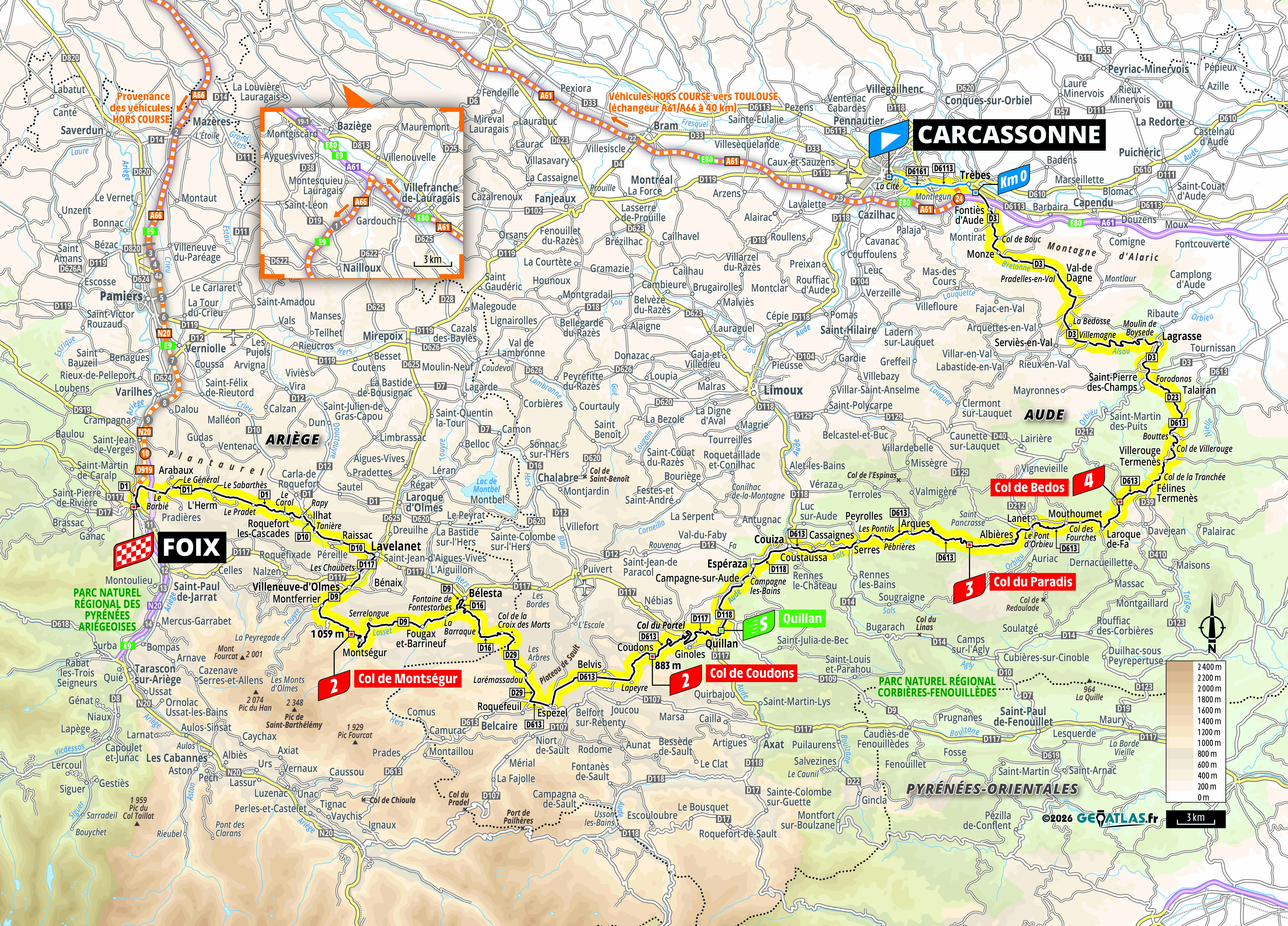
Tuesday 7 July
181.9km
Elevation gain: 2,700m
Start 11:25 Finish 15:34 (CET)
Hilly
After stage three’s amuse-bouche of mountains, it’s time to take a step back for a rolling stage in the foothills of the Pyrenees. This is one of those days where the breakaway will have to fend off the more confident sprint trains, and maybe even a GC contender looking to nab a few valuable seconds.
Today’s route
Carcassone’s medieval citadel has a long history of welcoming the Tour de France; even so, a noisy minority kicked up a stink in 2018 when the city’s UNESCO-listed walls were painted with concentric yellow circles to mark the arrival of a stage. This time, Carcassonne turns to start line duties, on an undulating day across Occitania.
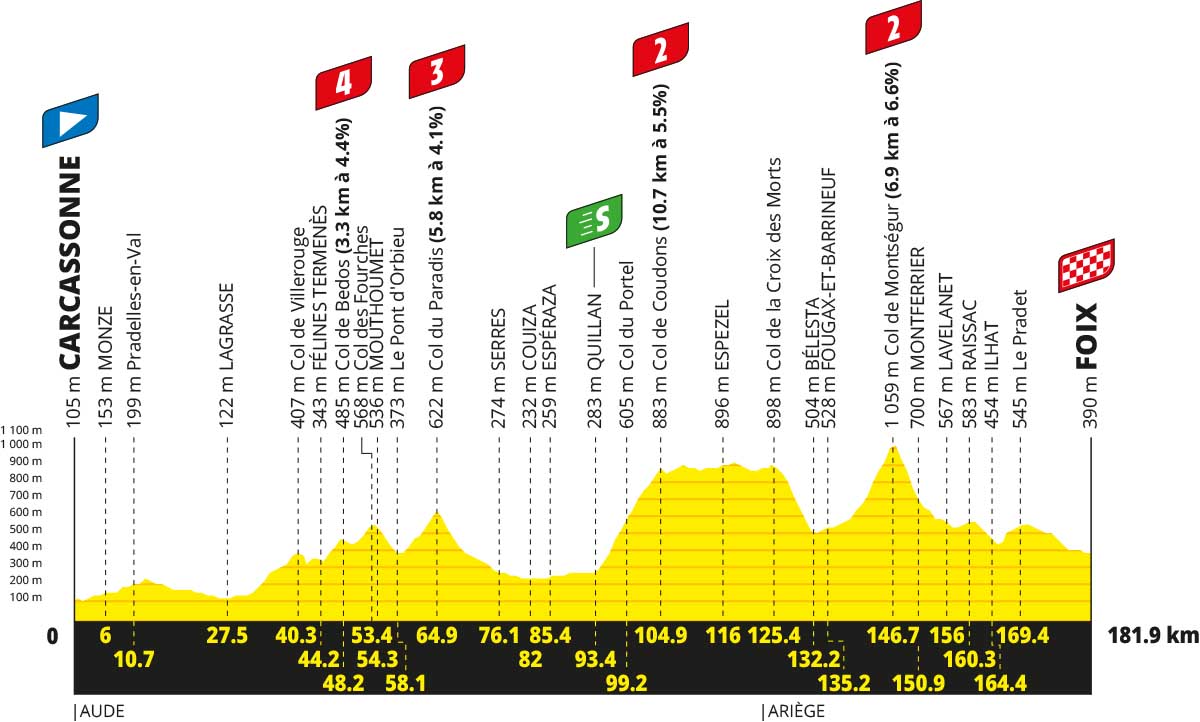
Four categorised climbs are spread evenly throughout the route, starting with the easiest of the lot, the fourth-category Col de Bedos. The hills keep coming thereafter, first a third-category, then two second-categories, before a descent to the line in Foix.
Route highlights
Much like Carcassone, the finish town of Foix dates back to medieval times, with a château fortress to rival its southern neighbour. Hugo Houle took an emotional victory the last time the Tour ended here in 2022, dedicating it to his brother who died 10 years earlier.
What to expect
This is set to be a tense battle between the breakaway and the sprinters. Any early escapees are likely to be kept on a tight leash by the sprint teams who will be hoping to get their fastmen over the final climb – summit at 35km to go – still in contention. If they do, the race will have its first bunch shoot-out in Foix. Any team that doesn’t want a sprint will have to ensure the stage is hard enough to take the sting out of the legs of the pure sprinters.
Stage 5: Lannemezan > Pau
Wednesday 8 July
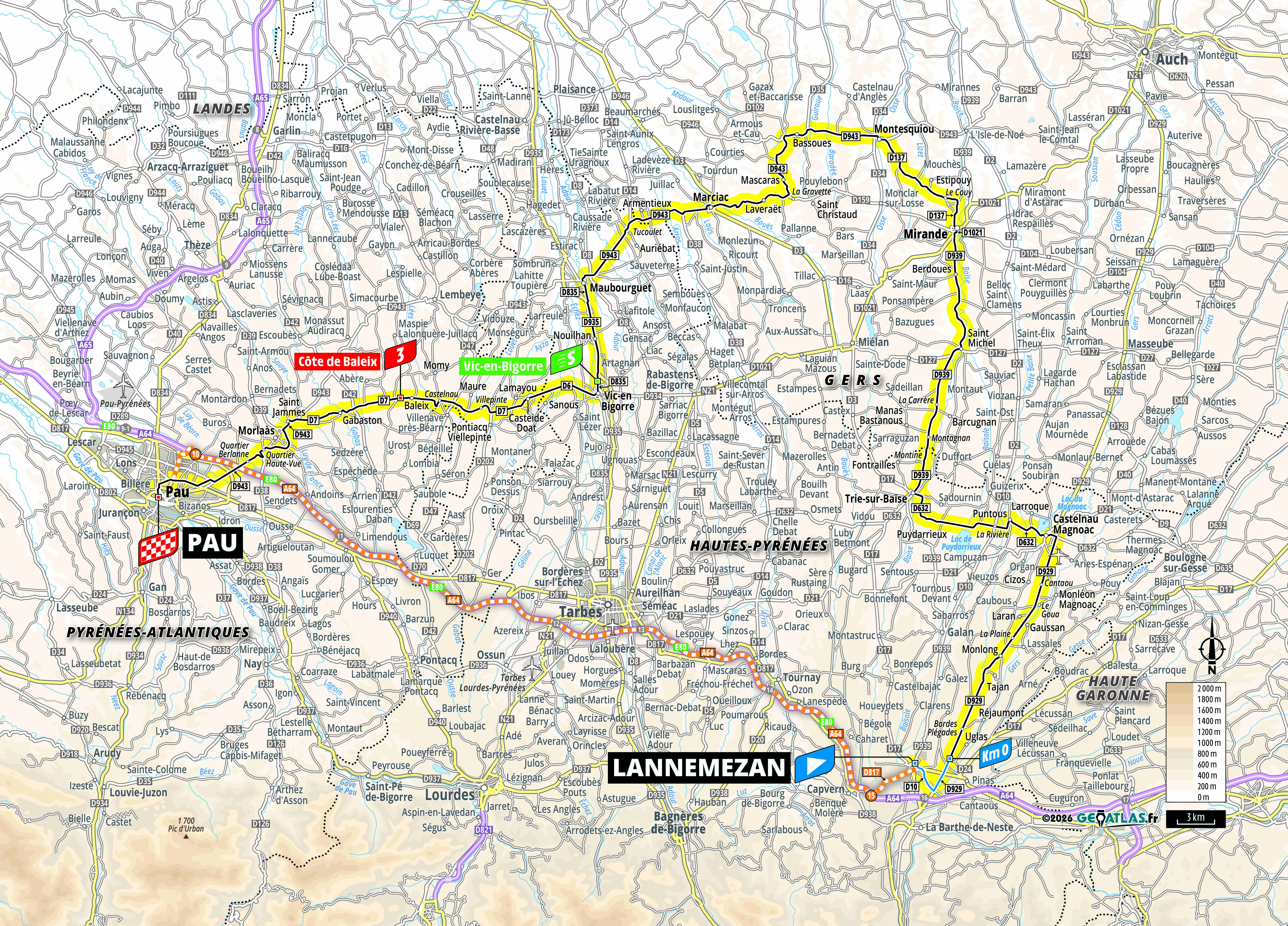
158.3km
Elevation gain: 1,600m
Start 12:15 Finish 15:46 (CET)
Flat
Following four days of hilly, and sometimes mountainous, action, the fast men will finally get their chance on the fifth day of the race, which could be the latest a bunch sprint has featured in the race for decades.
Today’s route
Carefully avoiding the foothills of the Pyrenees proper, this is essentially a loop north through the départments of Hautes-Pyrénées, Gers, and Pyrénées-Atlantiques. The day starts in Lannemezan, the fifth time that the race has begun here, the hometown of French rugby star Antoine Dupont.
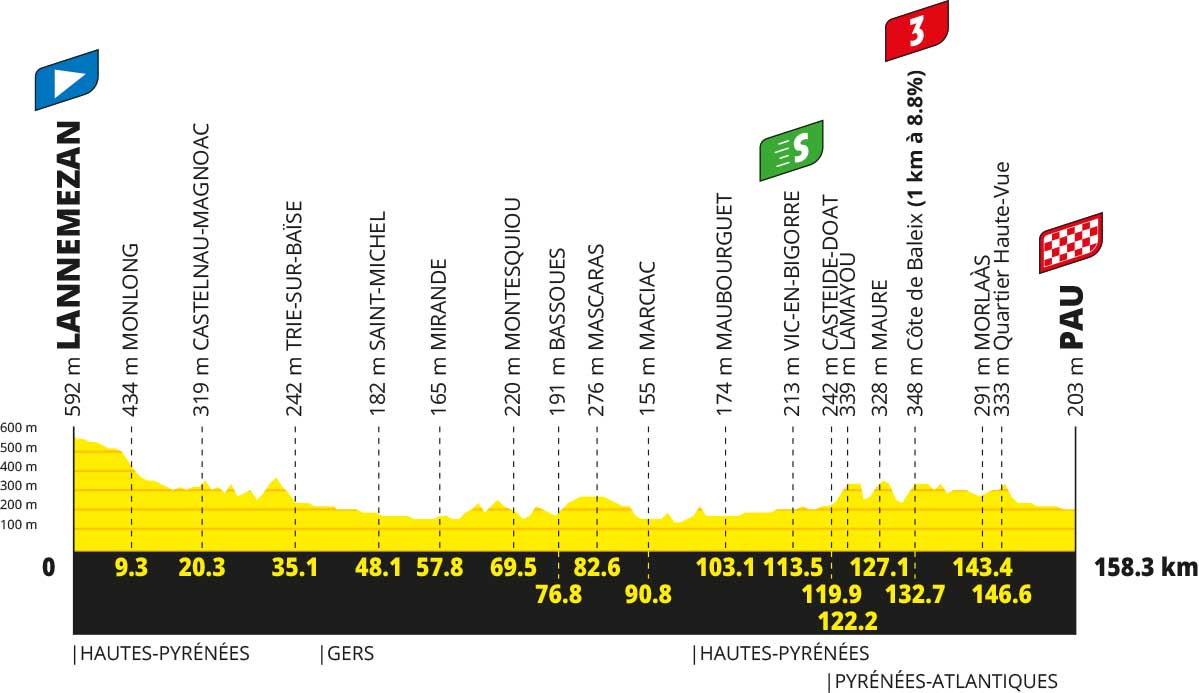
There follows a largely flat day, with just one categorised climb coming 132.7km into the route. It's a category-three effort, the Côte de Baleix (1km at 8.8%), which might sound tough to us, but should be easily dealt with, with 26km remaining once they're over the top. Still, if a rider is caught out here, they might struggle to make it back to the bunch.
Route highlights
Pau features pretty much every year in the Tour; in fact it has featured on the route 132 times, and hosted a finish 64 times. It is known for its view of the Pyrenees, which is majestic, and as the historical capital of Béarn, not that the peloton will have much time to think about that.
What to expect
As the first proper chance for the sprinters, and particularly if they have been foiled the day before, expect the interested teams to lock this stage down. It’s the kind of day where a breakaway of a few riders from smaller squads will be given a very short leash, before they are reeled in to make way for the bunch sprint. The last time the Tour finished here Jasper Philipsen won, and he will be a hot favourite again.
Stage 6: Pau > Gavarnie-Gèdre
Tour history
A lot has gone on the Tourmalet and the Aspin over the years, given their almost ubiquitous presence at the French Grand Tour – one is rarely used without the other, given that they are part of the same chain of mountains. When the Tourmalet was first featured, in 1910, it was Octave Lapize of France who went over the famed mountain first, and he went onto win his only Tour title that year. Three years later, it was the scene of legend, when Eugène Christophe broke his forks on the descent of the climb, and was forced to repair his own bike at a blacksmiths. Penalised for having a seven-year-old pump the bellows at the forge, he eventually finished seventh.
Perhaps surprisingly, as it has featured so many times, only thrice has the race finished atop it. In 1974, Jean-Pierre Danguillaume won, as Eddy Merckx was on his way to his fifth and final yellow jersey. Danguillaume backed up the feat the next day, on a mountainous day which finished in Pau. It took 36 years for the Tourmalet to host a finish again, in 2010, when Andy Schleck was victorious, ahead of Alberto Contador, who would go onto win the whole Tour, although that result was later stripped from him. In 2019, a Frenchman finally won atop the Tourmalet again, this time Thibaut Pinot, as Julian Alaphilippe clung onto yellow.
The Aspin has never hosted a finish, although this is the 72nd time the race has been up there. In 1950, supporters assaulted stage winner Gino Bartali after accusing him of causing Frenchman Jean Robic to crash on the descent of the climb; this led to the Italian team to withdraw from the race.
Thursday 9 July
186.2km
Elevation gain:4,100m
Start 10:40 Finish 15:46 (CET)
Mountains
For the fourth year in a row, a big day in the Pyrenees begins in Pau, a useful base in the south for the Tour de France. The finish, though, is a novelty, the first time the race has ever climbed to Gavarnie-Gèdre. Stage six also features the first hors-category climb, so it is an unmissable watch. This is the last we’ll see of the Pyrenees in this year’s race.
Today’s route
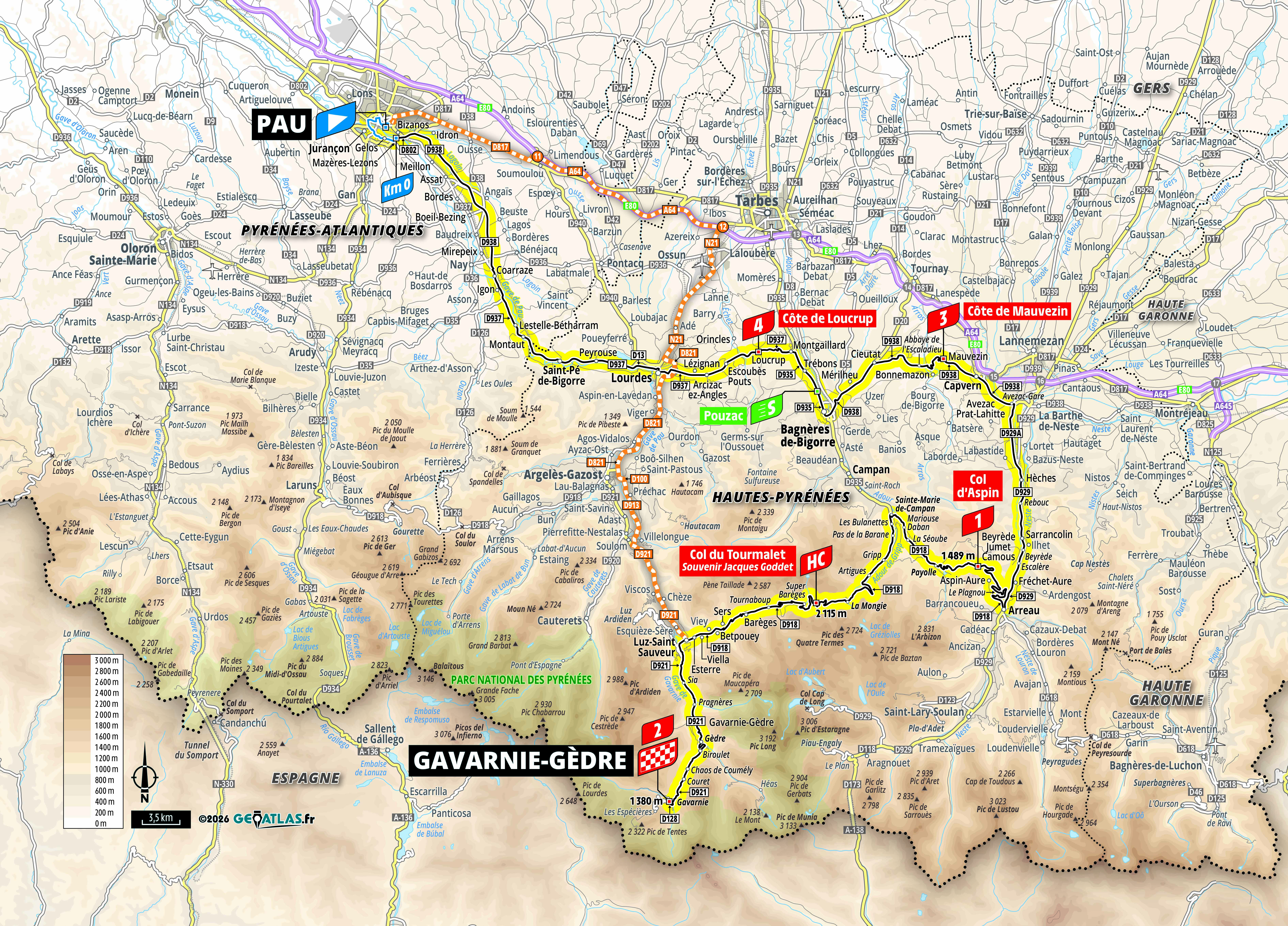
Having taken a breather on Wednesday, this is another early day for the GC men. Heading south-west out of Pau, the route passes through the holy town of Lourdes before the first climb of the day, the fourth-category Côte de Loucrup (1.9km at 7.1%), but that is just the starter.
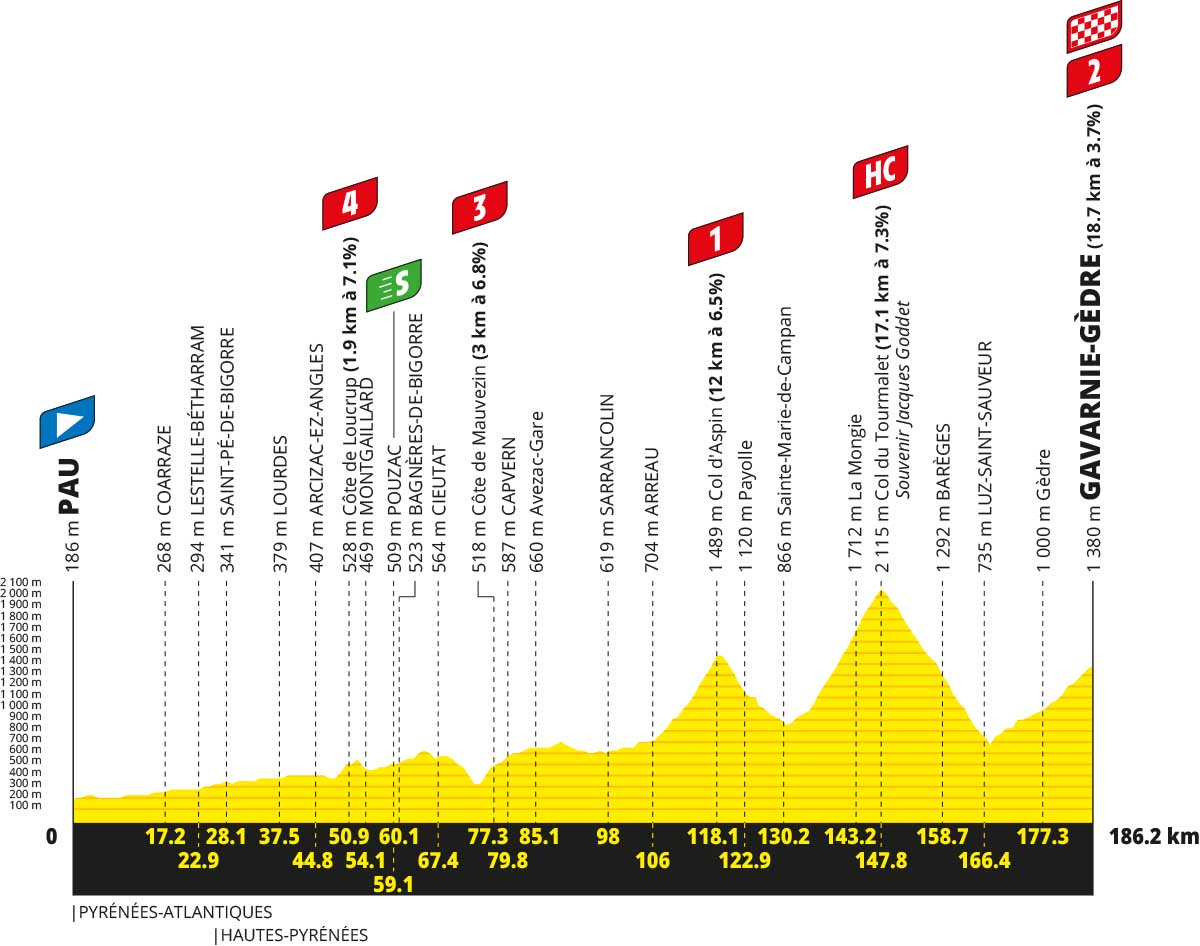
The day’s intermediate sprint follows at Pouzac, before the next climb, the Côte de Mauvezin (3km at 6.8%). The road then properly begins to rise, with the Col d’Aspin (12km at 6.5%) a first-category test, before the peloton tackle one of the most famous of Tour climbs, the Col du Tourmalet (17.1km at 7.3%), billed as the hardest ascent of this Tour to date. The day doesn’t finish on a summit finish proper, with the climb to Gavarnie-Gèdre a category-two climb, 18.7km at 3.7%.
The finish will show off the Cirque de Gavarnie, a cirque being an amphitheatre-like valley carved by glacial erosion. Apparently, Victor Hugo described it as the “Colosseum of nature”, and is part of the UNESCO World Heritage site that covers the Pyrenees. The village of Gavarnie itself is home to the Notre-Dame du Bon-Port Church, which is on the Camino, and claims to host skulls of members of the Knights Templar who died on the pilgrimage.
Route highlights
The Tourmalet doesn’t feature every year, but almost always; this will be its 89th inclusion in the race, the most of any climb at the Tour. It was first featured in 1910, and since 2001, the first rider over the top has won the Souvenir Jacques Goddet, named after the second director of the race, which comes with a cash prize of €5,000. The last four times the Tour has ridden over the Tourmalet, Tadej Pogačar has taken time on Jonas Vingegaard, and has won three of those stages. The Col d’Aspin, incidentally, is the third-most visited climb at the Tour, behind the Tourmalet and the Galibier. This is the big hitter day.
What to expect
Those expecting general classification fireworks may have their dreams spoiled by the final climb to Gavarnie. It is a long climb, 18.7km in fact, but at only 3.7%, it’s shallow enough for domestiques to set the pace and nullify attacks. However, coming after the Aspin and the Tourmalet, legs could well be softened up. If a rider was already looking out of sorts on stage three, then it will be even more evident on the first hors-category climb of the year. Don’t be surprised to see a couple of puncheurs survive to the finish here, but you can also see it coming down to an odd bunch sprint of climbers.
Stage 7: Hagetmau > Bordeaux
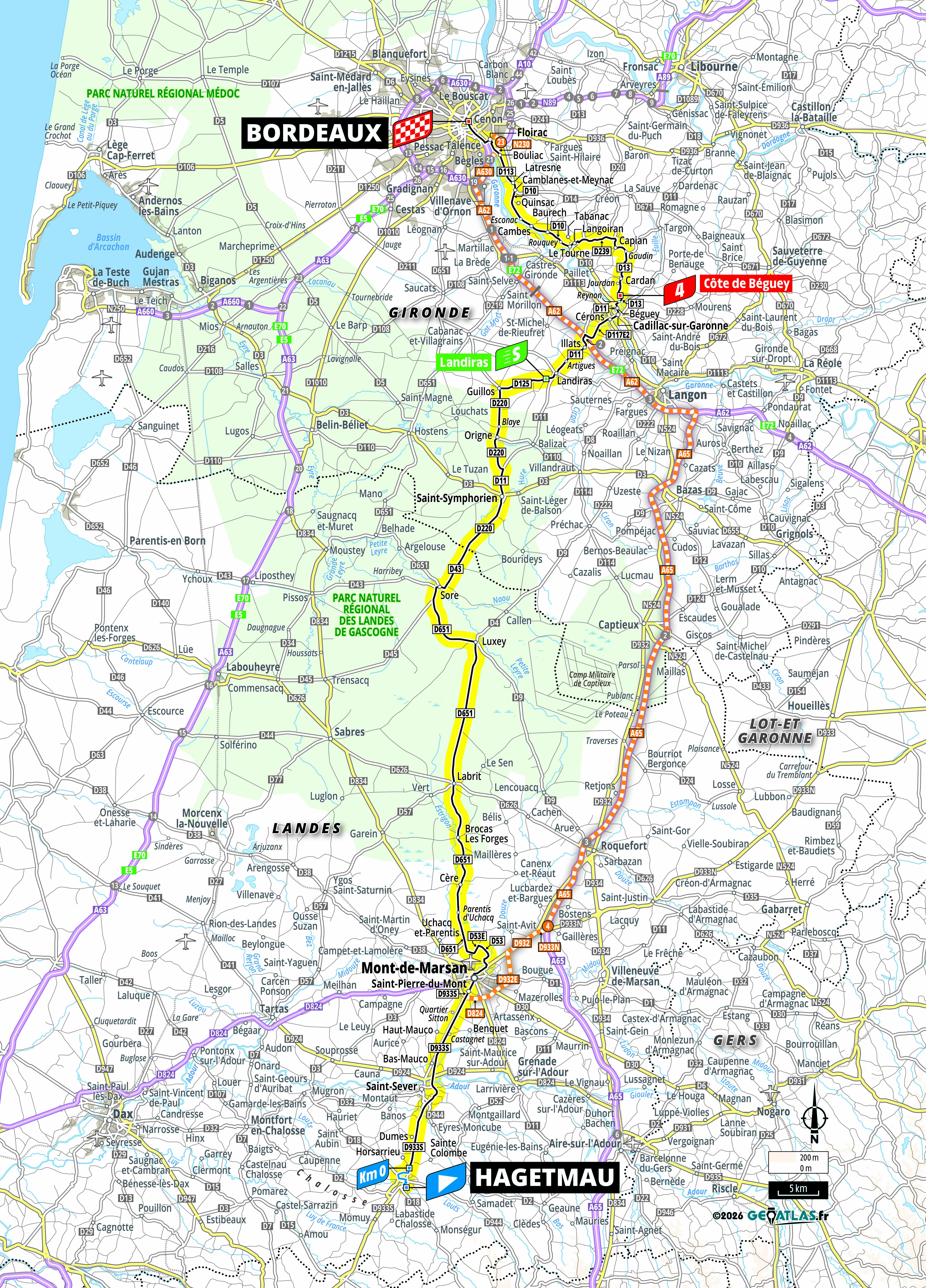
Friday 10 July
175.1km
Elevation gain: 850m
Start 11:25 Finish 15:24 (CET)
Flat
From the cliched shark’s tooth profile of yesterday to a pan flat profile today, the Pyrenees are in the rear-view mirror, and the race strikes north into Nouvelle Aquitaine, across the plains of south-western France. It is always a sprint in Bordeaux.
Today’s route
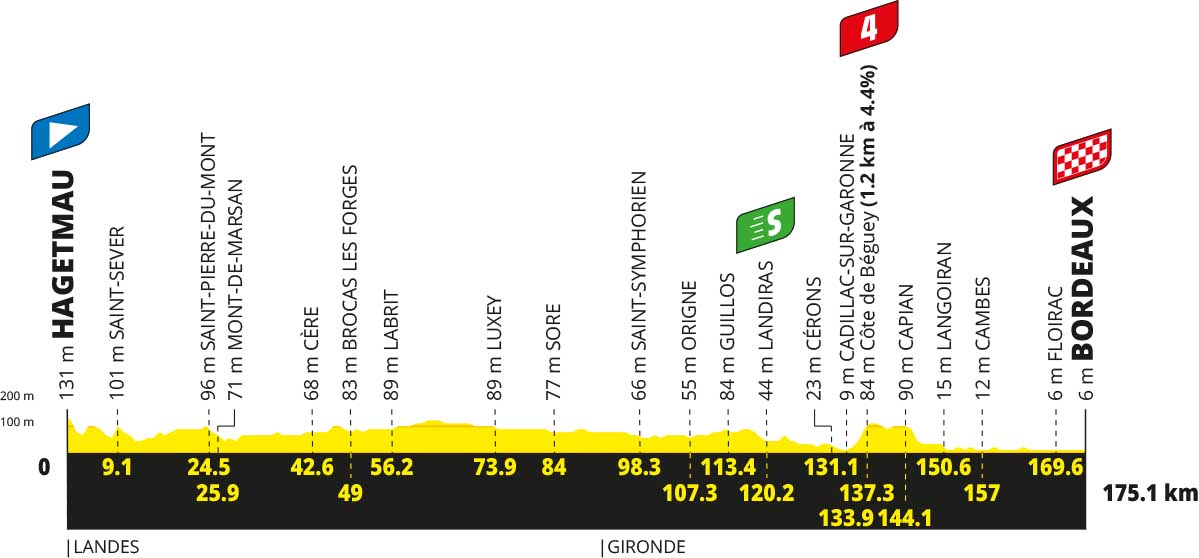
Stage seven traverses almost the entirety of the Landes department before entering Gironde. Hagetmau a town of just 4,000 inhabitants, hosts a stage start for the first time: it clearly has a cycling-obsessed mayor. There is just one categorised climb in the 175km, the Côte de Béguey, 1.2km at 4.4%, a cat-four which follows the day’s intermediate sprint in Landiras,
Route highlights
Bordeaux has hosted the most Tour finishes outside of Paris, which have all been bunch sprints. But the Tour didn’t visit between 2011 and 2023. Jasper Philipsen won on it’s return, centimetres ahead of Mark Cavendish, as he chased Eddy Merckx’s stage win record. This year’s finish line is almost right outside Le Frog and Rosbif; so what chance a British win?
What to expect
What will shape today’s stage is the formation of the break. If one or two riders slip away early it’s a sign the bunch want a rest after the mountains. But if lots of teams want to make it into the break it could be a fast and furious opening 40-50kms followed by a hard chase at the end of the stage.
The finish is almost exactly the same as in 2023, along the quays of the Garonne river, and about as untechnical as it’s possible to get, with the last corner coming with just under 4km to go as they cross the Pont Simone Veil. Expect a fast and furious leadout and 70kph-plus sprint.
Stage 8: Périgueux > Bergerac
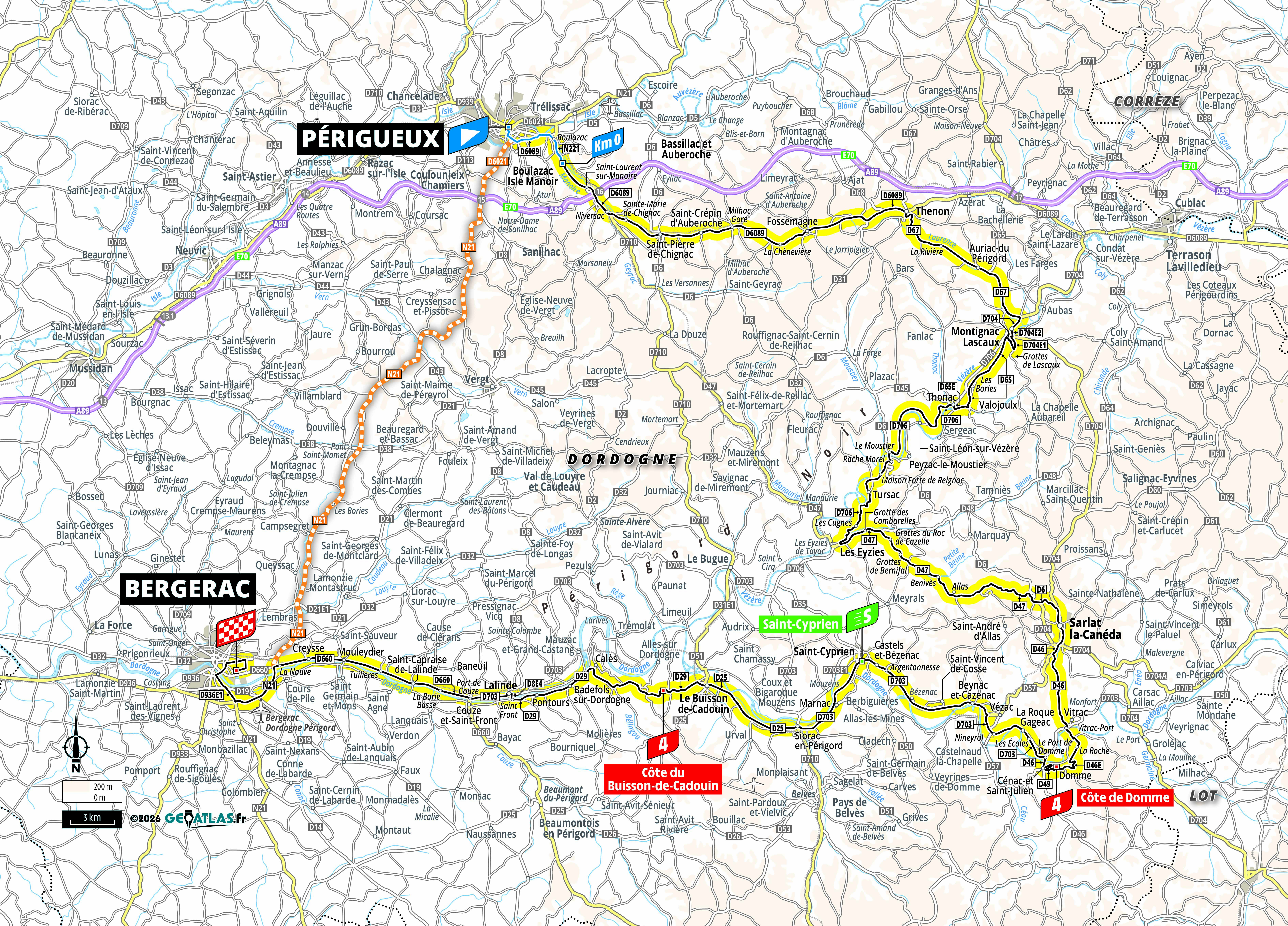
Saturday 11 July
180.4km
Elevation gain: 1,150m
Start 12:25 Finish 16:31 (BST)
Flat
The second flat day in a row, this time a loop around the Dordogne. With sprint opportunities at a premium in the second half of the race, sprint teams will be itching to make these days count.
Today’s route
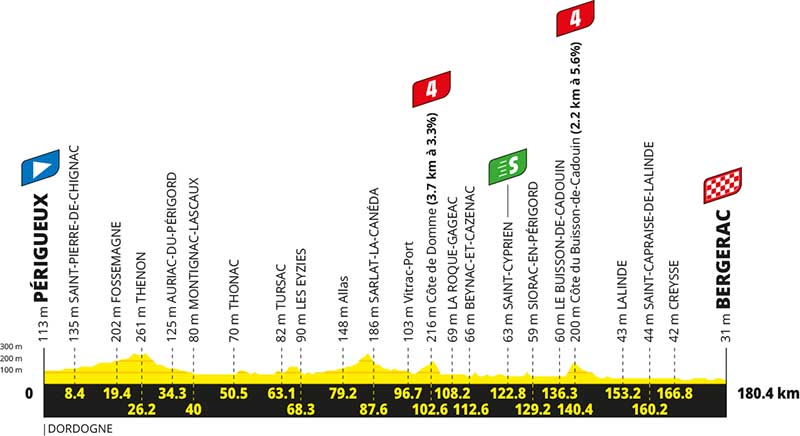
If you have a faint sense of déjà vu looking at the map for stage eight, it’s because the race followed almost exactly the same route for stage 10 of the 2017 Tour, won by Marcel Kittel. Right down to the categorised climbs and intermediate sprint. The route heads east out of Périgueux before looping south towards the Dordogne River. When it reaches the famous waterway the Côte de Domme is tackled (3.7km at 3.3%), and then the Côte de Buisson-de-Cadouin (2.2km at 5.6%). Between this the intermediate sprint is sandwiched, at Saint-Cyprien.
Route highlights
Bergerac is at the heart of tourism in the Dordogne, which is unsurprising given the town’s beauty, and its proximity to many vineyards. The region has 12 recognised AOCs for wine, including Bergerac and Montravel, so expect lots of helicopter shots of vines and mid-stage commentary on the area’s gastronomic fares.
What to expect
It’s the final sprinting opportunity of the first week, so teams like Alpecin-Premier Tech and NSN Cycling will be monitoring the break very closely. Especially if they haven’t won yet. Ideally, they’d want a small break of 1-4 riders that they can hold at a short time gap and then reel in without too much effort toward the end. There are four sharp corners within the final 4,000m, including one right-hander with 500m to go. The 5km-rule will be in place today so GC riders can sit up well before the sprint proper starts.
Stage 9: Malemort > Ussel
Sunday 12 July
185.5km
Elevation gain: 3,300m
Start 12:35 Finish 16:58 (BST)
Hilly
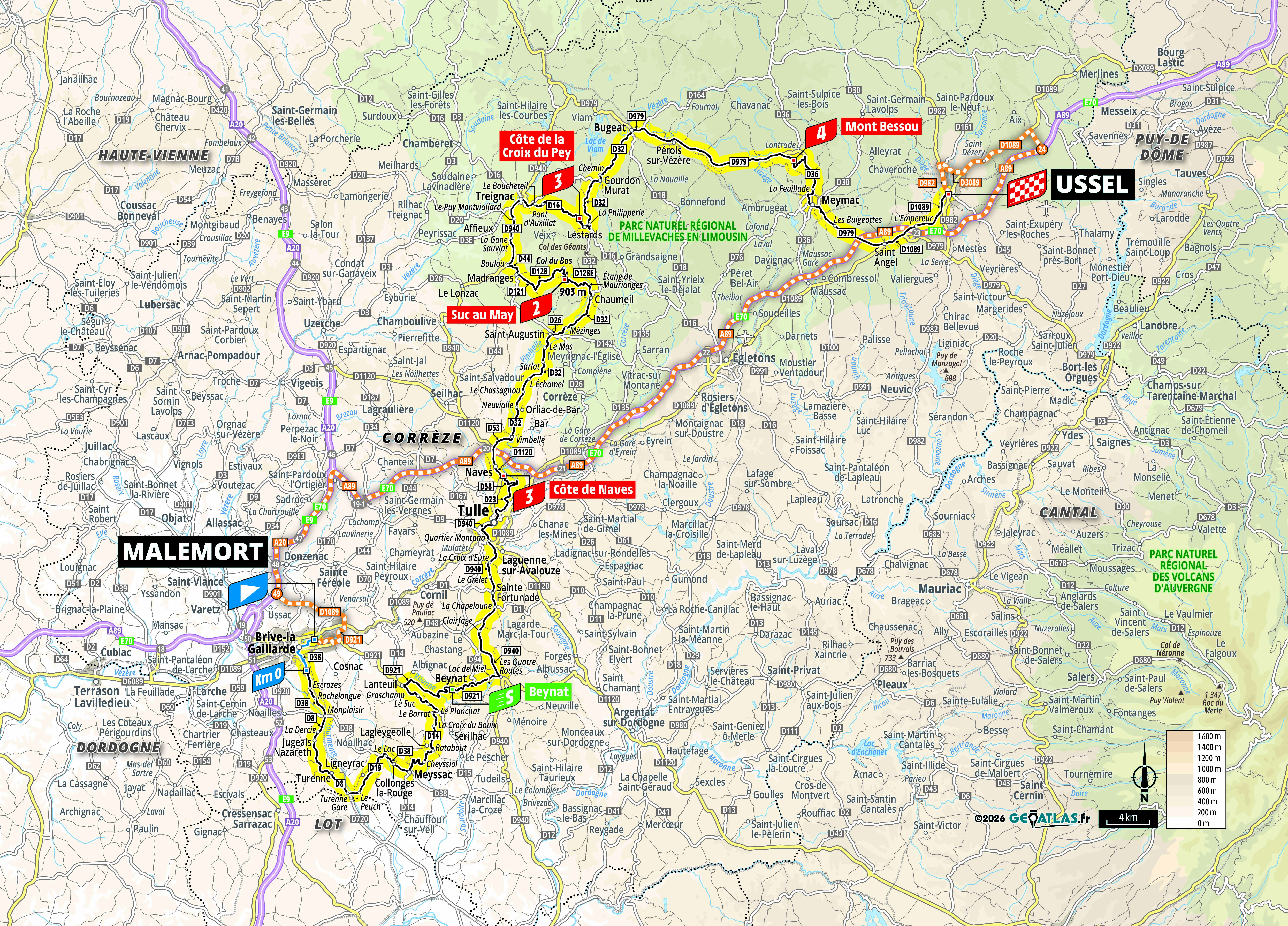
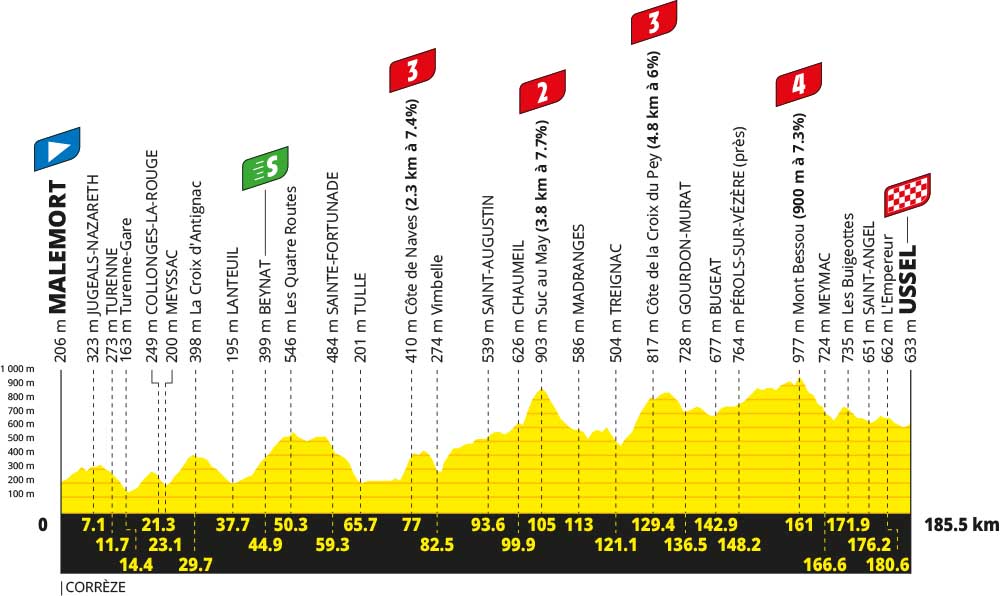
The Tour de France’s next mountain range moves into view for the final stage of the opening week, wholly in the Massif Central. There are four categorised climbs but it’s up and down all day on a stage ASO classify only as ‘hilly’.
Today's route
There’s plenty of geographical eyecandy for fans to feast on during this scenic stage, as the peloton races across the undulations and verdant plateaus of the volcano-sculpted uplands of south-central France, speeding along rural roads framed by forests of oak and chestnut. The landscape is lumpy from the outset, but the climb up Côte de Naves after 70km (7.4% for 2.3km) is a warning of what lies ahead. The elevation really ramps up after the race rolls through Saint-Augustin, midway through the day, as the course careers towards the 977m-high Mont Bessou (900m at 7.3%), the highpoint of the stage.
Route highlights
The 3.8km climb over the shoulder of Suc au May (7.7% for 3.8km) and the roads before it look to be the toughest section of the stage, and will likely see the break shed some weaker riders. After that they will have to contend with the long climb up Côte de la Croix du Pen (6% for 4.8km). The far-from-flat final 25km run-in to the finish line in Ussel promises drama in the break and peloton.
What to expect
A succession of punchy hills on roads that for the most part aren’t as wide, straight and smooth as those in the high mountains, can make for a harder day than the basic stats suggest. Today’s parcours, and the question mark over whose job it is to control the race, will tempt many riders out for the breakaway.
Stage 10: Aurillac > Le Lioran
Tuesday 14 July
166.6km
Elevation gain: 3,900m
Start 11:10 Finish 15:10 (CET)
Mountains
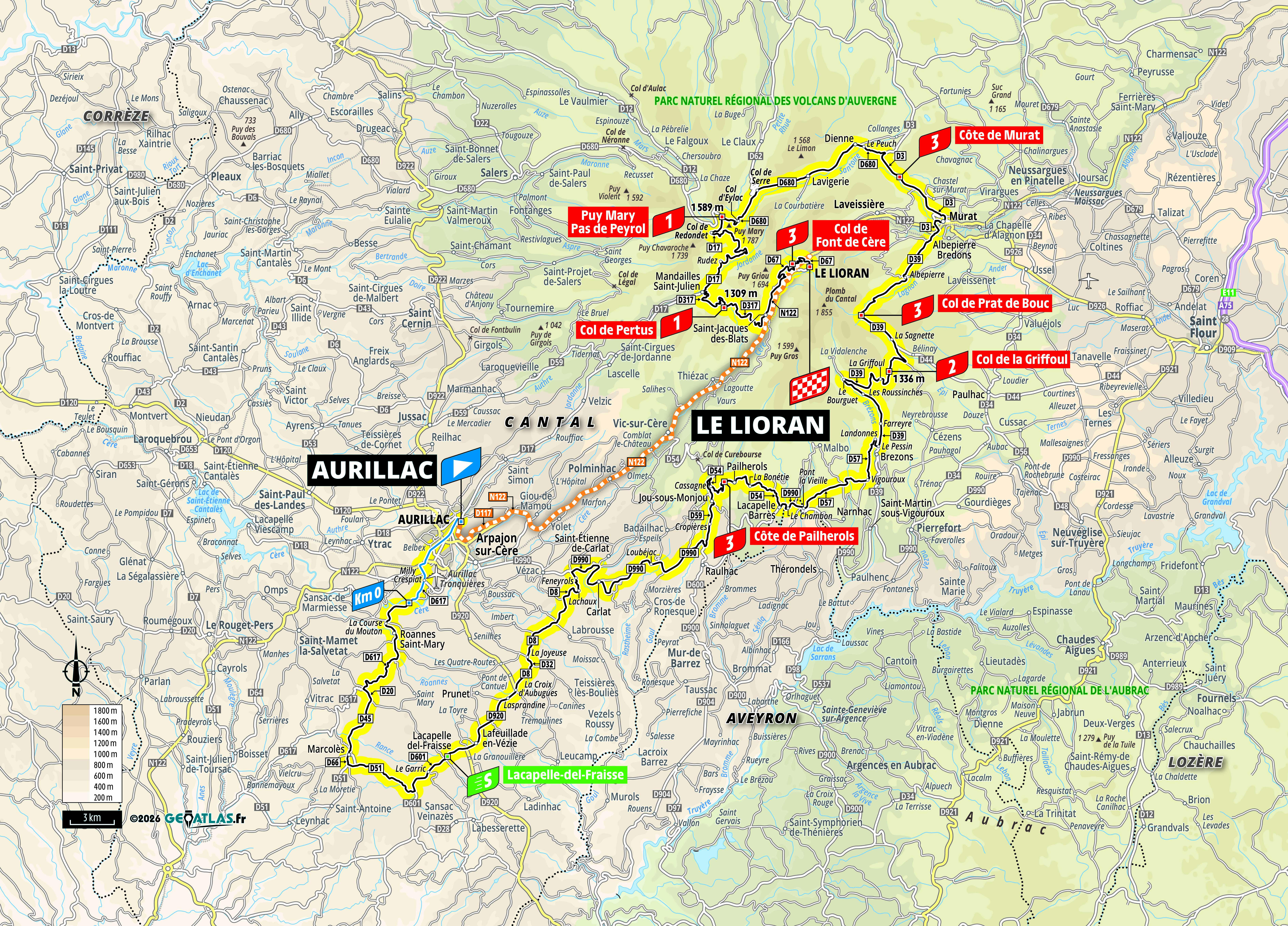
The peloton will storm into the Cantal on Bastille Day, riding through the peaks of the Massif Central on a tough route that features multiple categorised climbs and an uphill finish. This feels similar to the epic day last year when Ben Healy claimed yellow, also on 14 July. Vive la France!
Today's route
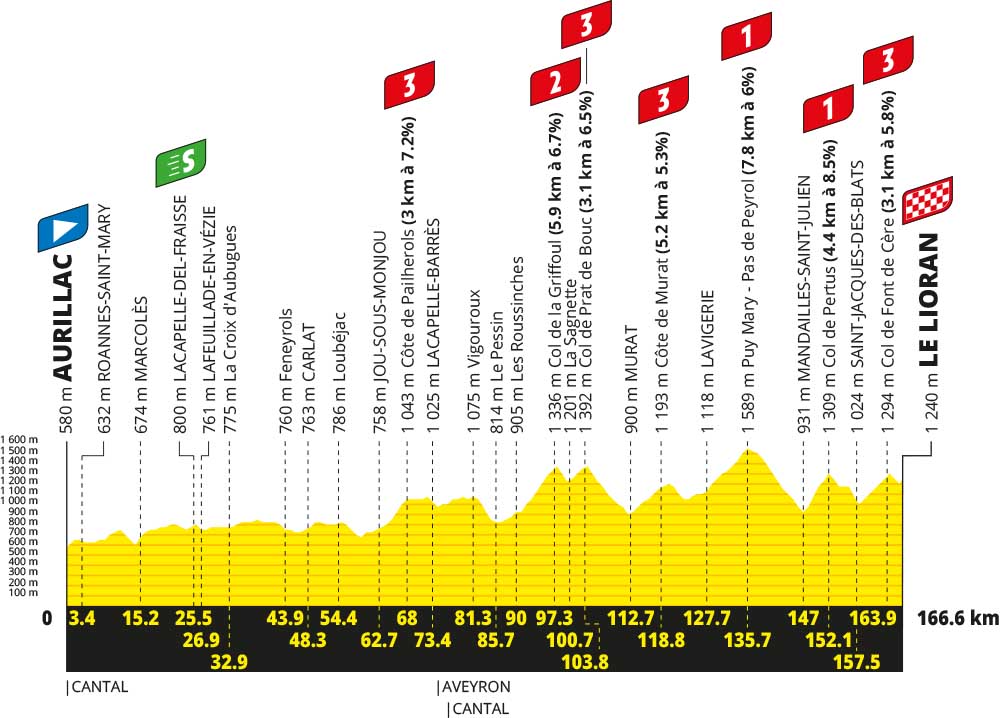
Riders gain almost 4,000 metres today, but the first real climb only rears up after 65km, in the shape of cat-three Côte de Pailherols (3km at 7.2%). Much stiffer challenges await in the second half, as Col de la Griffoul (6.7%, for 5.9km), Col de Prat de Bouc (5.8% for 3.2km) and Côte de Murat (4.4% for 6.6km) set the stage for the long haul up the Massif Central’s highest road pass, the 1,589m-high Puy Mary-Pas de Peyrol (6% for 7.8km). After dropping 650 metres during the 12km descent into Mandailles-Saint-Julien, the peloton will pedal over cat-one Col de Pertus (8.5% for 4.4km) before contending with Col de Font de Cère (5.8% over 3.1km) in the final 14km.
Route highlights
The peloton powering through mountain passes and historic hill towns, along roads lined by Bastille Day-bolstered crowds and overlooked by medieval castles and châteaux, promises to be a true spectacle. But will the racing be defined by the climb of the pyramid-like peak of Puy Mary-Pas de Peyrol? It’s too far out to tempt the GC riders into action, but it will be key for the break.
What to expect
With seven categorised climbs, including two first-cat ascents in the closing 40km, this stage represents a rich hunting ground for point-seeking polka-dot jersey fanciers. It’s not enough for the category to be decided, but anyone interested in the KOM jersey needs to be attentive.
Stage 11: Vichy > Nevers
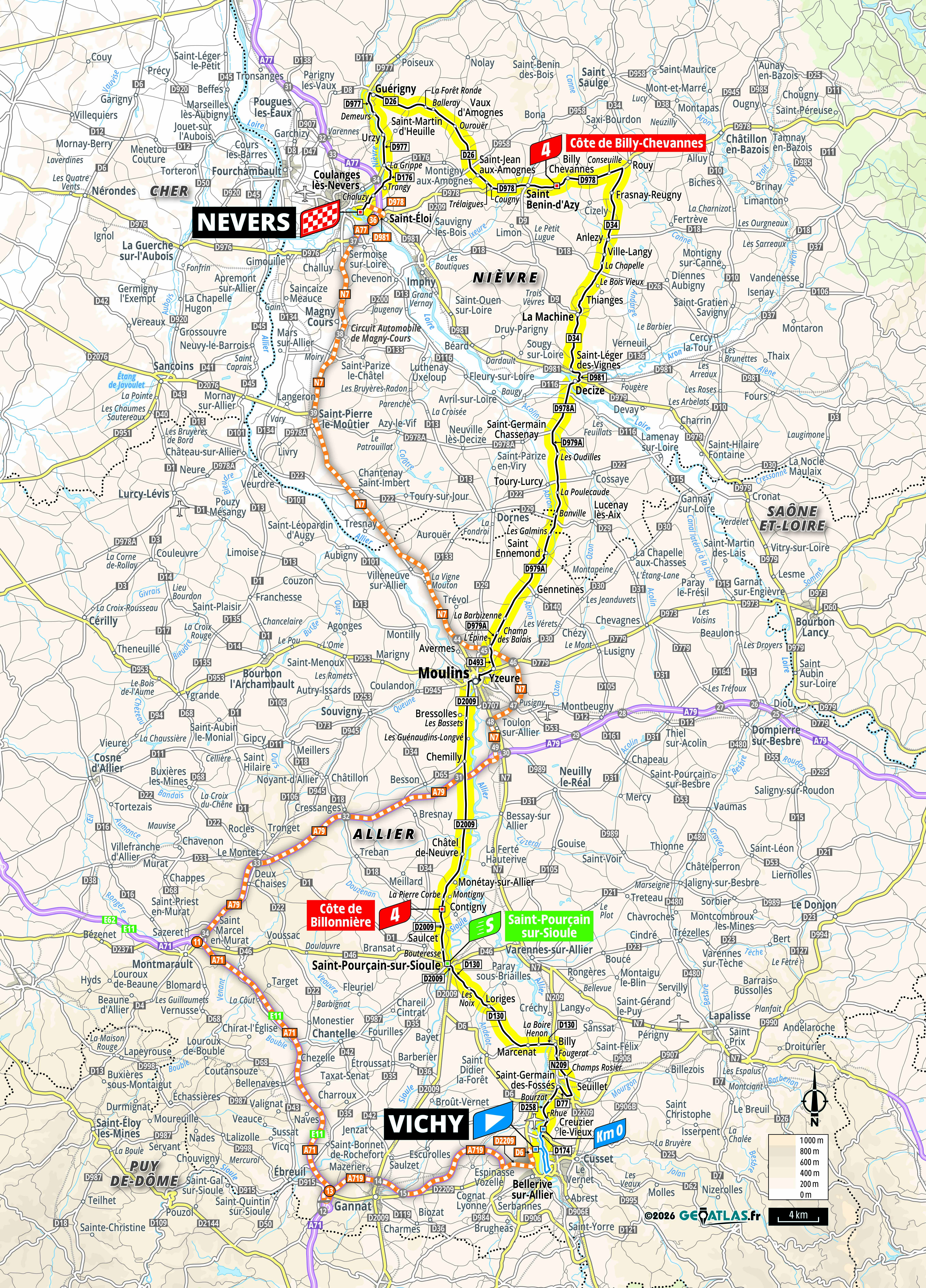
Wednesday 15 July
161km
Elevation gain: 653m
Start 11:05 Finish 14:40 (CET)
Flat
One of a brace of ‘easier’ days traversing central France mid-race. Today's stage has little in the way of climbing and barring something exceptional happening, should be one for the sprinters.
Today's route
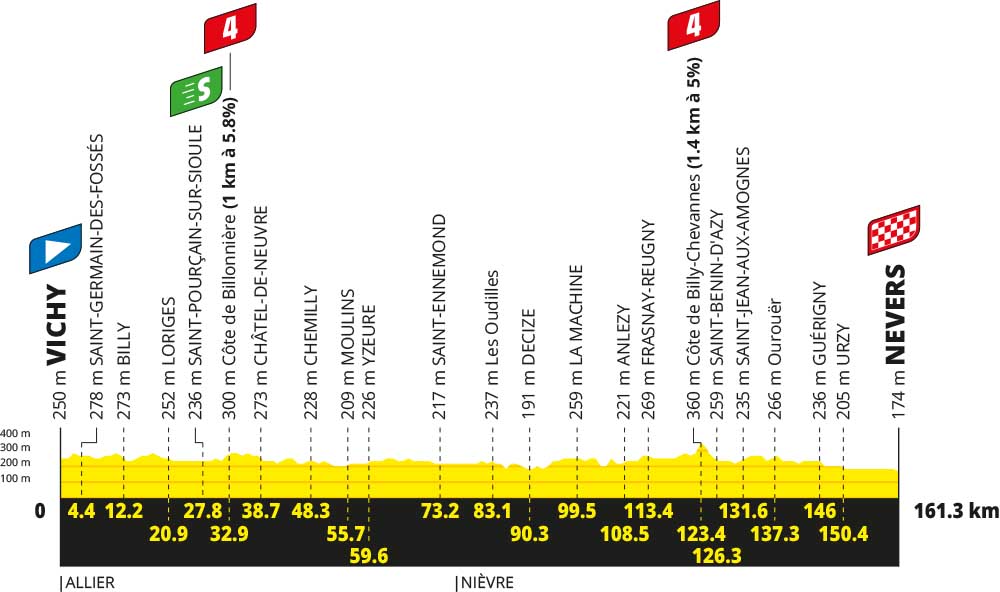
Today's outing takes the riders from historic Vichy to earthenware-obsessed Nevers, 161km north along the Alliers river. Organisers ASO have this billed as a shoo-in for the sprinters, and looking at the profile it's hard to disagree. There are two cat-four climbs that bookend the stage, although the peloton will barely register a change of gear on either of them and the latter is 38km from the finish.
Route highlights
As much as a category-four climb can be called a highlight, these are the most significant racing features on today's route, along with an intermediate sprint just 20km in. The Côte de Billonière comes around 30km into the stage, a mere kilometre long with a 5.8% average gradient. The Côte de Billy-Chevanne is the second of the two, located with 40km still to go. It's unlikely to prove enough to upset the sprinters' ambitions this far from the finish.
What to expect
As you have probably surmised already, this is a stage for the fast finishers. There will almost certainly be a breakaway, but they’ll be caught with plenty of time for the sprint to get organised. The run in is long, straight and on wide roads with the finale on the Rue Amiral Jacquinot almost perfectly straight but with two roundabouts in the final kilometre. Navigating these at speed will be key.
Stage 12: Circuit Nevers Magny Cours > Chalon sur Saône
Thursday 16 July
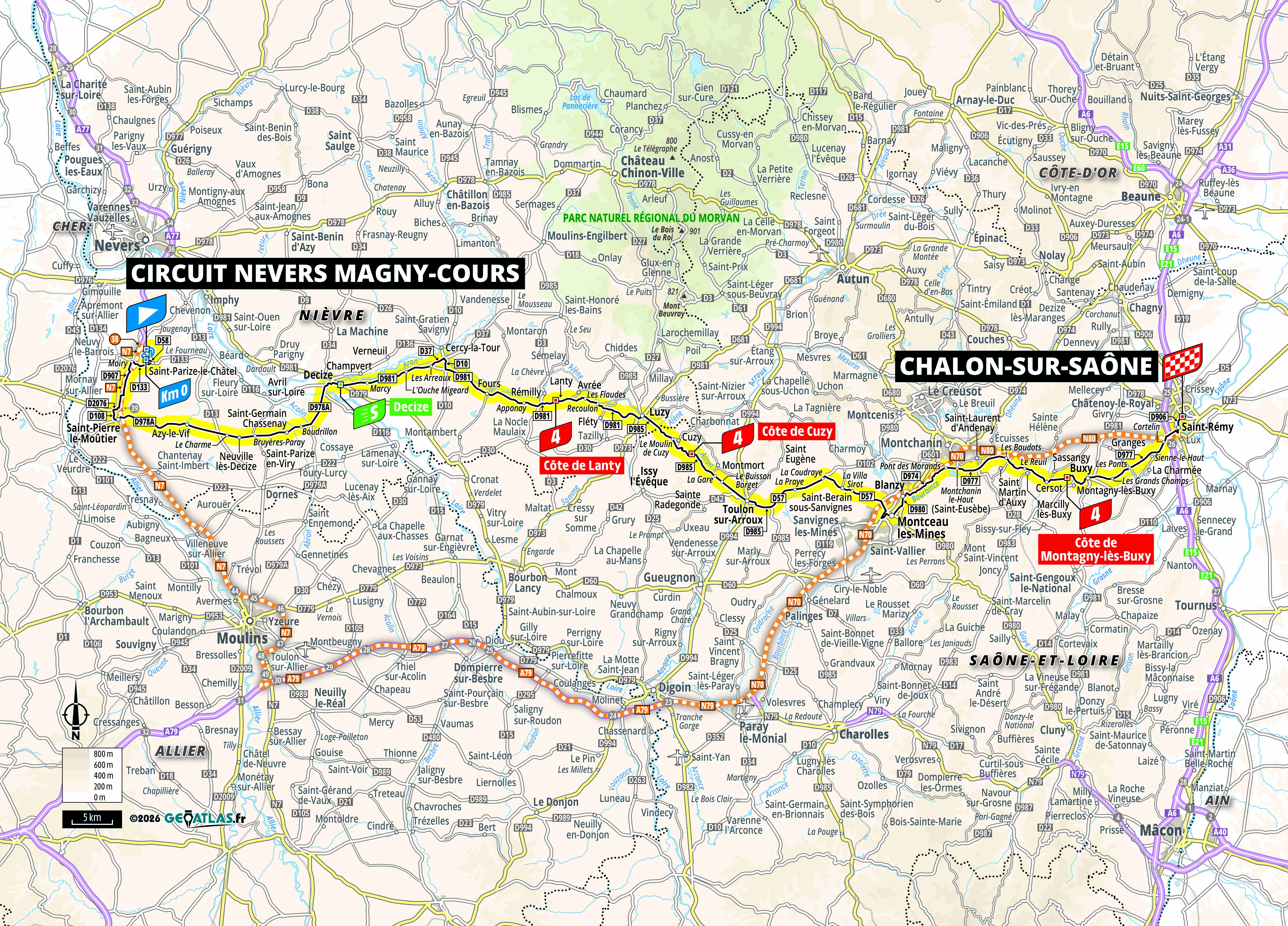
181km
Elevation gain: 1,555m
Start 11:40 Finish 15:39 (CET)
Flat
Taking the riders west to east and ever closer to their eventual date with the Alps, today's stage dials up the ante a notch or two from yesterday's near pan-flat parcours, and features a motor-racing themed start to proceedings.
Today's route
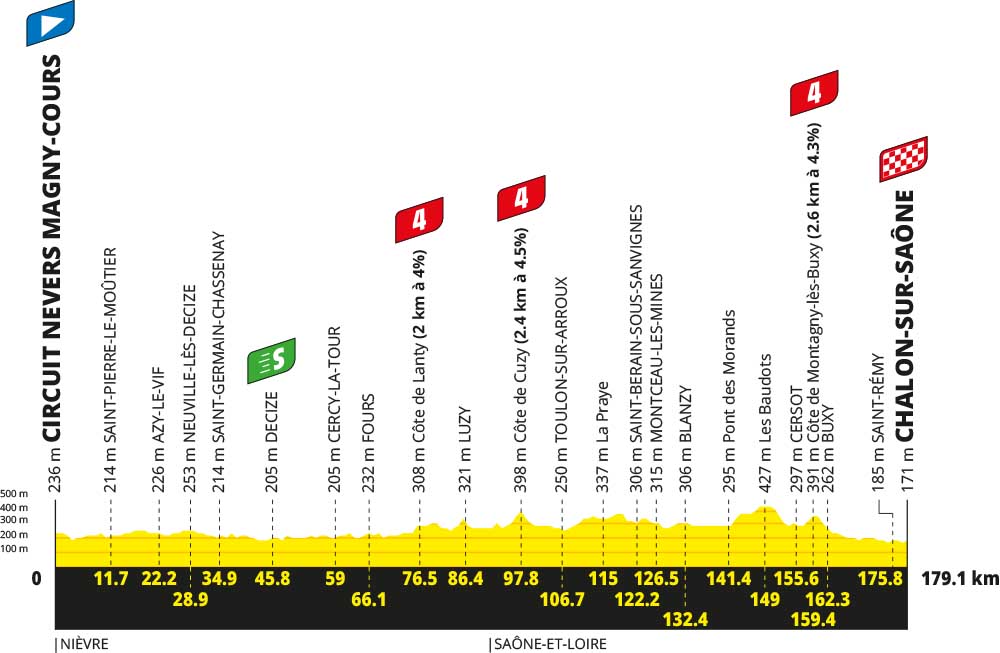
Spanning 181km across the centre of France, today's stage starts with a lap of the famous Magny-Cours motor racing circuit before delving into a route that gets a little lumpy from midway, with a pair of cat-fours halfway through, and then another with 15km to go. Neither are too difficult though, each around 2km long with gradients of somewhere between four and five percent.
The route crosses that of yesterday's stage and even follows it for a few kilometres in the lead-up to the intermediate sprint at 45km.
Route highlights
Any fans who pair their love of cycling with that of motorsports will enjoy the start of today's stage, as the riders rattle around the Magny Cours track just south of Nevers. There won't be any roaring of engines though, even metaphorical ones, as the track forms the neutralised zone – the real action begins once the riders leave the circuit.
What to expect
Were the hills a touch bigger, we might readily label today a breakaway stage, but these hills won’t break the sprinters out of their rhthym. They’ll be especially motivated to make the most of today as the next bunch sprint opportunity is not until stage 17, on the far side of some big mountains. Look out for the tight left turn with 2.9km to go. After that it’s a straight run into the line.
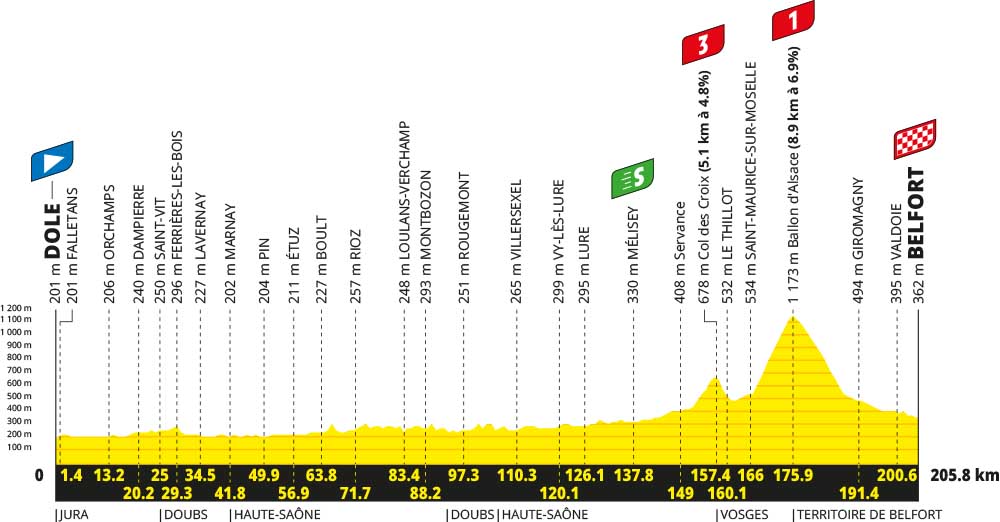
Stage 13: Dole > Belfort
Friday 17 July
205km
Elevation gain: 2,373m
Start 11:20 Finish 15:59 (CET)
Hilly
Today sees the race continue its diagnoal bisection of France, ending up in the Vosges mountain range. The official label for this is stage 'hilly', but make no mistake, it includes a bona fide mountain that the riders will crest 30 downhill kilometres from the finish.
Today's route
Following their exertions in the Massif Central on stage 10 the GC riders have enjoyed something of a truce for the past two days. That could well change today as the race enters its third mountain range – the Vosges in the far east. Much of the day is flat as it wends its way north-east to a destination with a brace of climbs – the cat-three Col des Croix and the cat-one Ballon d'Alsace. After cresting the latter, they plunge down towards the finish in the city of Belfort.
Route highlights
All eyes will be on the Ballon d'Alsace - the first mountain the Tour ever climbed back in 1905 - so called for its dome-like shape. At 8.9km / 6.9% and topping out at 1,173m, the riders will have tackled plenty of harder climbs already in this race. But it is still tough enough to play a major part in the result of the stage.
What to expect
There is likely to be two facets to this stage. Most obvious is the breakaway play, with the break refining itself over the two climbs, with perhaps two or three riders staying clear to contest the finish. Behind them, the GC riders could well test each other, and see if they can catch a rival napping. The potential to lose time and perhaps gain it is definitely there with the descent to finish likely to inspire a daredevil descender into action.
Stage 14: Mulhouse > Le Markstein Fellering
Tour history
The Vosges aren't the most glamorous of Tour mountains: that title goes to the Alps or the Pyrenees, with their legendary climbs like Alp d'Huez, or the Tourmalet. But it was the humble Ballon d'Alsace that was one of the first major ascents to appear in the race, all the way back in 1905. One of a few Ballon siblings, including the Grand Ballon and the Petit Ballon, it was introduced by Tour de France boss Henri Desgrange – always eager to punish 'his' riders with ever greater challenges and create publicity by doing so.
Desgrange talked up the inclusion of the Ballon, which appeared only a day into the race on stage two – a mammoth 299km haul from Nancy to Besançon. The belligerent Tour boss set the climb out as a challenge to riders – none would be able to ride all the way up it, he predicted.
But René Pottier did. In fact he beat Desgrange's entourage to the top to become one of the Tour's first celebrated climbers, and earn that monument at the Ballon's summit.
As was not uncommon in the very earliest days of the race – when cheating could mean taking the train and supporting your local rider could mean physically assaulting their rivals – the riders were dogged by outside issues. On the Ballon stage, punctures were rife due to nails having been strewn across the road.
Pottier was second that day, but had to retire after crashing on stage three
Saturday 18 July
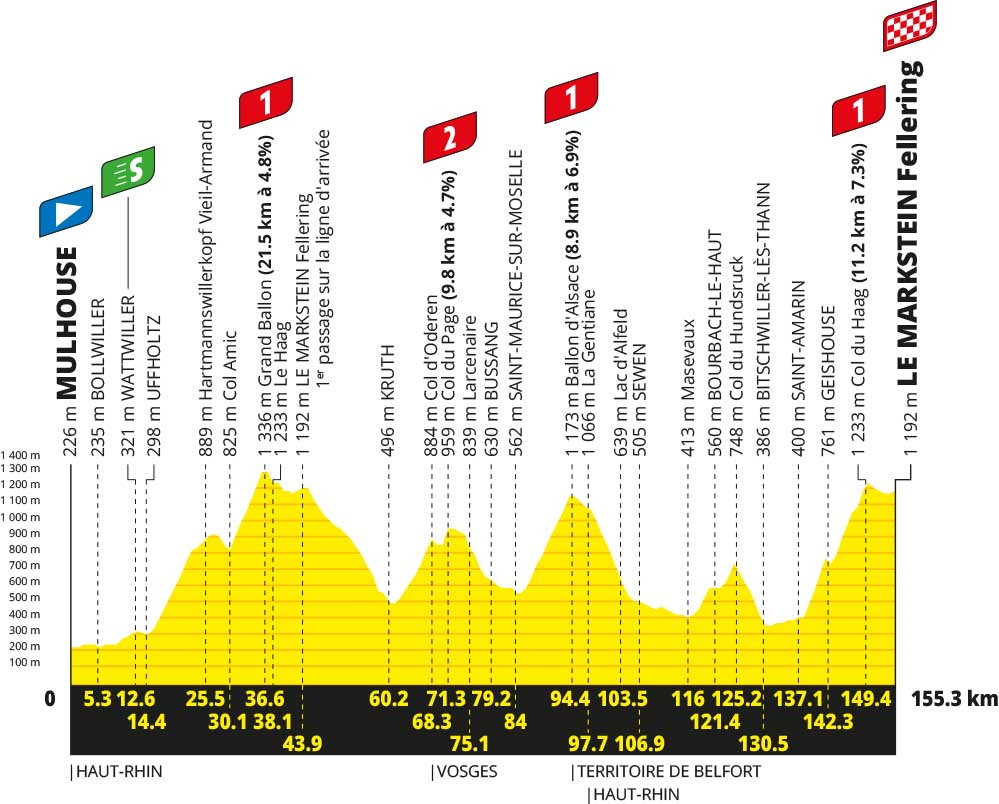
155.3km
Elevation gain: 4,602
Start 11:30 Finish 15:38 (CET)
Mountains
The Jura mountains, and most pressingly, the Alps are looming on the horizon, but the Tour de France's Vosges visit is far from a token flyby, as this stage demonstrates. It's a relatively brief but extremely potent parcours that features multiple big mountain climbs and Queen Stage levels of vertical ascent.
Today's route
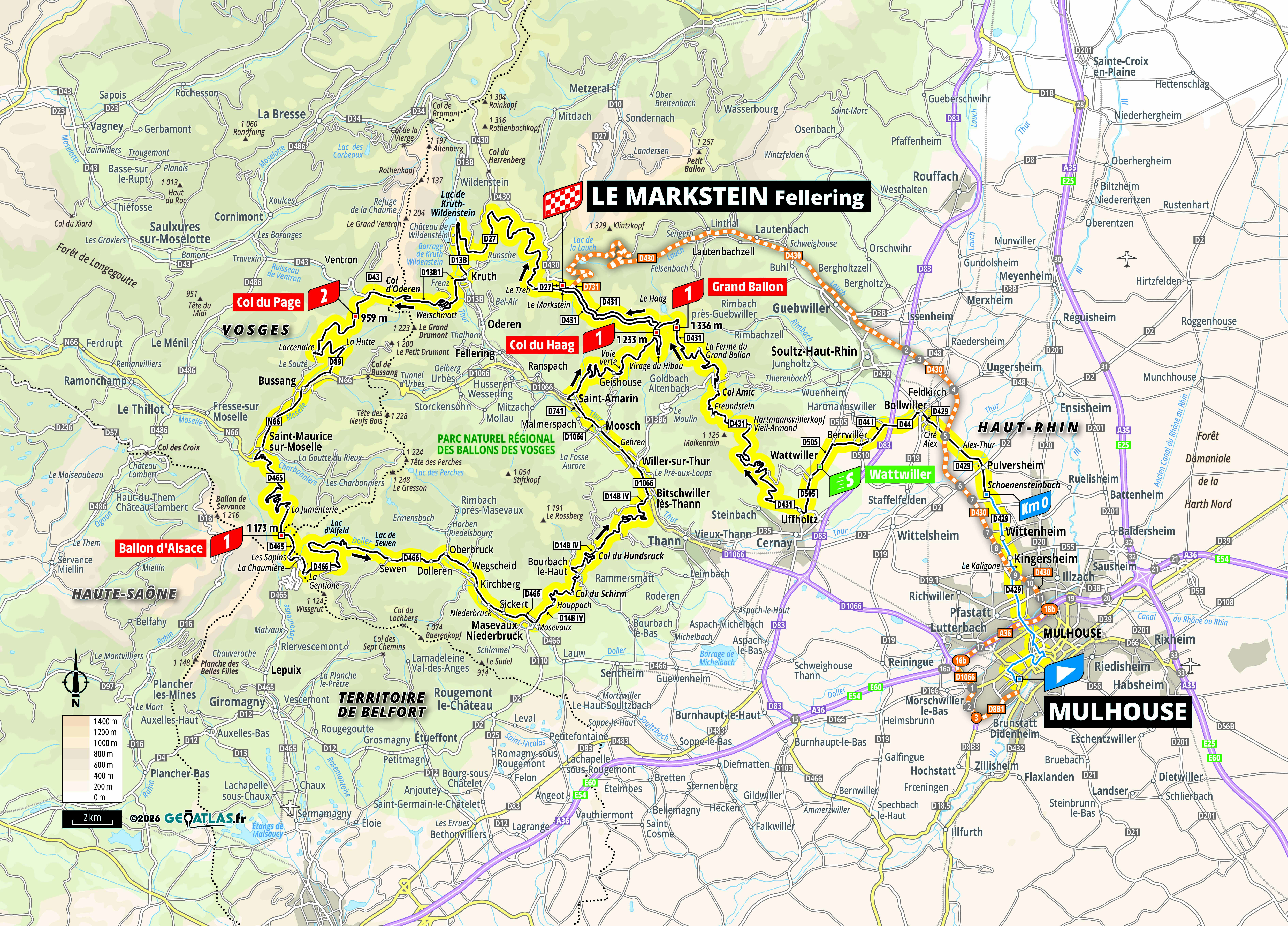
We don't often see route profiles this severe outside of the Pyrenees and Alps: it's a proper shark's-tooth profile. Tour fans will recognise the finish, Le Markstein, as it was used as the final mountain in the 2023 Tour. Tadej Pogačar took the summit finish victory on that occasion, although it wasn't enough to overturn Jonas Vingegaard's GC lead and rain on his Parisian parade the following day.
Back in 2023 the riders approached from the north, but this time the tables are turned and they will tackle the finish from the southern direction, over the Col du Haag as they complete a loop back to the finish line at Le Markstein which they first pass through after 44km.
The start town of Mulhouse is situated on the plains to the east of the mountains, and after a short, flat run-in the riders begin climbing and from that point onwards it's up and down all day.
The green jersey hopefuls are thrown a few crumbs in the form of an intermediate sprint during those first few kilometres, after which most of them will find themselves in the grupetto, bringing up the rear on the climbs with the simple aim of finishing inside the time cut.
Whether at the front or back, the riders face a quartet of major classified climbs. First up is the Grand Ballon, which the riders crest before sweeping through the finish line for the first time. Here they begin a Vosges loop that brings them back round by way of the Col du Page, the Ballon d'Alsace (as featured yesterday), and a final ascent of the Col du Haag, before a short descent and a final rise to the Markstein finish.
Route highlights
As the region's biggest cycling climb, the category-one Grand Ballon is easy to single out. It's long at 21.5km, but not very steep at 4.8%. However, its length, and the fact it comes so early in the stage, will make it a tough ask for any riders who are having a bad day.
The cat-two Col du Page that follows will be a mere mid-course palette cleanser in comparison at less than half the length and even shallower (9.8km / 4.7%). Hard on its heels, though, comes the Ballon d'Alsace – the cat-one ascent featured in yesterday's stage and approached from the same side. A reminder of the stats: 8.9km and 6.9%.
Finally comes the Col du Haag, a cat-one climb of considerable length; 11.2 km, especially after all the climbing that has come already, and 7.2% average gradient. This leads the riders up to the final down-up run-in to the finish.
What to expect
The Grand Ballon is likely to provide the catalyst for the breakaway of the day, and could be the perfect launchpad for any riders with eyes on the mountains classification but not necessarily the GC.
There will almost certainly be attacks from the GC riders today, the question is, where and when. The safe money is a point near the top of the Col du Haag, perhaps after their team has thinned down the peloton, or if one of them spot a rival struggling. However the final six kilometres descend to the finish, and they’re not particularly technical, meaning whoever attacks will need to be confident of pushing on, on the descent, or they’ll see their time gap eaten into. The direction of any wind, could be key.
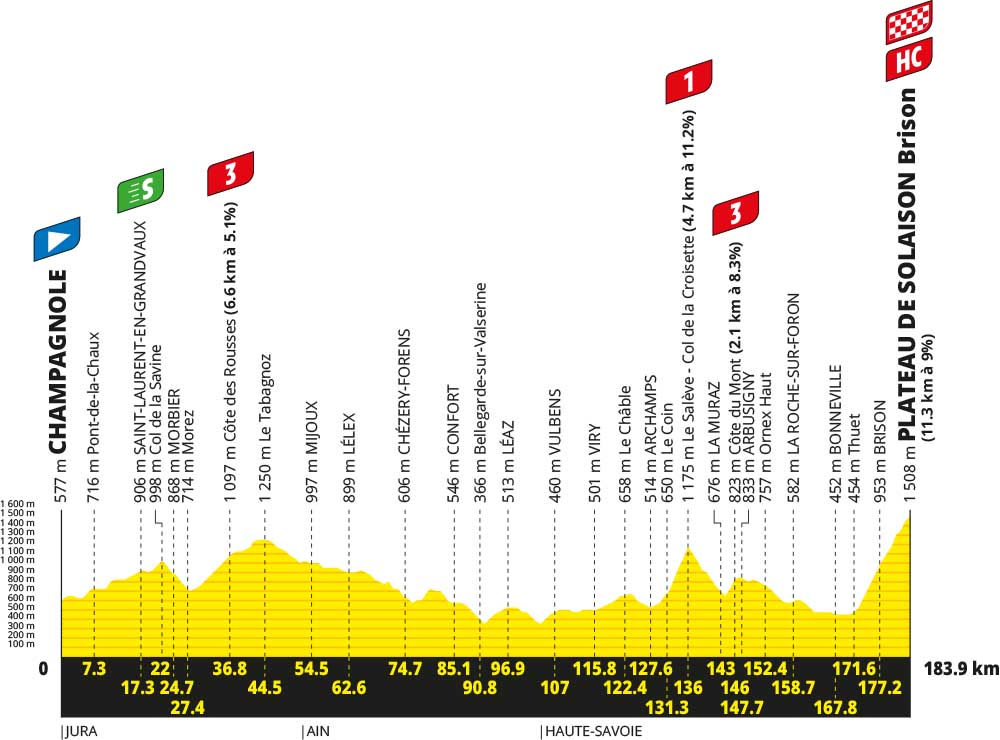
Stage 15: Champagnole > Plateau de Solaison
Sunday, 19 July
183.9km
Elevation gain: 4,701m
Start: 11:20 Finish: 15:55 (CET)
Mountains
Mountain stages are like London buses it seems – you wait ages for a proper one, and then two come at once.
Today's route
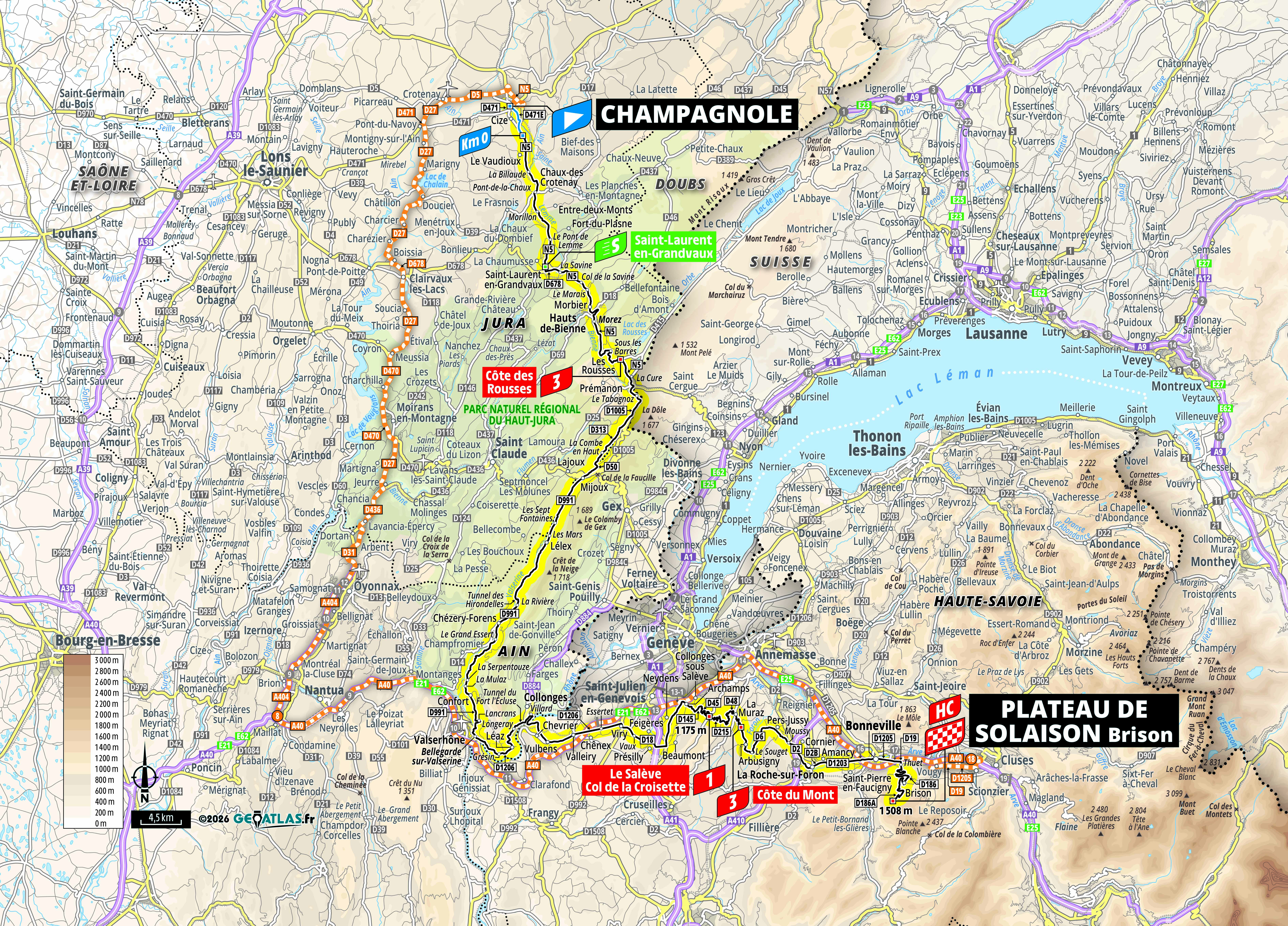
Not to be confused with the historic Italian bike manufacturer Campagnolo, the day starts in the similar-sounding Champagnole. There are three climbs en route to the show-stopping finale, including the short but relentlessly steep Col de la Croissette (4.6km at 11.2%) which tops out just 25km from the bottom of the Plateau de Solaison – an HC ascent that makes its Tour debut.
Route highlights
As soon as riders hit Plateau de Solaison the suffering begins, with the first four kilometres averaging between 10 and 11.3%. After that it’s not much more pleasant – the gradients only peter out to a more shallow 7% in the final stretch. The highest point today is the finish line at 1,508m, which, as altitude goes, isn’t a concern for the peloton.
What to expect
The first action will come from those chasing green jersey points, with the intermediate sprint taking place just 17.3km into the stage. The sprinters will be there, even if it is all uphill to that point. Expect the break to form immediately after, and a big one at that, with stage hunters and polka-dot jersey hopefuls present, given tomorrow’s rest day and the points available (10 for the first rider) on the cat-one Col de la Croisette climb.
But with the GC likely to be tight at the top going into a key summit finish, expect to see UAE Emirates and or Visma Lease a bike take control of the stage for their leaders and a fast start to that final climb.
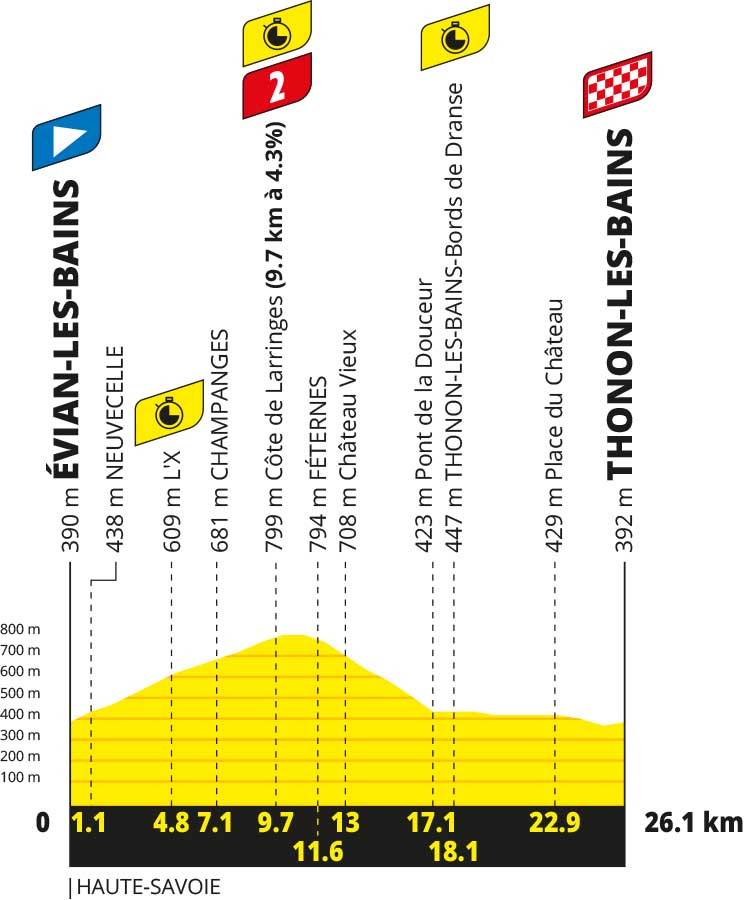
Stage 16: Évian-Les-Bains > Thonon-Les-Bains
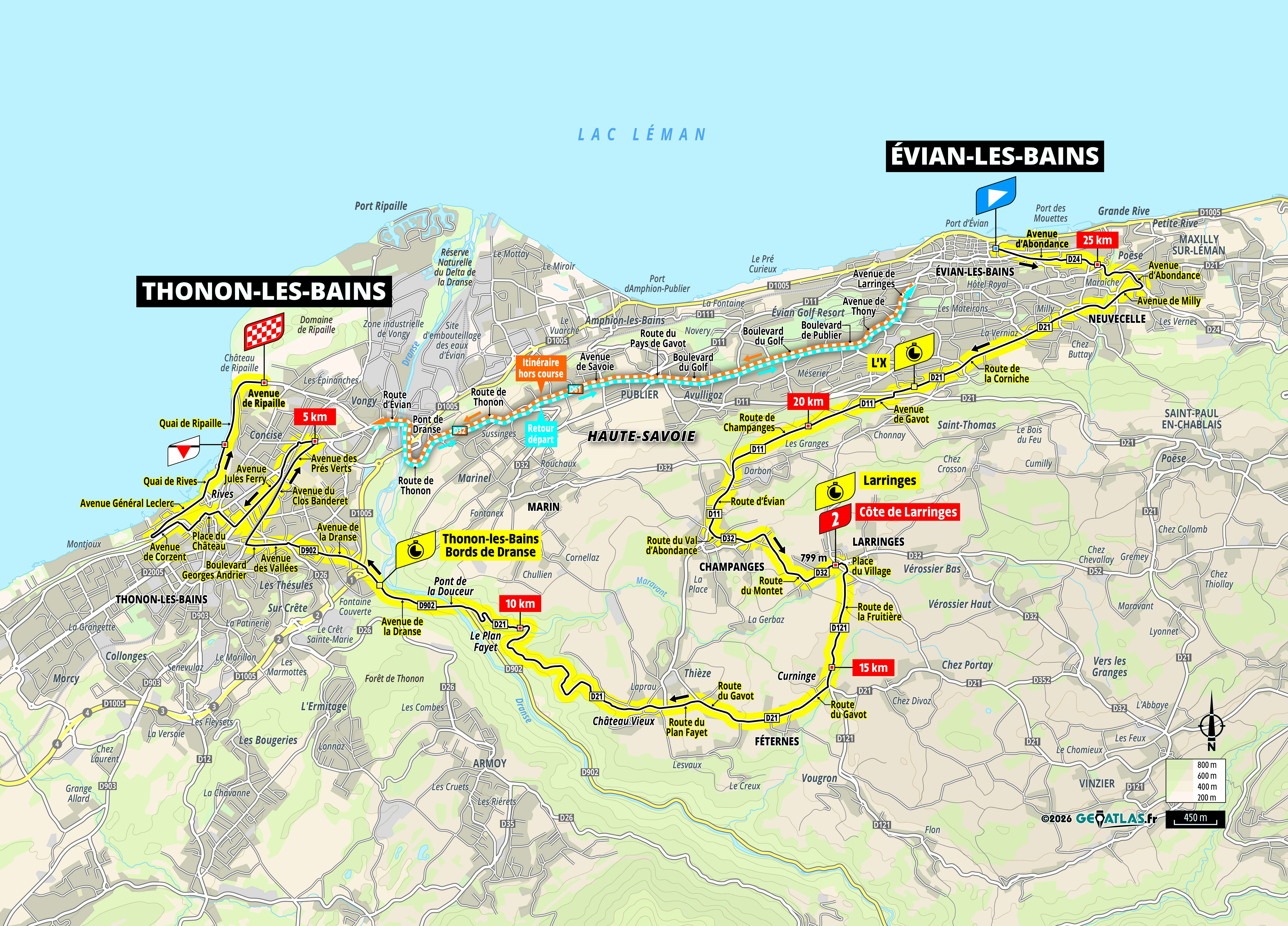
Tuesday, 21 July
26km
Elevation gain: 465m
Start: 11:00 Finish: 15:50 (CET)
Individual Time Trial
After the rest day in Haute-Savoie, which will be the home of the 2027 Super World Championships as well as the 2030 Winter Olympics, action returns with the race’s only individual time trial. It's only 26km long, so a 30-35 minute effort for the faster riders, but does go straight up a cat two climb.
Today's route
Starting on the shores of Lac Léman – or Lake Geneva as it’s also known – the riders immediately climb a gentle 9.7 kilometres up to the second-category Côte de Larringes. Gaining 361 metres at 4.3% means it’s a TT bike rather than a road bike day, especially as it’s then downhill and then flat all the way back to the shores of the lake. There are a few hairpins on the descent, and some tight turns on the flat run in to the finish, so expect the contenders to be out riding this course early in the day. And probably following a team mate in the team car as well.
Route highlights
As the only climb on the course, the Côte de Larringes will undoubtedly be this time trial's key sector, but don’t discount the importance of the flat final third where pure time trialling skills will be rewarded.
What to expect
Pacing will be key today as riders looking to win or gain time will not want to lose time on the climb, but at the same time leave enough in the tank to make the most of the final flat section. They’ll likely go all out on the climb, take a micro rest and some fluids over the top before getting on the pedals again. This would seem tailor made for Remco Evenepoel, but the time gaps will be mere seconds between the top riders.
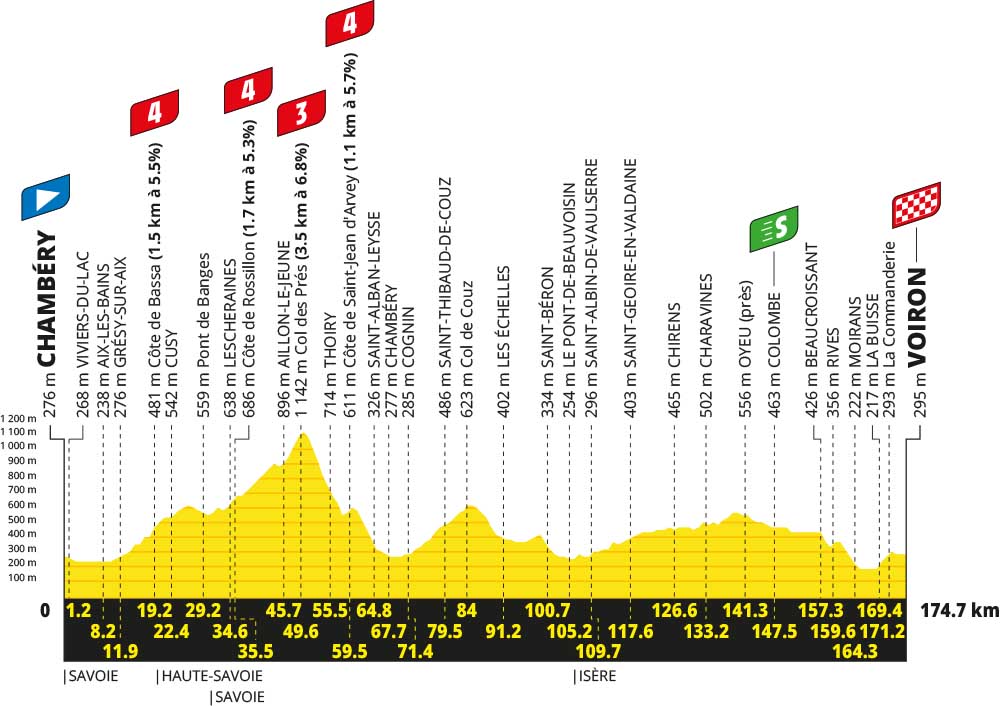
Stage 17: Chambéry > Voiron
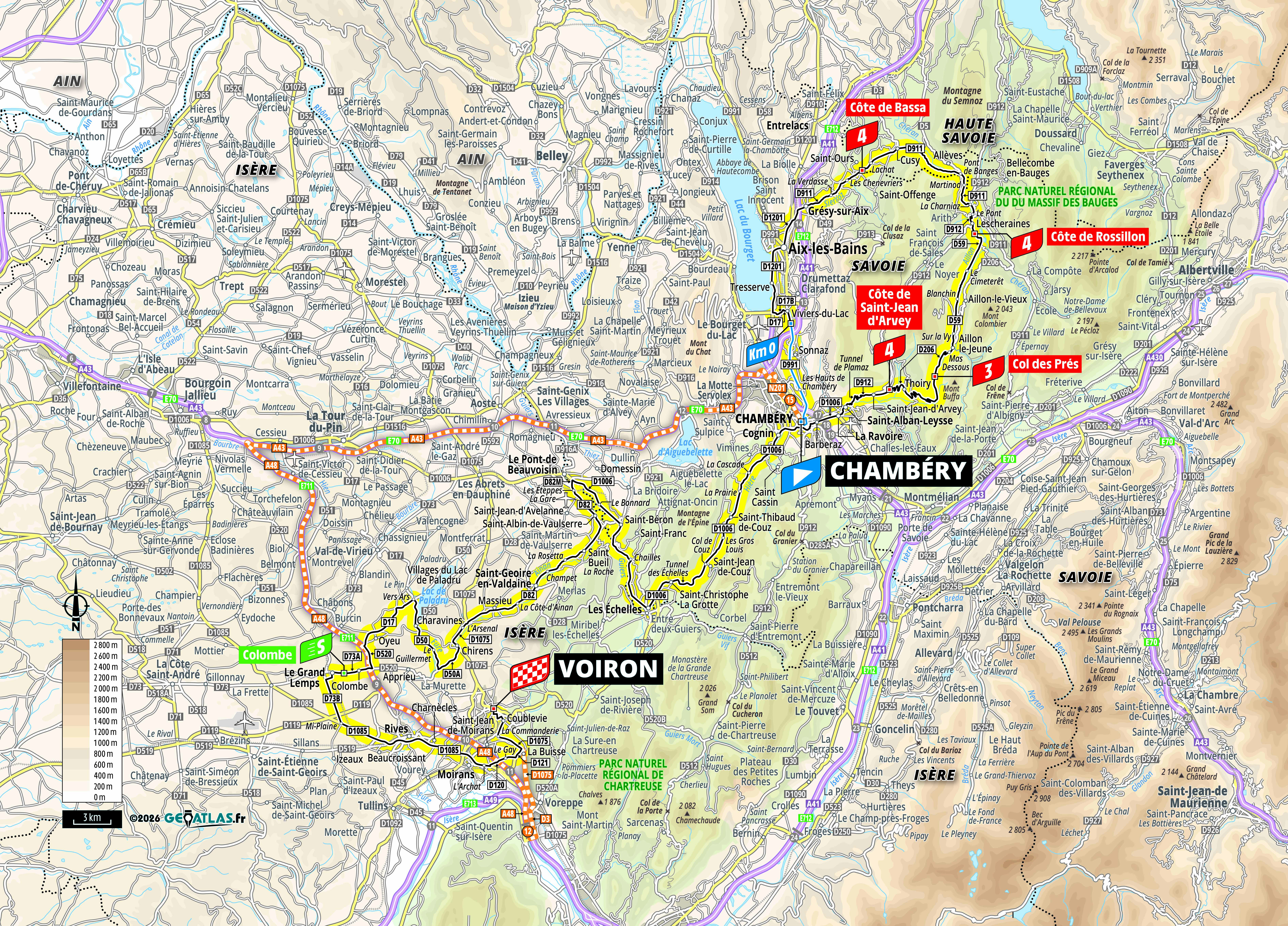
Wednesday, 22 July
175km
Elevation Gain: 2,361m
Start: 11:35 Finish: 15:28 (CET)
Flat
A lumpy stage that flattens out as it gets nearer to the finish, this is probably the last chance for the sprint teams – they’ll be desperate not to let this opportunity pass.
Today's route
Better known among foodies as the birthplace of chocolate truffles (yes, CW’s reporters will be sampling plenty when we get there), Chambéry is the starting point of a day that has around 2,400m of elevation and four categorised climbs, but doesn’t really include any notable ascending that will be consequential to the outcome of the stage. A mostly flat final 100km gives way to what should be a bunch sprint in Voiron.
Route highlights
The Col des Prés, which the riders crest 50km into the stage, comes too early to cause damage – but its surroundings in the Massif des Bauges are spectacular. Make sure you’re watching early to enjoy the scenery.
What to expect
With the final stage in Paris no longer a guaranteed sprint-fest, today represents the final chance for the remaining sprinters in the race to chalk a(nother) win on the board. An intermediate sprint 27km from the line will warm the legs up.
But don’t bet your house on a mass sprint taking place: history has repeatedly shown that expected bunch sprints in the final week don’t always materialise, with a massive breakaway often going up the road and cohesion among teams fraying amidst the fatigue in the peloton, resulting in a disjointed and unsuccessful chase. Not to mention how many sprinters are still in the race at this stage. The outcome in Voiron will probably be decided in the first hour of racing and how big the break is.
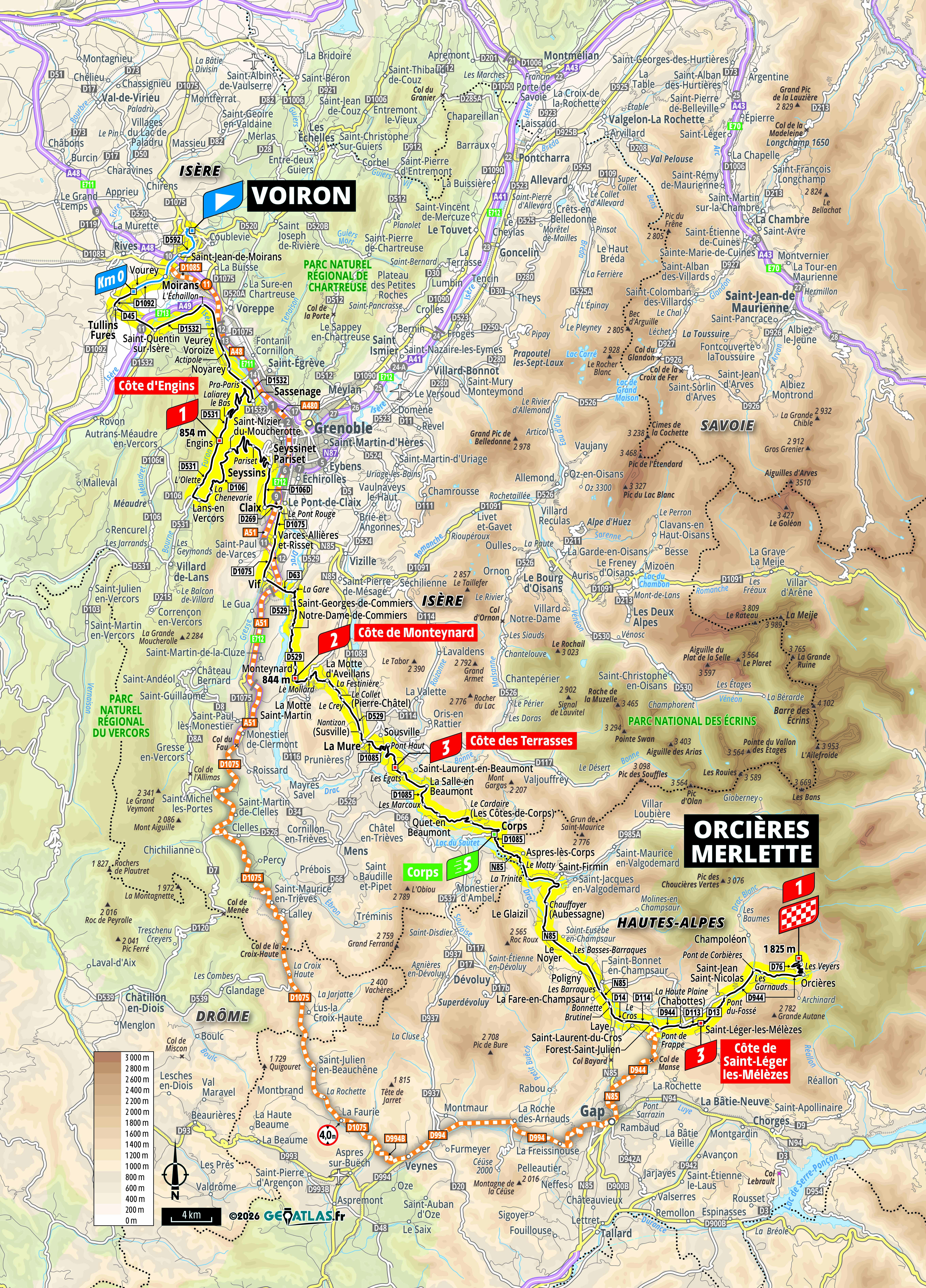
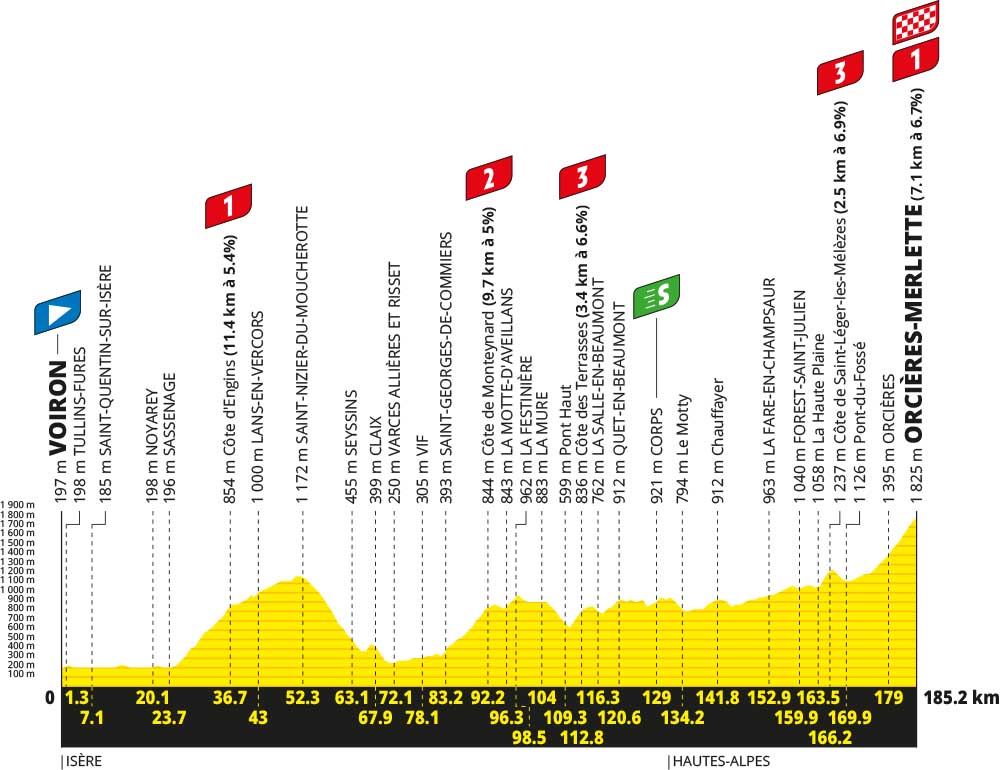
Stage 18: Voiron > Orcières-Merlette
Thursday, 23 July
185.2km
Elevation gain: 3,950m
Start: 10:50 Finish: 15:25 (CET)
Mountains
After a few days of playing in and around the pre-Alps, the peloton finally enters the actual Alps, with the first of three successive summit finishes, even if the race still doesn’t get above 2,000 metres.
Today's route
The first 23km are pan flat but from then on it’s an 80-20 split, in favour of the climbers. A quartet of categorised climbs – the first one, Côte d'Engins (11.4km at 5.4%), is the most testing but comes early doors – precede the finish at Orcières-Merlette, which hosts a finish for the sixth time.
Route highlights
The finishing climb to the ski station of Orcières is where the day’s pivotal moments will take place, with the gradient hovering around the 7-8% mark for almost the entire duration. The real intrigue, however, could be in the gradually uphill 20km section before that. Expect the likes of UAE and VIsma to go to the front set a high pace and shed riders from the main bunch.
What to expect
A break will go, and with so many riders now along way back in the GC, the leading teams can let a large group build a big lead with little risk. The smart money therefore has to be on the stage winner coming from the escape group. The question is, will they have enough time in hand to hold off the yellow jersey contenders when they start attacking on the final climb? The last time the Tour finished here, in 2020, the GC group all finished on the same time. Don’t be shocked if history repeats itself, this climb simply isn’t long, high or hard enough to split them.
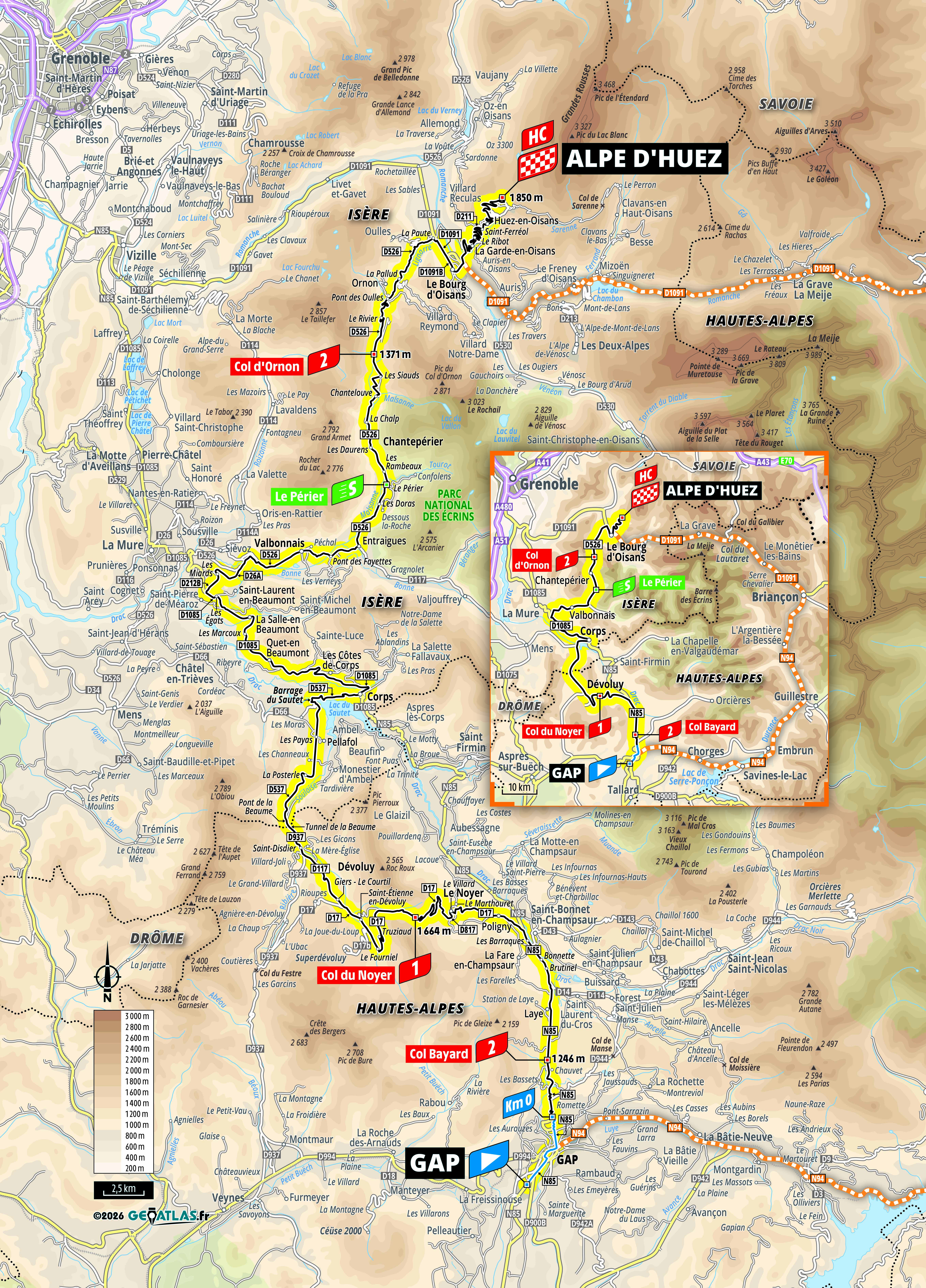
Stage 19: Gap > Alpe d’Huez
Tour history
Tom Pidcock called it “one of the best experiences of my life". Geraint Thomas said that “not in my wildest dreams did I ever think that I would win up here. It’s just insane.”
These are the sorts of emotions that are stirred by winning on Alpe d’Huez, glorious, euphoric feelings of disbelief, pride and amazement at winning atop cycling’s most iconic climb. An achievement that had always passed by British riders until Thomas’s triumph in 2018, when he also became the first man in the leader's yellow jersey to win here.
Four years later, Pidcock emulated his then-Ineos teammate. “Second Brit to win up here – it’s a nice accolade to have,” Thomas quipped.
The Tour has been climbing the mythical switchbacks up to the ski station since 1952 with each winner getting their name on one of the hairpins. Before Thomas’s victory, riders from nine different countries had raced to the top first. Colombia, USA, and even tiny Luxembourg had their flag raised atop the climb, with the Netherlands recording eight wins: Part of the reason they have their own corner in Huez village where a huge, three-day party takes place in the build-up.
Two countries that haven’t tasted success here are Slovenia and Denmark. What chance of that being put right this year?
Friday, July 24
128km
Elevation gain: 3,605m
Start: 12:15 Finish: 15:34 (CET)
Mountains
Tour organisers ASO have banked on two ascents of the mythical Alpe in two days to reshape the final GC right at the death. Will riders be hesitant and wait for tomorrow’s even bigger showdown, or will the gamble pay off and fireworks be lit on the first ascent of the Alpe’s iconic hairpins?
Today's route
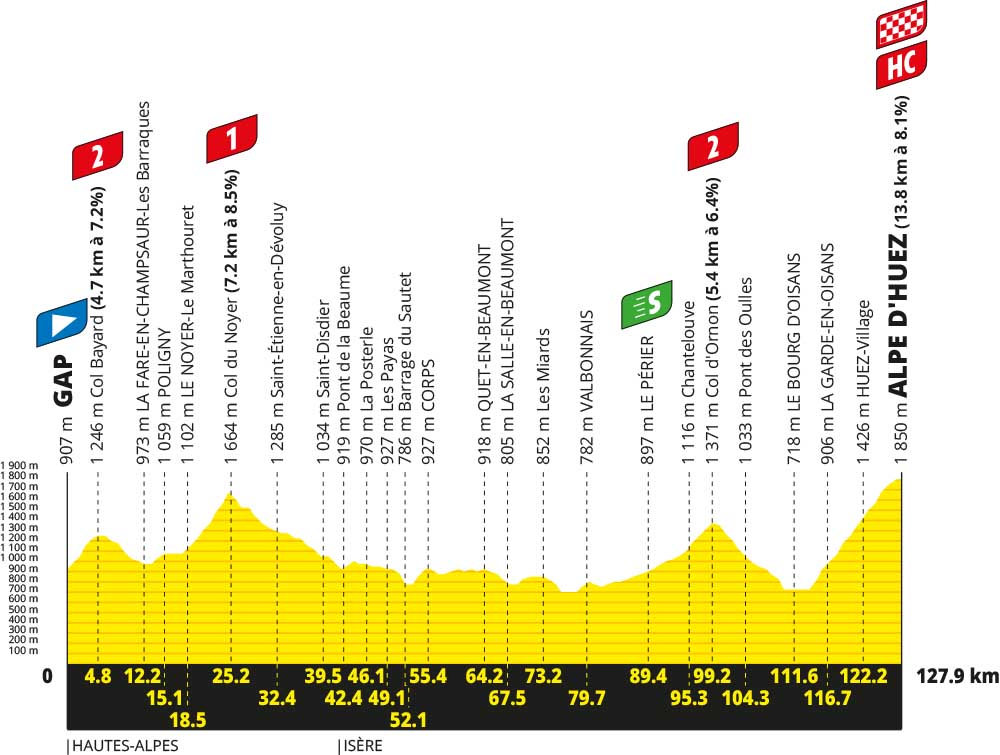
The climbing starts as soon as riders leave Gap, with the Col Bayard (4.7km at 7.2%) an immediate leg-warmer. The longer Col du Noyer (7.2km at 8.5%) follows pretty soon after.
Then a lull takes place with the ensuing 60km of mostly flat terrain culminating in the day’s intermediate sprint at the bottom of the Col d’Ornon (5.4km at 6.4%). Then it’s a quick drop down to the valley, through Bourg d’Oisans and onto the one and only Alpe d’Huez, where it’s 21 hairpins and its hundreds of thousands of fans from across the world await. At 13.8km long, the climb requires being in the red zone for around 40 minutes (sub 60 minutes is a good time for a well-trained amateur), and battling gradients that tip over and stay in the double figures at various points.
Route highlights
Get your stopwatch out and get ready to time what could be the fastest ascent up to the ski resort. Marco Pantani holds the Alpe d’Huez record, when the great, late, but controversial Italian posted a time of 37:35 in the (pre-Strava) 1997 Tour. Lance Armstrong, famously, was a second off Pantani’s time in 2004, but officially that result has been stripped from the record books.
There is great hype this time around that Pantani’s benchmark will finally be beaten. Tadej Pogačar and Jonas Vingegaard each recorded a time of 39:12 up the Alpe in 2022, but that came the day after the Col du Granon raid and after having already ascended the Col du Galibier and Croix de Fer, events which left Pogacar and Vingegaard significantly more tired than they will be today.
At 127.9km long, and with three ‘small’ Alpine climbs that will barely register in the legs of the yellow jersey contenders, the big guns will hit the Alpe as fresh as it’s possible to be this deep into a Grand Tour. And with just one more stage mountain stage to go, expect those in the hunt for yellow, and their teams, to go hell for leather from the bottom.
What to expect
The succession of climbs from the off will act as launchpads for those keen to spend the next few hours dangling in front of the peloton with the aim of being first onto the slopes of the Alpe. But with the absence of major climbs and a lot of valley road until the course gets to the bottom of Alpe d’Huez, the breakaway would ordinarily look doomed.
Yet with the following day’s racing even more demanding, the GC teams might be happy to let the breakaway go and reserve some of their energy for the final climb, and what awaits 24 hours later. What is guaranteed is that there will be movers and shakers in the general classification.
Tour fact: Between 1976 and 1997, Alpe d’Huez was only absent from the Tour route on three occasions (1985, 1993 and 1996), and has appeared 11 times since.
Stage 20: Le Bourg-d’Oisans > Alpe d’Huez
Saturday, July 25
171km
Elevation gain: 5,601m
Start: 09:30 Finish: 14:29 (CET)
Mountains
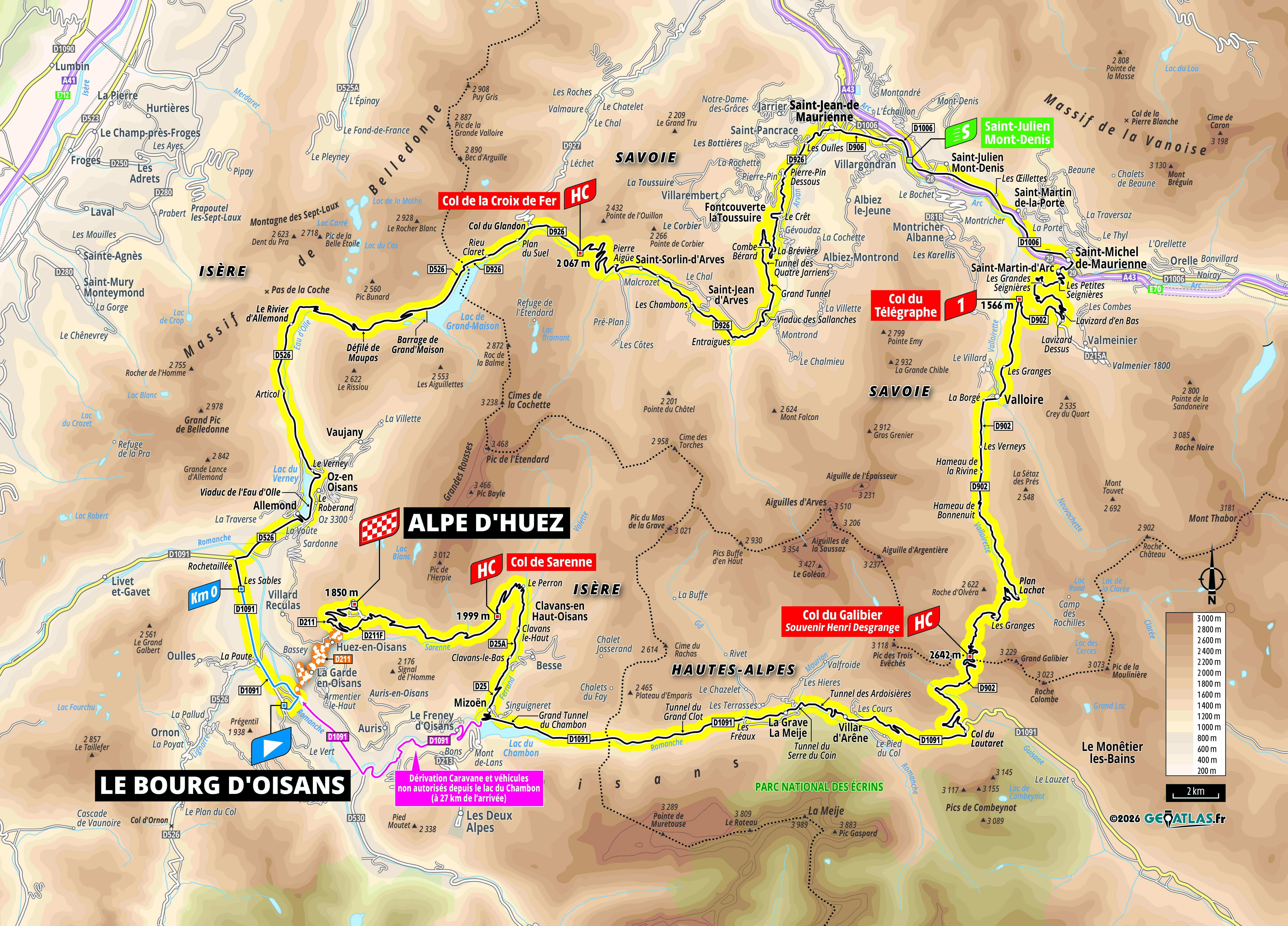
Back up Alpe d’Huez they go – though this time via the Col de Sarenne. Without any doubt, the penultimate day of action doubles up as the queen stage – the hardest day of the entire Tour, with nearly 5,600m of climbing.
Today's route
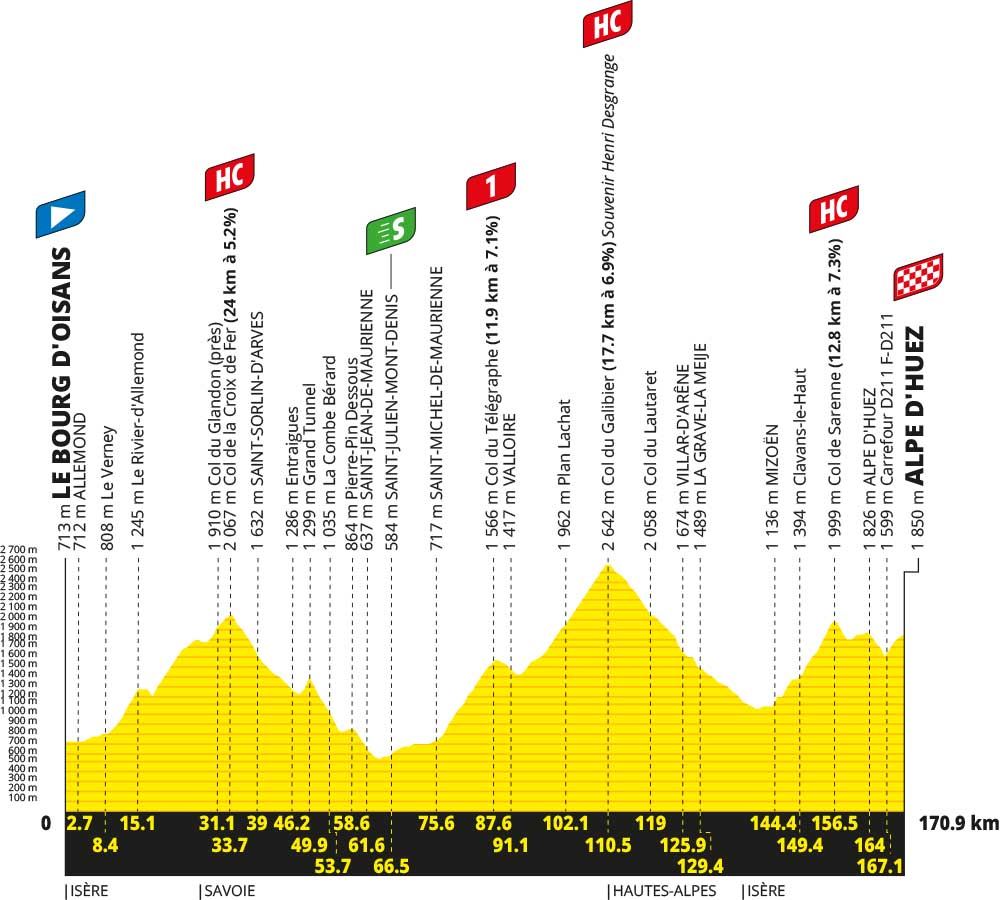
Starting in Le Bourg-d’Oisans at an almost unheard of time of 9:30 in the morning, the riders head north first to tackle the Col de la Croix de Fer. A rip-roaring, twisting descent off the 2,067m-high summit is succeeded by the Col de Télégraphe (11.9km at 7.1%) and Col du Galibier (17.7km at 6.9%), which almost always come as an inseparable pair.
Rather than leg-sapping gradients – though the final kilometre does average 10% – it’s the height that makes the Galibier such a frightening prospect for those feeling fatigued, and such an enticing one for those feeling good. At 2,642m, it’s the 10th highest road in Europe. Altitude will definitely play a role.
For more than 30 kilometres the riders will then zip downhill. Before they get to Bourg d’Oisans, however, they’ll turn off at the tiny village of Mizoën and begin climbing the Col de Sarenne, the ‘back route’ to Alpe d’Huez. From the top there’s two downhill sections for the next 11km, and then the road kicks back up – violently at first – for the final 3.7km into Alpe d’Huez. Tour organisers are dreaming of a final Saturday GC shake-up.
Route highlights
The whole day is a highlight. Make sure you’re watching racing as soon as the flag drops because anything could happen, and the race could explode at any point.
But if there is one climb we’re most intrigued by, it's the Col de Sarenne. Known as the alternative way to the ski station, it was used as a descent in the 2013 Tour, with the peloton then riding up the more traditional climb to the top of Alpe d’Huez.
This will therefore be the col’s debut in the Tour as a climb. The average gradient is a bit more pleasant than the conventional way up, but don’t let that fool you: the first kilometre and the final four kilometres are seriously steep.
What to expect
If the battle for the yellow jersey is still live, expect the unexpected. The Croix de Fer comes too early to tempt a long-range attack, but what is more likely to come into the thinking of riders and sports directors is an ambush on the Télégraphe and Galibier like Jumbo-Visma successfully pulled off in 2022. Isolate and weaken a rival when the air gets thin, and then attack them on the Sarenne.
Being the Queen stage and counting three hors-category climbs and a cat-one, the breakaway will be populated with rider(s) still dreaming of the polka-dot jersey, as well as climbers not in the GC hunt. They could very well prevail, but the biggest storyline – if organisers have their wish – will come from those chasing overall glory.
Tour fact: This is not the first time the Tour has finished on Alpe d’Huez two days in a row: it also did so in 1979
Stage 21: Thoiry > Paris
Sunday, July 26
130km
Elevation gain: 1,978m
Start: 14:25 Finish: 15:40 (CET)
Flat
Sprinters look away now – your once sacred final day bunch sprint on the Champs-Élysées is no more. The finishing circuit of Montmartre, inspired by the Paris 2024 Olympics course, has robbed the fastmen of their biggest sprint of the year. But in its place is a thrilling, unpredictable last hour of racing that has undoubtedly upped the spectacle.
Today's route
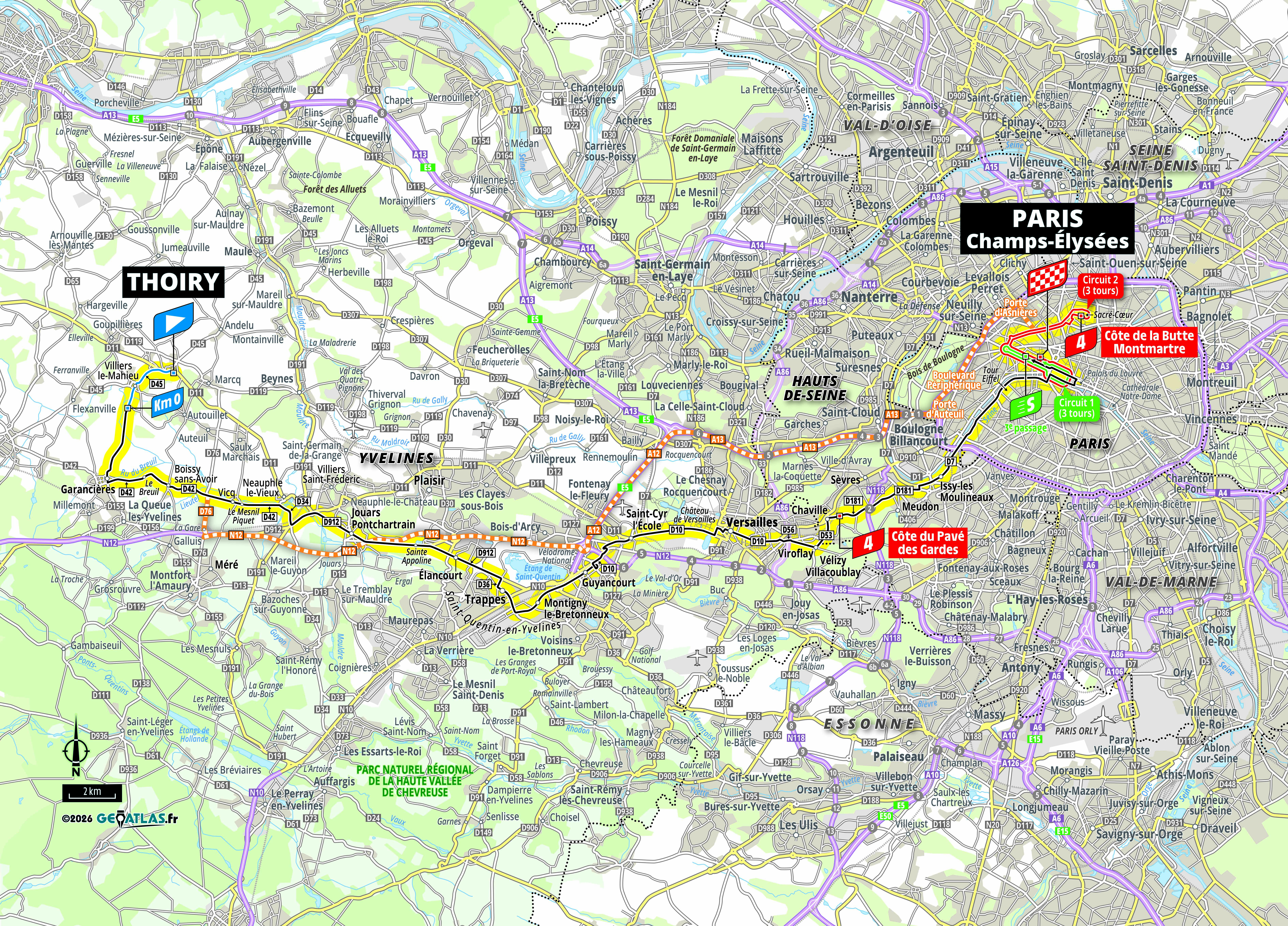
Thoiry makes its Tour debut as a stage town, but it’s waving off a procession, more than a race. The first hour of racing will be characterised by photoshoots of the various classification winners raising a glass of champagne before three laps of the traditional Champs-Élysées circuit and then three laps of the still new 16.7km Montmartre loop.
Route highlights
The cobbled climb up Rue Lepic, sidelined by thousands of screaming fans, is where the attacks will most likely come, before the riders pass the Sacre-Cœur Basilica. It’s a Classics-esque final loop that will keep everyone guessing and social media feeds full of spine-tingling atmospheric video clips. The World Cup in America will have nothing on this.
What to expect
Last year’s stage was somewhat nullified thanks to the rain and the risk that posed on a city centre course featuring cobbles, road paint and the general detritus that litters city centres. But Wout van Aert and - even without GC time gains on offer - Tadej Pogačar both stepped up along with Matej Mohoric and Davide Ballerini to make for an amazing spectacle on the new-but-instantly-iconic Montmartre loop.
The crowds flocked to the roadside, and the resulting scenes of the riders at the front and the back getting roared up the climb once again reminded us why the Tour de France is the greatest sporting event in the world. Vive le Tour!