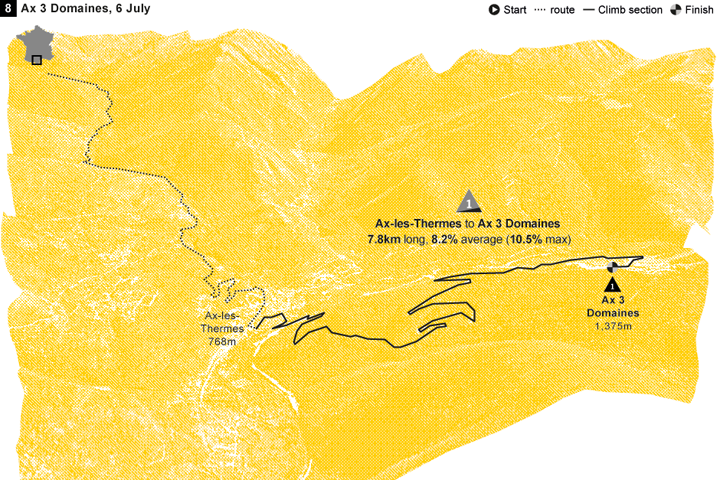
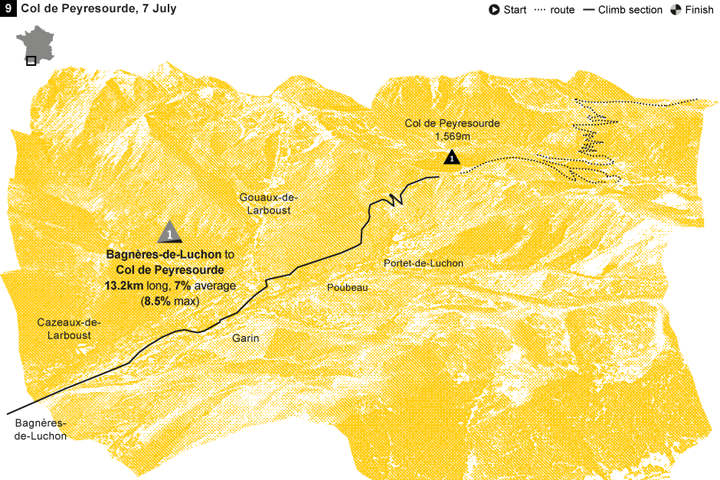
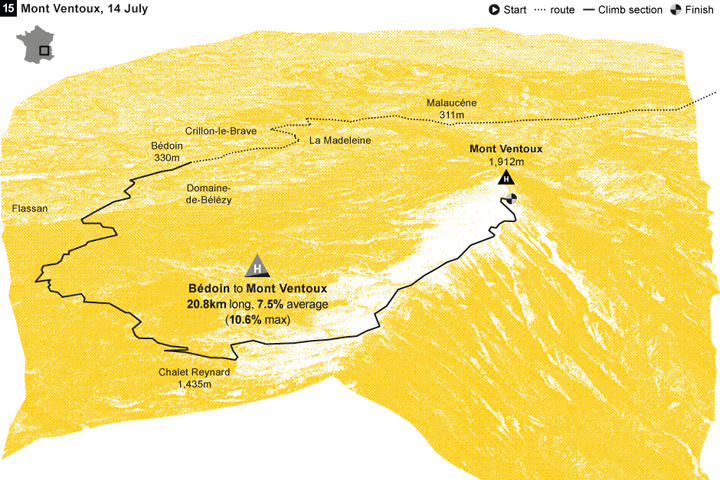
Ax 3 Domaines (stage 8): The significance of this one isn't in its steepness (not too steep, relatively speaking) nor its length (not too long). It's all down to location, location, location. In 2013 this is the first mountain top finish of the Tour, which is always the moment when the race truly takes shape. The critical factor is that for a stage finish here, the spectacular, narrow and steep hors-categorie ascent of the Port de Pailhères can be included immediately beforehand, with only the descent to the town of Ax-les-Thermes separating the two. That's quite a combination.Photograph: GraphicCol de Peyresourde (stage 9): There are longer Pyrenean climbs and many that are far steeper, but few boast the scenic splendor of this one; the long, sweeping hairpins across a verdant high mountain meadow, and the final gentle defile at the top are the opposite of the gothic splendour of the Ventoux or the nearby Tourmalet. The Peyresourde harks back to the first true mountain stage of the Tour in 1910 – when it was crossed in the other direction - and the long steady climb up from Bagnères de Luchon has been a regular feature ever since.Photograph: GraphicMont Ventoux (stage 15): A standalone peak south of the Alps used only 14 times in the Tour, the Giant of Provence is unremitting from the wide bend at the foot to the final pull past the observatory, with dizzying 360 degree views of southern France. It's also unique: a Tour climb that goes up a mountain to the very top, rather than to a ski resort on a plateau, or over a pass between higher peaks. It's horribly steep, with barely a hairpin in the early kilometres, which are just a direct pull up the side of the hill.Photograph: Graphic
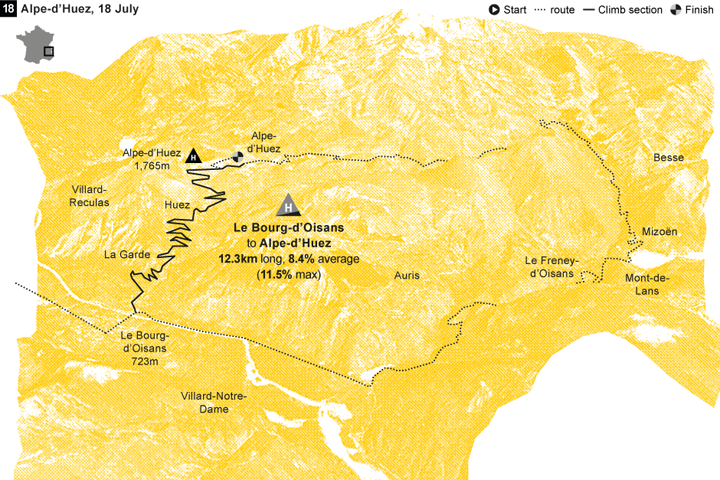
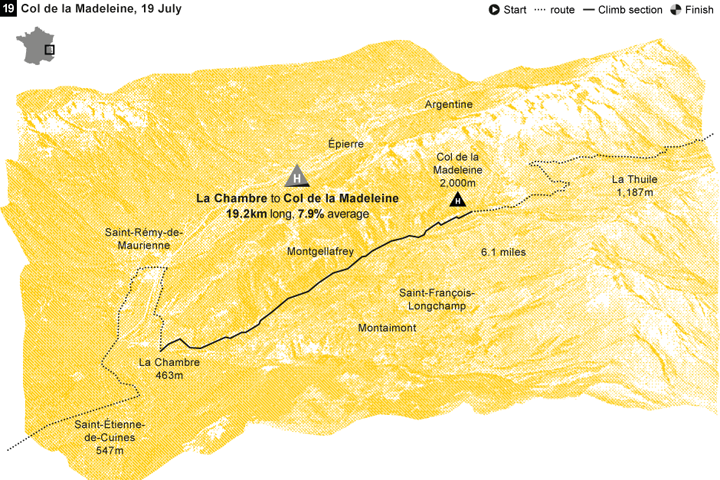
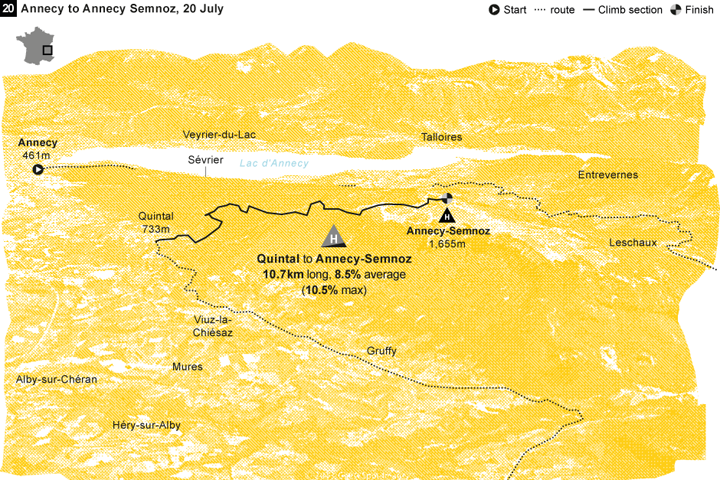
Alpe d'Huez (stage 18): If there is one place that sums up the madness of the Tour, it's the Alpe: the craziest crowds, the toughest gradient and a wealth of historical incident. But what's special this year is that the riders get to climb it twice, using a newly refurbished descent out of the resort over a second climb, the Col de Sarenne. There's no run-in to the Alpe, the peloton comes along the valley, then the riders hit the first, and steepest hairpins like a wave crashing against a cliff. That instantaneous suffering puts it in a class of its own.Photograph: GraphicCol de la Madeleine (stage 19): First climbed by the Tour in 1969, the Madeleine has become a regular feature, as one of the only two routes between the Maurienne valley to the south, and the Isère to the north. It's evenly graded, but unremitting, and runs the full gamut of mountain scenery: forest at the foot, flowerfilled meadows worthy of Heidi up top and a ski resort in the middle, with craggy slopes at the summit. On today's stage it should not be decisive; coming in the first half it will soften up the legs before the finale.Photograph: GraphicAnnecy Semnoz (stage 20): Very, very steep, with a very nice restaurant on the top. When the Tour organisers took the Guardian up here last October, the view across Annecy and its lake was hidden in mist; we are told it is spectacular. The final climb in the Tour is also the steepest, like the Ventoux with few hairpins to give any respite as it twists up the hillside at between 10 and 16 per cent. It's like the climb up to La Planche des Belles Filles in the 2012 race, but longer, and coming when the entire field will be wrung dry after three weeks of racing.Photograph: Graphic
Sign up to read this article
Read news from 100’s of titles, curated specifically for you.