KANSAS CITY, Kan. _ Two days after a Kansas boy died on the Verruckt water slide at a Schlitterbahn park, an expert questioned the attraction's design and park visitors came forward with troubling accounts about its safety.
Past riders recounted scary examples of harnesses coming loose and one instance of a boat lifting into the air as it plunged down the slide.
A Schlitterbahn season ticket holder said she once asked a worker atop the slide whether the hook and loop harness would keep her from flying out of the boat. Erica Conrad of Linwood, Kan., said that the worker "assured me, 'It's OK, they're not to keep you in the raft, but to make you feel safer.'"
Police said Olathe resident Caleb Thomas Schwab, 10, son of Kansas state Rep. Scott Schwab, was decapitated on the ride Sunday, a horrific conclusion to a day when elected officials and their families were invited to enjoy a free visit.
On Tuesday the Verruckt's designer and operator, Schlitterbahn, continued its silence on the matter, even when asked about the reports of the airborne boat and loose harnesses. The company did announce that the park would reopen Wednesday, but that Verruckt would be closed for the rest of the season.
An expert interviewed by The Kansas City Star said the use of netting over the slide and the uncontrolled nature of the boats _ they weren't attached to a rail like a roller coaster _ especially need to be scrutinized.
Mark Hanlon, a licensed mechanical engineer who was a certified inspector of amusement attractions in California, said that while the Verruckt resembled a roller coaster ride, it did not have similar safety precautions, such as having a vehicle tied to a rail line.
"Roller coasters, they're fully captured," Hanlon said. "They can't go vertical, they can't go sideways, they can't go down."
One Kansas family that recently visited the park experienced a ride on the Verruckt that showed the danger of not having the boats tied to a rail. Instead, they slide on a film of water.
Jon Powell, of Hutchinson, said that three weeks ago, the boat carrying his daughter's family _ her, her husband and their 8-year-old daughter _ went airborne.
They called him immediately to tell him what had happened.
"It kind of scared the heck out of them," Powell said. "They didn't think anything of it until they were met by staff at the bottom."
The lifeguard at the top of Verruckt had radioed down to the lifeguard at the bottom of the ride to report that the raft had gone airborne, Powell said. Management met the family once they got off the ride.
"They kept asking them, 'Are you OK? Are You OK?'" Powell said. "(Park staff) told them, 'That's not supposed to happen.'"
The three weren't injured and the reality of what had happened didn't sink in until later, Powell said.
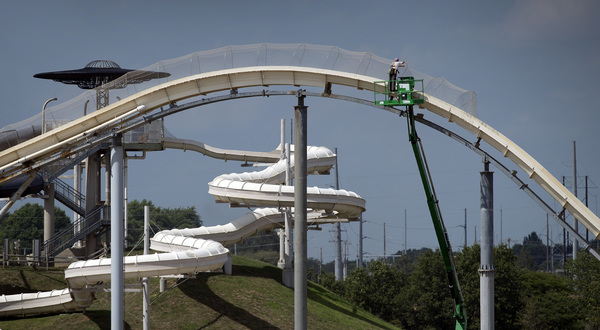
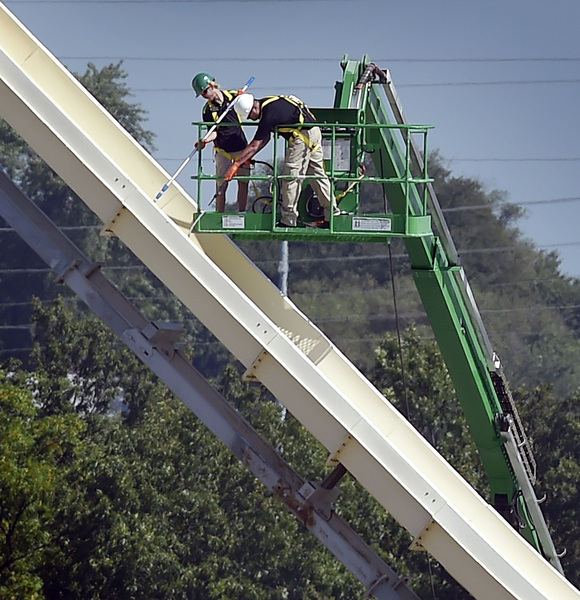
Verruckt puts three restrained riders on a boat that embarks on an initial 17-story drop, reaching speeds of up to 70 miles per hour. Then in it rises and descends on a hump and stops in a shallow pool.
Netting all along the slide over the riders is intended to keep them from falling off the slide. It's propped up every few feet by what appears to be metal semi-circular poles.
But the netting also drew concern from Hanlon. He said it presents risks to riders if they come into contact with it at high speeds.
"It will literally pull someone's arm right off," Hanlon said.
After Schwab's death, authorities removed a portion of the netting that covered the initial part of the second descent.
As far as the ride's riskiness, science can explain that, said one expert contacted by the Star. Tim Landschoot is a mechanical engineer and lecturer at New York's Rochester Institute of Technology. He is the faculty adviser to the university's Theme Park Engineering program, and he uses the Verruckt to teach fundamental principles of physics.
At its root, the science of the ride is not complex. Like roller coasters and other thrill rides, it centers on the acceleration of a body in motion, in this case a boat containing riders.
The height of the ride _ higher than the Statue of Liberty _ combined with the weight of the boat and the passengers, embues the combined boat and its riders with loads of potential energy, ready to be unleashed.
"It's not a vertical drop, but it's a steep drop," Landschoot said.
As soon as the raft tips over the edge, gravity takes over. As soon as the boat begins its 168-foot first drop, the acceleration of gravity takes over. The potential energy of the boat is converted into kinetic energy, so that by the time the raft gets to the bottom of the drop, it hits what the designers intended to be its maximum speed, 65 to 70 miles an hour.
"As soon as you step out you have no real support on you. Gravity is going to start pulling you down," said Paul Rulis, a professor of physics at the University of Missouri-Kansas City.
Air resistance and the friction of the water may slow down the boat a bit, but not much.
At the bottom of the initial drop, the raft now has momentum (mass multiplied by velocity) to help propel it up some 50 feet up another five stories and over the Verruckt's final rise.
"The last thing you want is too much speed," Landschoot said. "On the second hump, you don't want to actually go flying off, leave the slide. You want to go slow enough so you are riding over it and not just jumping over it."
Once the raft reaches the top of the rise, the weight of the boat and passengers pulled down by gravity takes over once again. Gravity pulls the raft and riders down the chute. Friction and water resistance deplete the raft's energy as it cruises to a stop.
"If it performs as expected, the raft stays on the water and on the slide. And that's good," he said. "But if a restraint or harness has given way, that's bad."
It's bad because, as physics dictates, a body in motion will remain in motion and in a straight line unless acted on by another force.
If a rider is speeding over the rise and, for whatever reason, the harness gives way, physics dictates that the individual will continue in a straight line, flying out of the seat as the boat and its other passengers continue to drop down to the pool below.
The forces acting on riders are why the harnesses are so critical.
But Frank Branson, a Dallas attorney who has represented victims in amusement park incidents, questioned the efficacy of hook-and-loop restraints on high-velocity rides.
"I'm not sure at the speed they say they're going that Velcro is a good fastener, and how did they determine Velcro was a good fastener?" Branson said.
Experts also say hook-and-loop products experience wear and tear over time, which reduces their strength, making it easier for someone to unfasten them.
Hook-and-loop products are commonly called Velcro, which is a brand name for the popular fastener. Velcro Companies said in a statement that Schlitterbahn was not one of its customers.
"Velcro Companies doesn't manufacture products for amusement park rides," said spokeswoman Amy Thompson, "and no they don't sell products to amusement park operators for the purpose of harnessing guests on rides."
Several riders told the Star on Tuesday they experienced mishaps and faulty equipment on the Verruckt before Sunday's tragedy.
Conrad, who has ridden the ride before and was told not to worry about the safety of the harnesses, was at the bottom of the Verruckt last summer, taking photos as her husband, a friend and her young cousin zoomed down the slide.
"When they got to the bottom, we realized (their friend) Matt's strap was off," said Conrad, "We didn't realize it until Matt yelled, 'My strap came off.' "
A lifeguard who would have heard the comment "didn't act like it was any big deal," Conrad said. So the group didn't report the issue.
After Sunday, Conrad wanted people to know what her family and friend experienced. Other families have also come forward detailing frightening experiences.
On July 26, Paul and Erin Oberhauser, of Omaha, Neb., took their family to Schlitterbahn and a few in the group went on the water slide. When they heard about Caleb's death, they thought back to their own experience when Paul's shoulder strap came loose at the bottom of the first hill.
"He said it just happened so fast," Erin Oberhauser told the Star. Her husband held on tight to handles by his legs for the rest of the ride, she said.
When he got off, he told workers what had happened. They said, "Oh, that's not good," Erin Oberhauser said.
The family figured the raft would be taken out of commission until workers could figure out the problem. But two hours later, Erin Oberhauser said from their cabana near the water slide, they saw it happen to another guy on the ride.
"We heard a guy yelling, 'My belt came undone!"
Erin later posted about the experience on Facebook and tagged Schlitterbahn and included the hashtag Verruckt. She didn't hear anything from the park.