Scott Morrison said last week that his intention in extending drug testing and income management for Newstart recipients was “helping people”. This seems strange on the face of it. The best help that Australia’s unemployed could get would be an increase in their payments, which are, relative to median incomes, among the lowest in the developed world. How could tightening access to our diminishing range of social protections be of benefit to those who may be denied them?
It’s possible to read this as mere subterfuge, as cover for a naked populist gesture. Having been demonised in rightwing media for generations, the unemployed make a useful punching bag. “Getting tough” on them plays well to the resentments of those who have been encouraged to think that anyone without a job is likely to be a feckless junkie.
In a budget that does little to address the looming structural problems in Australia’s economy, and disproportionately hurts middle income households, it represents an appeal to the “common sense” of voters attracted to One Nation. And those are voters that the Liberal party has not stopped chasing for the last 20 years.
If we step back from the moment-to-moment scorekeeping of everyday politics, though, we can see that this is all part of a much broader pattern, and a shift in the problems that Australian politics sets itself, and proposes to solve.
Remember that in recent years, the incarceration of refugees in Nauru and Papua New Guinea has also been framed as an effort to help them. We have been told time and again that we must indefinitely imprison refugees – even children – in order to stop them dying at sea in rickety boats.
The Australian government avoids, where it can, taking much public responsibility for what happens in the camps it has commissioned. (Their management has largely been farmed out to contractors, just as the mooted drug testing of the unemployed would be.)
At the same time it offers, effectively, to take full responsibility for the safety of people en route to the country, outside Australian territorial waters. In part, their safety has been promoted by means of naval vessels turning boats back to sea. Indeed, previous governments who fleetingly tried to ameliorate the conditions in the camps are told by the Liberals that they have blood on their hands, and that they caused people to drown.
And again, when Mal Brough was arguing for the Indigenous intervention back in 2007, which started the slow creep of welfare quarantining across the system, seized ownership of Aboriginal townships, and put them under military occupation, he said it was in order to offer the people in those communities “a better quality of life”.
This came in the fourth term of a government which had begun by dismantling structures of Indigenous self-government, and legislating away the impact of recent high court decisions pertaining to Aboriginal and Torres Strait Islander people’s most insistent demand: land rights.
It’s wrong to see these arguments made in the last decade as mere double-talk. Morrison, I think, really does think it’s a good idea to extend state surveillance and discipline of unemployed people. Successive governments really have considered it prudent to disincentivise boat arrivals. Howard and Brough really did think it best to exert direct federal control over Indigenous communities.
Sadly, they mean it.
But the odd thing is that these are the things that the state proposes to manage at the same time as it takes other things off the table – the things that the people in question actually want. Robust social protection. Asylum. Restitution for theft and historic injustice.
The orthodox view of neoliberalism sees it as a project directed at making the state wither away. But in these examples we can see government assigning itself responsibilities that it has not previously had, often at considerable expense.
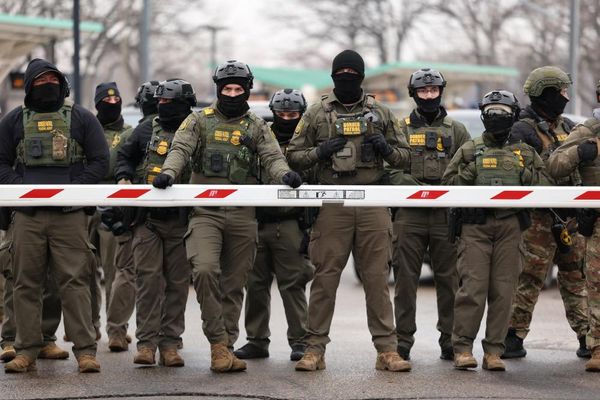
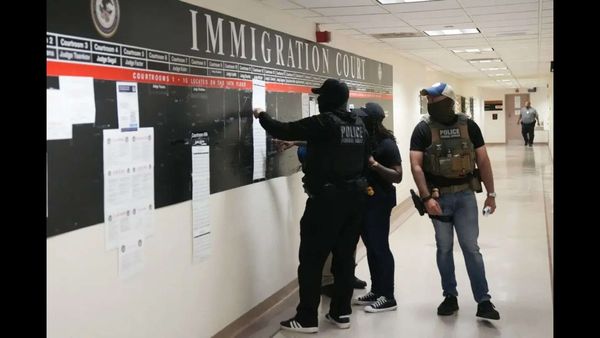
In each case, governments have responded to social problems as, effectively, security or law and order problems, and have devised measures of surveillance, incarceration and even armed occupation in response to the distress of certain marginalised groups.
And each time, assaults on the autonomy and privacy of various groups have been carried out in the name of their health, or more broadly, their safety. In the case of refugees, their treatment is also justified in terms of the terrorist threat that they, who are always under suspicion, may present to the rest of us.
While contractors draw cheques, the rest of us are invited to draw only lessons. Governments are less and less interested in addressing our welfare by confronting issues like inequality, poverty, the colonial legacy, or the human consequences of wars we have participated in. There is no broad plan in the budget, or in any platform, for any redistribution of resources in the light of predictions of greater un- and underemployment in the due to low growth and automation.
Instead, they draw us closer to the state with surveillance, policing, and the management of what Jacques Ranciere calls the “sentiment of insecurity”. More and more problems are cast as security threats, including the difficulties of people who have been thrust to the margins of society or the economy. And the state more and more emphasises its role as police officer.
By nominating and offering to contain only threats to our physical safety, government may not shrink, but it may be gradually reduced to its most primitive function: order.
If more of us do find ourselves unemployed, and subject to more intimate forms of discipline, perhaps we will be more inclined to resist this. But perhaps by then it will be too late.