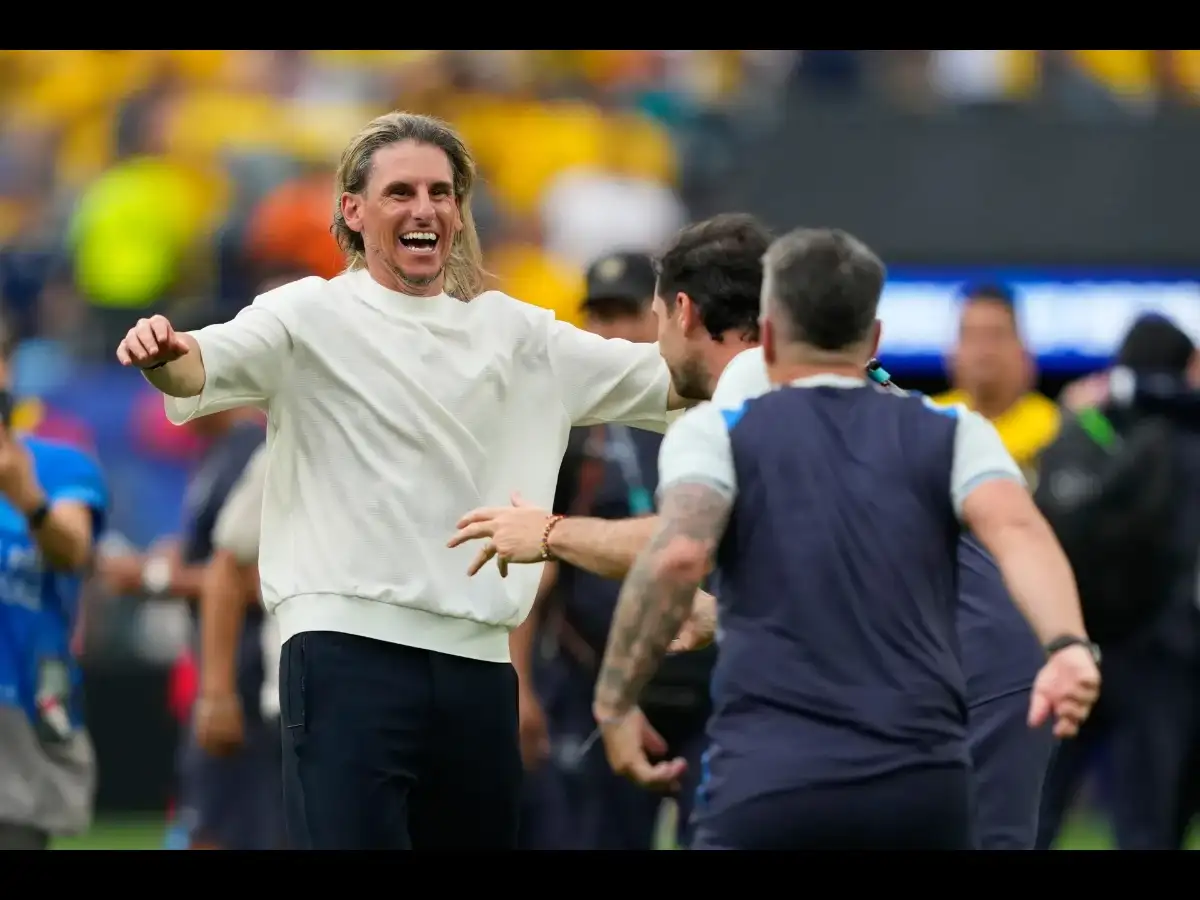
There he goes, the wind in his flowing wheat-gold hair, arms outstretched, a big grin on his young Iggy Pop face as he runs to his family in the stands, clambering over stadium barriers. Sebastian Beccacece had pulled off a great heist. Ecuador’s 45-year-old Argentine manager had taken a team on the brink of a first-round exit, inspired them to a famous win over powerhouse Germany, and moved them into the knockouts.
“For as long as we’re still alive, we need to seek that light,” Beccacece said after the win. “We’re talking about an entire country that is now celebrating. Let them enjoy, let them have a beer, and celebrate with their friends and family members, those beloved ones that passed away. This Ecuadorian national team, it makes people fall in love with them, doesn’t it?”
Ecuador is no footballing giant, but they are inching towards it. At the World Cup, their defence features Arsenal’s Piero Hincapie, PSG’s Willian Pacho, and AC Milan’s Pervis Estupinian. Ahead of them there’s Chelsea’s Moises Caicedo. They would walk into pretty much any top squad. Ecuador stuttered in their first two group matches, losing to Ivory Coast and drawing against the tiniest nation ever to play in a World Cup, Curacao. In the win-or-exit match against Germany, Beccacece’s boys finally showed the mettle that took them flying through the South American qualifiers, finishing second only to Argentina.
Also Read | FIFA World Cup 2026: Saudi Arabia set to sack head coach Donis after group-stage exit
Beccacece, born in Rosario, Lionel Messi’s hometown, has spent most of his career managing club teams in Argentina and Peru, with short stints as assistant manager with Chile and Argentina. Now he is the main man, the one making Ecuador dream, taking their team to the knockout stages for the first time since 2006.
The World Cup is football’s biggest, most hallowed stage — not just for players, but managers too. In shaping the team, they shoulder the burden of a nation’s expectations, are at the receiving end of overflowing love or intense hate, and the focus of national obsession.
Take Japan’s coach Moriyasu Hajime. In his eight years in charge, he has taken Japan from an Asian powerhouse to a genuine global force. Under his watch, Japan stunned Spain and Germany at the 2022 World Cup to top the ‘Group of Death’, beat Brazil in a friendly, and England in a pre-World Cup match at Wembley. Clad in a bespoke three-piece suit, always scribbling in a notebook while walking the touchline, Hajime looks like an unyielding detective from a Japanese police procedural.
Hajime has given Japanese football an identity — a team that’s both dogged and buccaneering, intensely drilled in positional play, with formations that can change fluidly as the game flows.
The team Japan will meet in the round of 32, meanwhile, is in search of theirs.
Also Read | Iran coach: US treatment at World Cup 'really terrible'
Brazil was once the symbols of footballing magic, the custodians of the game’s beauty. Now they are simply another cog in the world football’s g i a n t commercial machine, having lost both their beauty and power.
Who better, then, to lead them out of this hole than the great pragmatist, Carlo Ancelotti?
The Italian is the first foreigner to manage Brazil in a hundred years. No foreign coach has ever won the World Cup — but if there’s one thing Ancelotti knows, it’s how to win. Few coaches have enjoyed the kind of success in football that Ancelotti has, and perhaps none is as comfortable and familiar with the reins of a team with a library’s worth of legacy and history.
Whether it’s AC Milan or Real Madrid or Brazil, Ancelotti knows how to bring the biggest players together and make them work towards one goal — winning, in whatever way it comes. But so does Didier Deschamps. He won the World Cup with France as captain in 1998, as coach in 2018, and then took them to a second successive final in 2022 — that’s 17 wins in 22 World Cup matches as Les Bleus coach. And he is not breaking the cosmic rule that doesn’t allow foreign managers to win the Cup.
Cape Verde coach Bubista, born Pedro Leitao Brito on the island of Boa Vista, may not be looking to win the World Cup, but he is already a legend, along with his team of miracle makers, who have made it through to the knockout stage on debut. Cape Verde, the third smallest nation by population ever to play in the World Cup, are now the smallest nation ever to reach the knockout rounds. Expect every one of the half a million people who live on the Atlantic archipelago to be glued to their TVs when Bubista’s men play Lionel Messi’s Argentina.
Bubista fell in love with football while watching the 1990 World Cup on the only TV in his village. His mother made him balls out of socks to play with. Asked about the opponents he will face in the group stage, Bubista said: “We want to play the best teams at the World Cup. We are lucky to get Spain, Uruguay…Saudi Arabia, who have been Asian champions…We feel very relaxed.” He must be overjoyed at the prospect of playing Argentina.