As society becomes increasingly complex these days, stress is becoming a part of life. Coupled with the unknown future of the coronavirus pandemic, the number of people who will become ill either mentally or physically can be expected to gradually increase. For illnesses linked to stress, problems often go undetected in examinations, making diagnosis and treatment difficult.
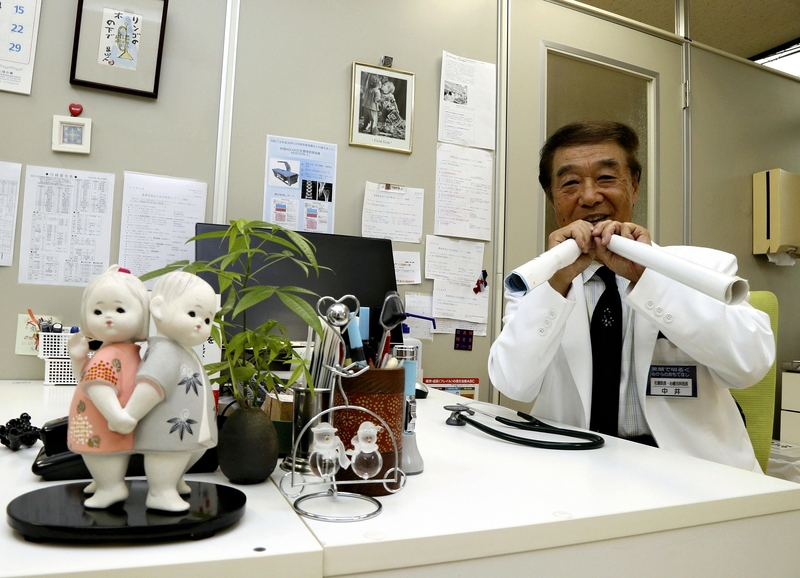
Dr. Yoshihide Nakai, 78, a former chief director of the Japanese Society of Psychosomatic Internal Medicine and current professor emeritus at Kansai Medical University, talked with Yomiuri Shimbun senior writer Hiroya Yamaguchi about the essence of psychosomatic medicine, in which the body and mind are examined without separating the two.
The following are excerpts from the interview.
Fifty years have passed since I became a psychotherapist. But many people still have a misunderstanding of psychotherapy.
Psychiatry deals with such mental disorders as schizophrenia, depression and anxiety. Neurology addresses illnesses related to cranial nerves, such as Parkinson's disease and cerebral infarctions.
In contrast to those two fields, psychosomatic internal medicine refers to "the examination of the body and the mind without separating them." Practiced within the domain of internal medicine, psychosomatic medicine examines the appearance of physical problems and the worsening of chronic illnesses mainly brought on by psychosocial stress. As its Japanese name (shinryo naikai) suggests, a psychotherapist is an internist.
When the Great Hanshin Earthquake occurred in 1995, there was a man in his 70s at an evacuation center set up in a gymnasium whose blood pressure rose in the aftermath of the disaster. Even after taking antihypertensive drugs, his systolic reading never dropped below 180. In our discussions, he revealed that a friend had died before his eyes when a house collapsed in the quake. He had many flashbacks of the scene, and for a month he could barely sleep. I took his hand in mine as I took his pulse, and lent a concerned ear to his words. After that, with the help of sleeping pills, he was able to sleep well, and his blood pressure dropped to the 120s.
Then there were these cases: a man in his 30s, fretting over a personal relationship, who constantly broke out in hives; a woman in her 50s who suffered chest pains from her husband's verbal abuse; a man in his 40s who developed chronic pancreatitis from excessive drinking because his parents showed no affection from childhood. Their conditions could be alleviated by implementing a "holistic therapy" that, on top of precise physical examinations, takes into consideration psychological aspects relating to society and environment, such as families, schools and workplaces.
Of utmost importance in such psychosomatic medical diagnoses is "touching the patient."
At the hospital where I currently work, a man in his 70s was admitted and I became the attending physician. He suffered serious kidney failure which required artificial dialysis, but, as he also had dementia, he aggressively refused the treatment. At first, he yelled at me, "Go home!" But as I started massaging his shoulders and neck, his face became calm and he said to me, "You're very good at that. Who exactly are you?" From then, he regarded me as the "masseur," and several months later, he quietly took his last breath.
For a baby in the womb, touch is the first of the five senses that is acquired. Human's most primordial sensation is touch. Particularly important when we are 1 or 2 years old, it remains so even when we become adults. Palliative care is a case in point. Sitting at bedside, clasping a patient's hand. A sympathetic touch. This makes the patient feel at ease.
However, due to the spread of novel coronavirus, physical contact has become an "evil" act. Online medical examinations are spreading. There are concerns about patients getting good medical treatment. But these are not normal times. During major disasters in the past, emergency physicians played central roles initially, with psychotherapists coming onto the scene after the situation had calmed down. So, I suppose it will take some time before we can make our marks this time.
I myself have experienced many diseases, including infantile beriberi several months after my birth, and miliary tuberculosis and cardiopulmonary arrest due to bacterial shock from dysentery that I suffered during my early elementary school years. Because of this, I continued to ponder on the four inevitables of human life -- life, aging, illness, death -- since I was in elementary school. As a teenager, I read hundreds of books on philosophy and religion. Through these life experiences and from treating many patients as a psychotherapist, what I came to realize was the importance of the "narrative."
Many patients accept experiences such as separations, failures and illnesses negatively. But it is necessary to cast a light on the darkness. I am the person I am now because I went through these hard experiences. There is happiness because there is unhappiness. So is the reverse true. As long as there is death, life will shine its light. I call this way of looking at things as "reverse perspective."
Speaking of my experiences, it was because I was so sickly as a child that I came to think so profoundly about the meaning of life, and am able to empathize with my patients. It was better to go along for the ride on my own "river of narrative." Realizing this after turning 40, it made life easier.
I have treated many elderly patients, and I myself as now among the latter-stage elderly. As we age, our bodies deteriorate and we become more forgetful. We no longer have jobs, and spouses and friends die. While it seems that only losses are increasing, this is not the case. We can get something very valuable when we become elderly. I believe there are three privileges.
The first is to become able to have a bird's eye view of things. The second is the emergence of intuitive awareness. The third is the fading of ego. Instead of doing something for ourselves, we want to do things for others. This equates to "gerotranscendence," the last of the developmental stages as categorized in the field of psychology.
In my case, since passing the age of 70 the number of things that I become aware of has greatly increased. One day, between patient appointments, I was looking out the window at the nearby woods. I suddenly realized "an absolute truth that is more certain than death." To be sure, "death" is an absolute truth, but there is uncertainty as to when one dies. More certain is that "we are alive at this time."
Since then, I have often spoke about this to my patients. Meeting a patient in an examination room means that I am right in the middle of truth. Leading a daily life means we are living in the truth.
The elderly have an abundance of wisdom and power. Their primary role is to convey these things to young people. Despite that, the government's intention to make the elderly work as "producers" can be seen from its policy. It is regrettable.
In the future, cutting-edge medical care will be transformed into one using artificial intelligence. For example, in the case of a breakout of an infectious disease on a cruise ship, if AI-equipped robots are sent aboard the ship for consultation, testing and treatment, infections via medical staff will not spread. Such medical care will likely become possible.
But future medical care will center on that for the elderly with big individual differences, home healthcare rooted in regional communities, and team medicine. What is indispensable for all is communication. It is hard for AI to do this. Notifying a patient that they have cancer in a way best suited for them cannot be done by AI. This is because AI has no "heart."
What I have talked about here is not limited to psychosomatic internal medicine, but is warranted in all fields of health care. There is a difference between medicine and medical care. Medicine is a field of natural science, while medical care is humanics which includes religion and culture. In Japan's medical education, I believe that the subject of "medical care" should be taught thoroughly along with medicine.
Read more from The Japan News at https://japannews.yomiuri.co.jp/