The hay, as they say, is in the barn.
Here at Touchdown Wire, we have made you as ready as possible for the start of the 2020 NFL Draft. We have broken down our top 11 at each position. We have put together our top 50 overall players, along with a list of comparisons for each player, to get you ready for Thursday night. We have assembled various film breakdowns, watched tape with prospects, and given you a variety of mock drafts to game out various scenarios.
But the work goes on, and the dream never dies.
By “the dream,” we mean the NFL hopes for players that might not be included in those previous pieces. Players that might not have cracked a top 11 at their position. Players that might not break into a top fifty list, and players that might have to wait until Friday or even Saturday to see how their NFL story begins.
Part of the reason that people love sports is the underdog story. Rocky. Rudy. Miracle. Movies that capture our attention are rooted in pulling for the longshot. Before they became the Evil Empire, the New England Patriots were the crappy underdog, led by a sixth-round sleeper of a quarterback, taking on the Greatest Show on Turf. It is why people love March Madness, as it taps into our love of Cinderella stories, and why we still get choked up when Gene Hackman says his team is on the floor.
In that spirit, here are some of the best sleepers in this draft class. Underdogs that might not hear their name called until late on Saturday, but players that have both NFL dreams, and NFL potential.
Logan Wilson, LB, Wyoming

Logan Wilson cracked Touchdown Wire’s list of the top 11 linebackers, but as we get closer and closer to the draft the Wyoming defender might be moving even higher on draft boards. Wilson received just one scholarship offer coming out of Natrona County High School in Wyoming, despite being a two-time All-State performer at both defensive back and wide receiver. But after a redshirt year, Wilson was slotted into Wyoming’s defense as a linebacker, and never looked back. Over his four years on campus he played 3,618 snaps, which is almost a Cal Ripkenesque number in today’s college game.
On the field, Wilson is a smart, experienced and patient linebacker who is ready to take on the responsibilities asked of him in an NFL defense. Wilson is a sure tackler between the tackles in the run game, moves well as a blitzer and handles his coverage responsibilities well. Over his career he tallied ten interceptions, an impressive number for any college linebacker. Given the need to stop the pass, linebackers who can both cover and still stop the run are a desired commodity, and Wilson checks both of those boxes.
Beyond that, Wilson checks some of the throwback desirables at the position. If you are a coach or a general manager that loves seeing a linebacker standup a lead blocker in the hole, shed him at the point of attack and make the tackle, then Wilson is going to get you excited.
But he can also contribute plays like this, one of the more amazing moments from the 2017 college football season:
Wilson has the coverage chops and experience to handle the pass defense aspects of the position, but the nose for the football, along with the stack and shed requirements, that will allow him to play on both first and second downs in the league. Perhaps it is no surprise that in Bob McGinn’s pre-draft piece on the linebackers (his pre-draft series is must-read every year) a scout told him that Wilson is a starter with a chance to play every snap given his experience.
Do not sleep on the kid from Wyoming.
McTelvin Agim, DT, Arkansas

As far as underdog stories go, it is hard to root against a prospect who was told in middle school that either an early death or jail time awaited him by his 18th birthday. McTelvin Agin had a rough childhood, moving from school to school and even spending some time living at the Salvation Army. In middle school a principal told him that he would either be in jail, or dead, by his 18th birthday. But he was the top player in the state of Arkansas coming out of Hope High School, and stayed in-state to play for the Razorbacks.
During his four years in the SEC, Agim played all along the defensive line for Arkansas. His senior season saw him spend most of his time on the inside as more of a nose tackle, but he has the length and athletic ability to play at almost every alignment up front. Even from that interior alignment last season he had his most productive year, registering seven sacks and 18 quarterback hurries, all career-high numbers despite playing just 532 snaps, his lowest snap count of the past three seasons.
What gives Agim the potential to stick at the next level is his explosiveness combined with what he brings to the table as a penetrating defensive tackle. Turn on any one of his games and you will see an impressive first step, with the quickness to penetrate gaps off the snap and give offensive lines immediate trouble. You will also see an array of pass rushing moves, as he put on film against Alabama:
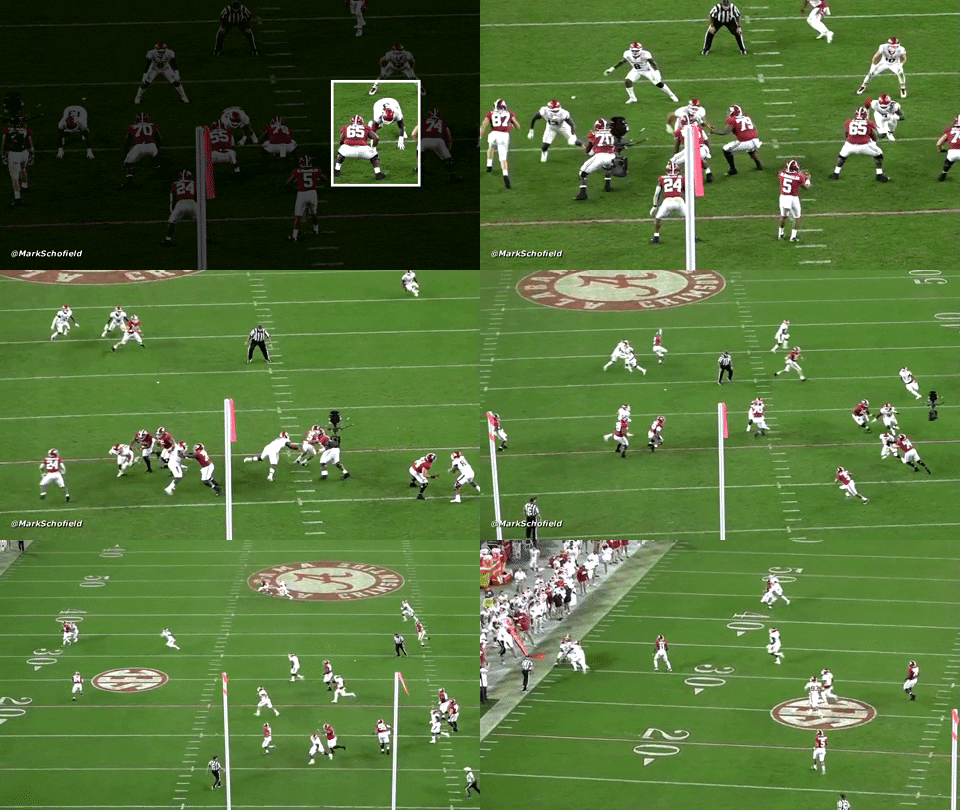
Bear in mind, this came in the second half of a blowout loss to the Crimson Tide, and against Alabama’s starting offensive line. Agim uses a swat to rip combination that scouts would love to see from an edge defender, let alone an interior defensive lineman.
Players like Javon Kinlaw, Derrick Brown and Jordan Elliott might get more attention at the start of the draft, but if a team is looking for a disruptive interior tackle later in the process, Agim is definitely someone to watch.
Logan Stenberg, OG, Kentucky

Interior offensive linemen are, perhaps by dint of their position, sleepers by default. Offensive tackles get all the notoriety during the draft process due to their task of protecting the edges, and handling the talented pass rushers coming off the edge that teams face week in and week out. But the interior guys? Perhaps the best compliment you can pay to an offensive guard is that he is a “road grader in the running game.” Well, this is a passing league so…
But these guys obviously still matter. Especially when you observe what immediate A-Gap pressure can do to even the best of quarterbacks. Watch Tom Brady when he struggles, and chances are you will see that quick inside pressure forcing him off his spot and causing him frustration.
Logan Stenberg might not be the first name that comes to mind when thinking about this draft class, but he will certainly leave a lasting impression on you. His teammates called him the most hated person in the SEC, an almost impressive accomplishment when you consider the options in the conference. Stenberg himself has called his playing style “nasty,” and he drew comparisons to Conrad Dobler here at Touchdown Wire.
This guy:
What makes Stenberg a good prospect is how he combines his nasty streak with his technical side. His hand placement is fantastic at the point of attack, as well as in pass protection. In addition, he plays under control with his feet under him and with patience. Some offensive linemen will wait for the defender to strike, but they lack the ability to truly counter the move the defender puts on them. Stenberg is the opposite. He can be patient during the play but can deftly counter what the defender throws at him.
A nasty technician. I think both Stenberg – and his next quarterback – would love the description.
Tyler Biadasz, C, Wisconsin

Sometimes players become sleepers due to a fall down the draft board, allowing pre-draft expectations to be such that they become enticing once more. Wisconsin center Tyler Biadasz might be that kind of prospect. The three-year starter along Wisconsin’s offensive line was viewed as a potential first-round type of player not so long ago, but has seen his value plummet over the past few months.
Why? Well Owen Riese, who covers both Wisconsin and the Green Bay Packers, as well as coaching the offensive line for the University of Wisconsin-Whitewater, has a theory. In his scouting report on Biadasz the former college offensive lineman writes “[w]hile this hasn’t been confirmed by Biadasz, it’s been rumored/understood that he was playing banged up in 2019 and wasn’t healthy. Paul Alexander, a former NFL offensive line coach, said on Twitter that Biadasz wasn’t healthy.” As a result of playing through injury, he did not look like the player people saw in 2018.
What has this meant for his draft stock? This steady prospect, once viewed as a first-rounder, might be available on Day Three:
The team that drafts him, however, is getting an NFL-ready interior lineman. Biadasz checks many of the technical and mental boxes you look for in a center. He processes interior blitzes well, he constantly looks for work, and comes from a “pro style” offense that uses a varied run blocking scheme as well as a variety of protections when the quarterback drops to throw. His battle with Davon Hamilton from Ohio State was a fascinating one to watch. The big defensive tackle got the better of Biadasz on a few times with a bull rush, but the center was able to handle Hamilton on a variety of pass rushing opportunities as well as in the running game. His experience puts him into a position to step in perhaps on Day One on the inside of an NFL offense. Getting that on Day Three – and from a potential first-round talent – would be one heck of a steal.
John Hightower, WR, Boise State

The depth of this year’s wide receiver class is going to push some tremendous talent down the draft board. Boise State’s John Hightower might be one such example. Hightower was a three-star recruit coming out of the JUCO ranks, having played junior college football at Hinds Community College in Mississippi. He considered scholarship offers from Arizona State and Kansas but opted for the blue turf at Boise State. While on campus, Hightower has been a true vertical threat. During the 2018 season, his first with the Broncos, Hightower’s average depth of target was more than 18 yards downfield and he turned his 46 targets into 31 receptions for 504 yards and six touchdowns.
The first box that he checks as a receiver, particularly a vertical threat, is speed. Hightower ran a 4.43 40-yard dash at the Combine in Indianapolis, with a 1.49 10-yard split, a split that placed him in the 98th percentile among wide receivers. This is not just track speed, however, as it shows up on tape:
You often hear the expression “if he’s even, he’s leaving.” Hightower shows that on this play. He wins the route on the first few steps off the line, erasing any semblance of a pre-snap cushion and getting into top gear in a flash (remember that 10-yard split). From there, Hightower just extends the separation, showing that long speed en route to a huge touchdown.
Vertical threats need to have great ball tracking skills downfield, and that is a box that Hightower checks as well:
Hightower’s vertical route takes him up the field well inside of the numbers, but the throw here from his quarterback takes him almost to the bottom of the numbers themselves. But the receiver tracks this football perfectly, secures the reception, and races to the end zone for the core. Oh, and you probably noticed the separation he got on this route as well.
Denzel Mims and Tee Higgins are looked at as perhaps the top two vertical, X type of receivers in this class. Teams that are eyeing those players in the top half of this draft and miss out might be overjoyed if the Boise State product is staring them in the face come Day Three.
Tyler Huntley, QB, Utah

Quarterbacks often dominate the pre-draft discussion, and this year’s process is no different. From speculation over Tua Tagovailoa’s hip, to the possibility that Justin Herbert is the second quarterback off the board, to the discussion about Jalen Hurts and Jake Fromm on Day Two, some of the names at the top are generating a ton of buzz, and content, in the final few hours before the event begins.
But what if I told you that one of college football’s most efficient passers in history was in this draft class, was not even invited to the Combine, and might not even get drafted at all?
Meet Utah quarterback Tyler Huntley. A three-year starter for the Utes, Huntley took his game up a notch during his senior campaign. Last year he completed 72.3% of his passes for 3,048 yards and 19 touchdowns, all of which were career-high marks. His college passer rating of 120.2 was a career-high. According to grading from Pro Football Focus, his overall grade of 90.0 was eighth overall in the entire country. We mentioned efficiency? Well, Huntley’s mark of 177.6 was the 25th best in FBS history, the fifth-best number in FBS a season ago, and the top mark in all of the Pac-12.
Yes, above the aforementioned Herbert.
What does Huntley do well on the field? First it is his ability to make smart, quick decisions with the football and to get the ball out quickly while still working through progressions. Huntley is very adept at ruling throws in or out prior to the snap, depending on the defensive alignment. If he sees soft coverage or a big cushion, or an uncovered receiver in the slot, he will make you pay immediately after the snap. He also brings athleticism to the table as a quarterback. He can extend plays with his feet and mask protection problems up front. His game might be termed as the best insurance policy for an offense, because when things break down, he can still keep the offense on schedule.
If coaches and general managers are forced to rely more on film this draft given the lack of Pro Days and Top 30 visits, they are going to love what they see from Huntley. He might not have gotten an invitation to Indianapolis, but his tape and improvement over the course of his time with Utah speaks for itself.
Devin Asiasi, TE, UCLA

Ask anyone who covers the NFL and/or the NFL draft about this tight end class, and their response might resemble something of quiet desperation. As they say, hanging on in quiet desperation is the tight end way. Or the English way, I forget. Anyway, where were we?
Right, the tight end class. It is not the best group of players, in contrast to last season when a pair of TEs were drafted in the first round. In fact, perhaps the top two at the position, Cole Kmet and Adam Trautman, are sleepers in their own ways. Kmet is a former left-handed relief pitcher for Notre Dame whose pitching days were cut short due to an elbow injury, raising some injury concerns about his time on the gridiron. Trautman, a former high school quarterback, went the FCS route and now has to battle the small school tag.
Beyond those two players, however, is a Pac-12 tight end who might be the potential dual purpose TE this draft needs. Asiasi originally committed to Michigan out of California powerhouse De La Salle High School, but after a season in the Big Ten he returned closer to home to play for the UCLA Bruins. Last year was something of a breakout season for him, as he caught 44 passes on 68 targets for 641 yards and four touchdowns.
In a draft class lacking true “do it all” tight ends, Asiasi is a rare bird. He has the ability to slot in next to the tackle and handle the blocking responsibilities asked of him, in both the run and the pass game, but also can detach from the line and be a threat as a receiver. In the passing game he shows the awareness to find open spaces in zone coverage, and his releases off the line of scrimmage are sudden and with purpose. He threatens the leverage of the nearest defender well, and when jammed off the line he barely loses a step.
With so many move-type TEs in this class, Asiasi could benefit from being one of the more traditional type players available to teams. He has the traits and experience to play more of an inline role, and there is something to work with when it comes to the receiving part of the position. Come the later rounds he might be one of the best options at the position, and someone that can contribute immediately as a rookie given his experience and all-around ability.
Derreck Tuszka, EDGE, North Dakota State

One way to measure how much of a sleeper a prospect is is whether there are images of him already saved in the USA Today photo library. For North Dakota State Edge Derrek Tuszka, the cupboard was bare.
He might not be a sleeper for much longer.
As you get into the third day of the NFL Draft teams can bet on a prospect in one of two ways. Perhaps the player has elite athleticism, such as Utah defensive back Javelin Guidry. The defender ran a blazing 4.29 40-yard dash at the Combine, and on the final day of the draft betting on pure speed is something of a safe bet.
Or, a team can bet on production. The team that drafts Tuszka is going to be making that bet. Last year was a career season for the Bison defender, as he tallied 15 sacks, 13 quarterback hits and 28 quarterback hurries. According to charting data from Pro Football Focus, Tuszka won nearly a quarter of his pass rushing snaps last year (24.7% to be exact) and had 56 total pressures on 255 such opportunities. He was dominant against FCS offensive tackles, turning in reps like this on film:
That is an offensive tackle that is simply over-matched.
Two factors are going to push a player with Tuszka’s production down draft boards. First, the small school aspect. He was turning in these numbers against tackles who are going to be pursuing careers away from the football field, for the most part. Then there is the size element. Tuszka is undersizes by NFL standards, as he measured in just the sixth percentile in weight for his position, and the third percentile for hand size. Teams might shy away from him unless they are convinced that adding on weight is not going to slow him down around the arc.
But on the final day of the draft, betting on that level of production might be a smart investment.
Dane Jackson, CB, Pittsburgh

Attending the Senior Bowl has been something I’ve done for each of the past five years. The week of practices down in Mobile, Alabama is the official kickoff to draft season, and as Jim Nagy, the Executive Director of the Senior Bowl, likes to tweet: #TheDraftStartsInMobile.
Every year the process for me is the same. I set up shop in the north end zone, giving me a bird’s eye view of the practice unfolding below me, and something of a window into the mind of the quarterbacks as they go through each drill. Of course, you try to watch everything, but there is a lot to keep track of. This year, I was watching the quarterbacks throw during a one-on-one session between the receivers and the cornerbacks when a defender broke up a pass at the catch point and was pretty vocal about it after the play. Turning to the other media members near me I asked who the defender was.
“Dane Jackson, from Pittsburgh” was the response give in chorus.
A notation was made in my notebook, and over the following weeks and months I started to watch more of him on film. You see almost everything you want in a cornerback, starting at the line of scrimmage. Jackson is a solid, talented press cornerback who can end routes at the line before they begin. But beyond that, his ability to break on throws and disrupt at the catch point is among some of the best in this class:
Jackson’s entire week was like this down in Mobile, and it backs up moments like this on film (he is at the top of the screen here):
Jackson never loses track of his receiver, fights at the catch point, and creates the turnover opportunity.
Here he is again fighting through the route and to the catch point, preventing a completion in the vertical passing game:
What likely pushes Jackson down draft boards is his size and athletic testing. Jackson weighted in at 187 pounds at the Combine, and life as a press coverage corner playing under 190 pounds is a tough way to make a living. Bigger, more physical wide receivers will have a distinct advantage against him. Furthermore, if Jackson lost weight to test well out in Indianapolis, he did not fulfill the other end of the bargain. Jackson ran just a 4.57 40-yard dash, and his three-cone drill of 7.07 seconds placed him in the 38th percentile of cornerbacks.
On film, however, he checks the boxes you want to see checked from a press cornerback. Teams that rely on that style of play might still love what they see.
Rico Dowdle, RB, South Carolina

In the major media space, there are names that one can turn to when it comes to studying specific positions. In terms of evaluating offensive skill players, one of the keenest minds is that of Matt Waldman. Waldman has been studying the game for years and his Rookie Scouting Portfolio, which always goes north of 1,000 pages, is one of the premier pre-draft publications. This year’s version covers 1,194 pages, and when Waldman speaks highly of a player, I take notice. NFL teams do too.
In this year’s version of the RSP, one of the players that Waldman highlights at the running back position is Rico Dowdle, an often-injured running back from South Carolina. As a freshman, Dowdle rushed for 764 yards and six touchdowns, averaging almost 5.7 yards per carry and as Waldman termed it, he spent that season “playing peak-a-boo with defenders between the tackles with a style reminiscent of Joe Mixon and Le’Veon Bell.”
Unfortunately, Dowdle never replicated that production, let alone built on it. He battled injuries throughout his college career. His freshman campaign might have seen more production, had he not missed the first four games of the season recovering from sports hernia surgery. In 2017 he looked to be building off that strong finish to his freshman season when he scored a pair of touchdown in South Carolina’s season-opening win over NC State, but he broke his leg and missed the final five regular season games.
In 2018, Dowdle suffered a hamstring injury early in the season and was relegated to sharing the load with Mon Denson and Ty’Son Williams. Even in a rotational spot, Dowdle managed over five yards per carry.
Last season, the job seemed to be his alone. Williams transferred to BYU, and Dowdle earned the starting spot in preseason despite suffering an ankle sprain. After getting off to a solid start, his season was hampered by a knee sprain that limited his effectiveness this past season.
But when he is healthy, he can be a force as a runner and out of the backfield in the passing game. This touchdown run from his freshman season highlights his vision and change-of-direction ability:
First is the vision, as Dowdle identifies the cutback opportunity to his right. But then he implements a jump-stop move, flashing that change-of-direction skill. In the open field, Dowdle as great feel for the external threat, as he implements a spin move to avoid the would-be tackler and take this play the distance.
This cutup from The Ringer’s Danny Kelly also displays some of his skills, including his balance, his ability to finish runs falling forward, and what he offers after the catch out of the backfield:
As noted by Kelly, while Dowdle did not do all of the drills at the Combine, his vertical of 38 inches and his 10 foot 7 inch broad jump are both elite for running backs, according to Kent Lee Platte’s Relative Athletic Score system.
Putting this all together, it is clear there is promise and potential. As Waldman writes, “[Dowdle’s] also a professional-caliber athlete on the field.” Waldman expands on that, stating that “[if NFL scouts] decide there’s reason to limit the weight of [South Carolina’s] perspective and an NFL organization selects Dowdle late on Day Three, it could be an indication that they believe Dowdle has potential value worth a firmer investment. The film says so regardless of the limited production.”
In a year and in a climate where the teams are going to rely on the film more than ever, Dowdle might be worth that firmer investment.
Reggie Robinson II, CB, Tulsa

Reggie Robinson II was a three-star recruit coming out of high school, having played both safety and wide receiver for Cleburne High School in Cleburne, Texas. He entertained offers from schools like Houston, North Texas and Minnesota, but elected to play for Tulsa. While on campus, Robinson was a four-year starter at cornerback after a redshirt season, and parlayed his experience on the field into a spot down in Mobile for the Senior Bowl.
On film, Robinson shows flashes of what you want to see from a cornerback. He has the ability to play press coverage and just erase receivers at the line of scrimmage, and displays that throughout his game tape. But there are also times when he seems to struggle against a variety of different receivers and skillsets. One thing that is trending in his direction is the passer rating allowed over the past few years. Back in 2017 he gave up a passer rating of 92.9 when targeted, but that dropped to 64.6 in 2018 and 52.6 last year. That trendline is something you love to see when projecting growth to the next level.
Plays like this are what you also see from him when he is at is best. This quick cutup from Ben Fennell, who covers the league for a variety of outlets and also does work for the Philadelphia Eagles, highlights his coverage skills and what he offers on special teams:
On that first play you see the sticky man coverage skills Robinson offers. He stays in perfect position on the receiver, right in his hip pocket. That puts him in position to make a play on the football and come down with the interception.
Robinson also moves well for the position, as he displayed at the Combine with a 4.44 40-yard dash as well as during positional drills. He has the size and length that are almost ideal for the position. What he needs is consistency. Helping him is the fact that he can contribute on special teams, given his prowess at blocking kicks. That might enable him to stick on a roster, giving him time to sort out the technique and consistency issues that are holding him back.
Josh Love, QB, San Jose State

You had to know that one more quarterback was making this list.
Jordan Love is not the only QB with a nameplate that reads “J. Love” that is worthy of a draft pick. His counterpart from San Jose State, Josh Love, fits that bill as well. The Spartan took an interesting road to San Jose State, as Love spent time at two different high schools including Tesoro High School before finding his way to Long Beach Poly High School. While at Tesoro, the head coach was fired and the quarterback coach pled guilty to heroin possession, forcing Love to look to a different program.
While at Long Beach Poly, Love played well enough to become a three-star recruit and the 71st pro-style quarterback in the country. But that was not enough to earn any scholarship offers, probably because most schools were onto the next recruiting cycle. Love walked on at San Jose State, earning playing time in both 2016 and 2017 before becoming the starter in 2018.
Last year, however, Love shined. He completed 60.9% of his throws for 3,923 yards and 22 touchdowns, with just eight interceptions. He became the first player in school history to earn Mountain West Offensive Player of the Year honors, and according to Pro Football Focus he was one of the ten most valuable players in all of college football last season.
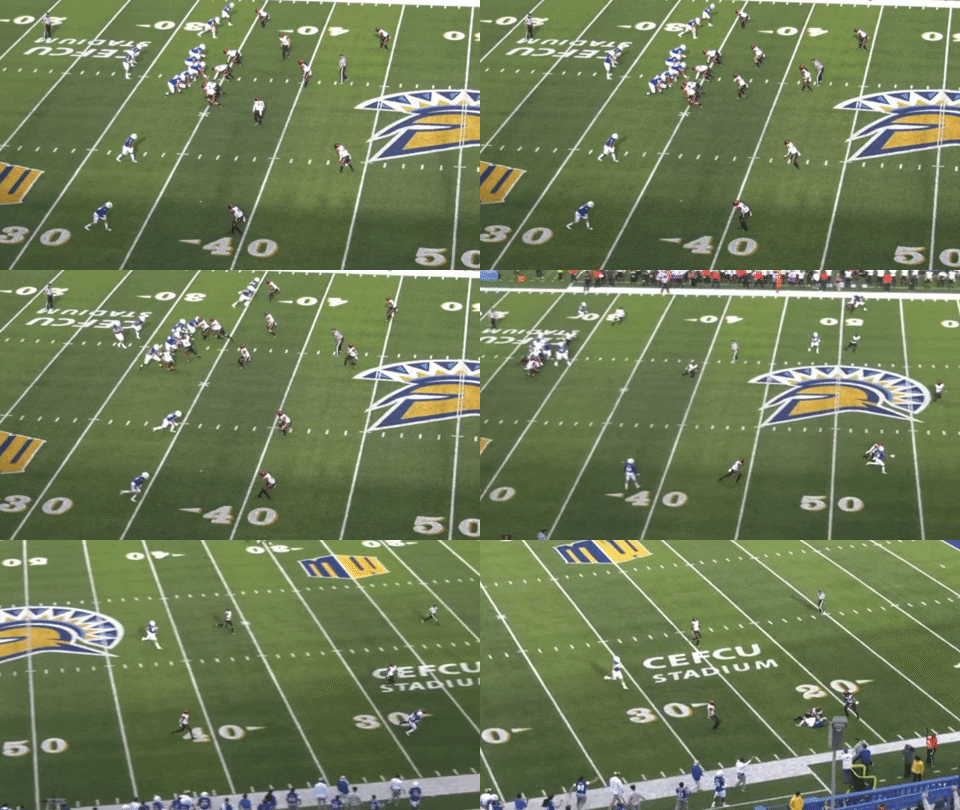
Watching him on film, two things stand out. First, the ability to push the football downfield in the vertical passing game. On this play against San Diego State, he drops in a bucket shot on a slot fade route to open the proceedings:
Then, Love is fearless in the pocket. He put up over 400 yards on Arkansas on the road this year, and again, he opens the game with this beautiful downfield throw knowing full well he is going to take a shot:

Love is undersized, just a hair taller than six feet and that will certainly move him down draft boards. He also has just the one season of true upper level production. But if a team is willing to take a flier on him on the third day of the draft, they might just cash in a lottery ticket.