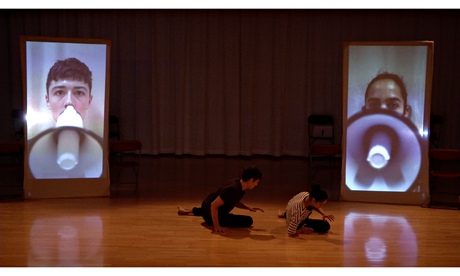
The informal sharing of works in progress has become an integral part of contemporary dance-making. The process allows choreographers to try out ideas in front of an audience, to solicit peer opinion and to give potential funders an idea of projects in hand. Sharings of work are usually private; choreographers are understandably wary of showing partly formed work. But last week the Place opened its autumn season with Touch Wood, a paid event open to the public.
Four works were on offer in Wednesday’s programme, in various stages of evolution. In The Face to Face, James Morgan and Esther Siddiquie showed us a fragmentary duet, a video projection (by Alex Springer) of Morgan and Siddiquie issuing commands to each other by megaphone – “Thou shalt not kill me” – and an audio recording of a brief passage from Pride and Prejudice.
How these elements will fit together is anyone’s guess; mystification is part of the pleasure of these occasions. Even more cryptic was Freddie Opoku-Addaie’s Unplugged Bodies, in which Opoku-Addaie shuffled and leapt explosively in front of a still projection of himself and the dancer-choreographer Kyoung Shin Kim.
Brian Lobel and Catherine Long are interested in the way that fitness classes and other group movement activities stigmatise bodies that don’t comply with the ideal, normative, “sexy” model. Grinding Thoughts is a participatory piece, presented with much good humour, inspired by The Grind, a 1990s MTV workout series that featured ripped young dancers freestyling in micro-shorts and crop tops. By applying the same moves to civilian bodies in all their diversity, Lobel and Long highlight the casual body fascism informing this kind of entertainment.
Jo Meredith’s Margarete investigates the tragic heroine of Goethe’s Faust, whom Faust grooms, seduces, impregnates and abandons. Meredith, a choreographer with a growing reputation, works with text created by long-time collaborator Sean Bruno. Using five dancers, she shows us a stylised folk dance set to barrel organ music and the sound of gulls. Margarete, a voiceover tells us, “pours tonic into thin glasses of gin” and “doesn’t want to die in a seaside town”. In another fragment, a minimalist dance unspools to a spoken meditation on the sea (“to hate it would be to hate yourself”). The result, while already displaying the intensely distilled character of Meredith’s work, is wholly enigmatic, but it’s enough to set the hook. I want, very much, to see the finished piece.