OSAKA -- If you consider moss to be somewhat unspectacular and somber, you might have to change your mind. Many people are attending events where moss is displayed in glass jars or in the bonsai format, and stores are offering moss products for interior decoration. Moss, in fact, is now considered something that puts people at ease.
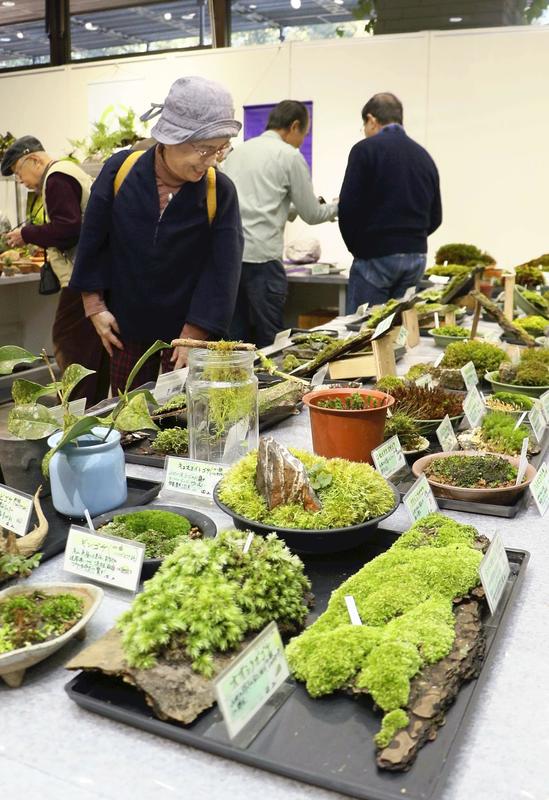
An event featuring moss at the Kyoto Botanical Gardens in Kyoto in November drew more than 3,200 visitors across three days, from inside and outside Kyoto Prefecture. About 300 items were on display, such as bonsai and terrariums (transparent enclosures in which plants are cultivated). Illustrated encyclopedias and guides for beginners were on sale, while sessions on moss observation and workshops on making terrariums were offered.
"Moss looks very beautiful with water droplets," said Keiko Tazaki, 58, who visited the event all the way from Oita. "I cultivate moss at home and feel comforted when looking at and touching them."
The botanical garden has held annual moss events since 2013, with more than 3,000 visitors each time.
At last year's event, the organizers set up additional booths outdoors for displaying or selling items to respond to the large number of visitors. "This is one of the most popular events held here," said Hisao Ogawa, an official at the garden.
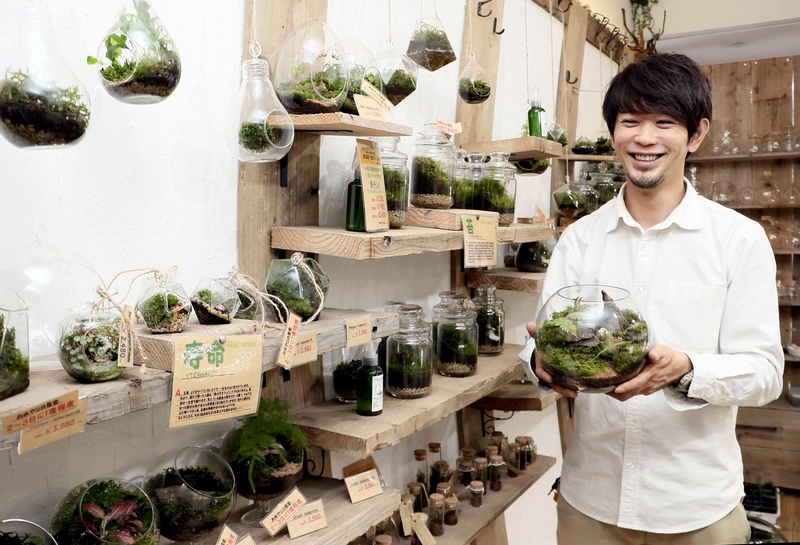
Last summer, a store focusing on moss terrariums opened in Chuo Ward, Osaka. "Many people want to make a terrarium for interior decoration at home," said Yutaka Imada, the 35-year-old owner of Moss-Connect.
The shop offers workshops that require advance booking due to it being able to accept only one group of two to four people a day. They are already booked until April, according to Imada.
"It's easy to take care of moss: Basically, all you have to do is spray water on them. In addition, the plant is strong and can grow anywhere," Imada said. "Moss looks ordinary, but seem to stand firm and do their best -- this is why, I believe, people feel comforted by looking at them."
The growing popularity of moss is behind an increasing number of related products and books hitting the shelves. Vixen Co., an optical equipment maker in Tokorozawa, Saitama Prefecture, known for its binoculars and telescopes, released a kit for observing the plant in July 2016.
Designed for those who want to enjoy the activity outdoors, the set includes a small loupe magnifier, a guidebook and tweezers -- all in a pouch. The loupe, which has 10-times magnification, can be placed over a smartphone camera lens for taking photos. The kit is sold for around 4,000, yen mainly at home electronics stores nationwide.
Bun-ichi Co. in Tokyo published a revised edition of a moss guidebook in September after its original edition, released in 2013, sold well. The publisher added extensive information, doubling the number of moss varieties to 100 and providing more detailed information on locations suitable for observing moss across the country.
"Moss is small and pretty, and its appearance attracts young people in particular," said Kensuke Shimizu, 42, the editor-in-chief of the section that compiled the guidebook. "More and more women enjoy climbing mountains, and it's become easier to share photos thanks to smartphones and social media. I believe these factors have contributed to putting moss in the spotlight."
Easy maintenance
According to Imada, all you need to cultivate moss at home are soil and a container; fertilizer is not required. "As the plant doesn't have roots, it absorbs water and photosynthesizes over its whole surface," he said.
A soil called akadama-tsuchi is often used for gardening. Put the soil in a container before placing your favorite moss on it. Moss looks nicer if you use tweezers to bury its base in the soil. You can also cultivate moss on stones or roof tiles.
To water moss, use a spray bottle and spray the entire plant. How often you need to water depends on the type.
Sunagoke (racomitrium moss) and gingoke (silvergreen bryum moss) are among the varieties tolerant of dryness. These require watering about twice a week and should be put in a plate or a vessel without a cover. They can be exposed to direct sunlight, such as near a window or on a balcony.
Varieties that like humidity include tamagoke (bartramia moss), which needs watering about once every two days. If you put them in a vessel with a cover, you only need to water them once every one to two weeks, as it stays humid inside. Do not expose them to direct sunlight.
"To bring home moss growing on mountains and in other places, you should obtain a permit from their owners," Imada said.
Read more from The Japan News at https://japannews.yomiuri.co.jp/