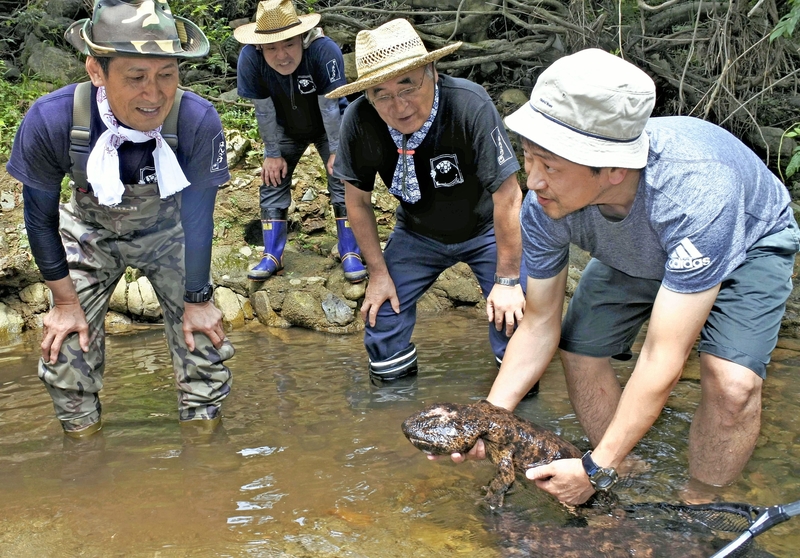
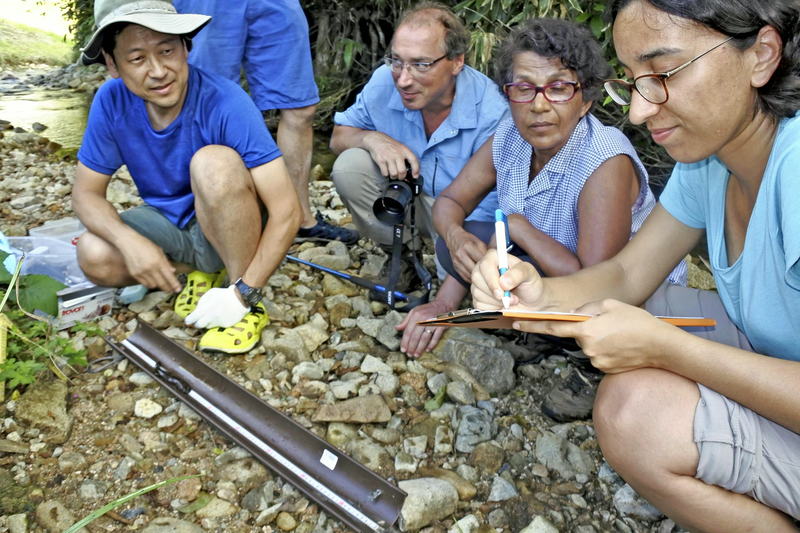
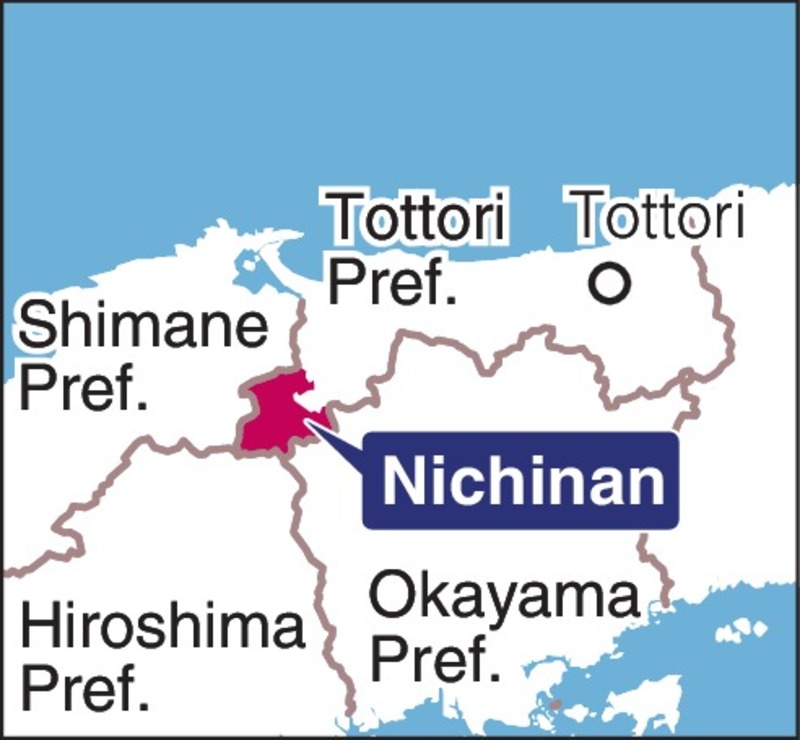
NICHINAN, Tottori -- In early August, a Dutch family of four, participating in a nature tour, exclaimed in admiration as they spotted a young giant salamander, about 20 centimeters long, in the shadow of rocks in a clear valley stream -- also the habitat of Japanese singing frogs and yamame trout -- in the Tari district of Nichinan, Tottori Prefecture, roughly in the center of the Chugoku mountain range.
"The presence of young giant salamanders is proof that the species has been breeding," remarked Sumio Okada, 51, director of nonprofit organization Hanzaki Research Institute of Japan in Asago, Hyogo Prefecture. Serge Ligtenberg, 55, the father of the family, said with a smile: "It's wonderful. We were able to connect with the rich nature and the ecosystem."
Nichinan, located in the headwaters of the Hinogawa river, which flows into the Sea of Japan, is one of the foremost habitats of the giant salamander, a special natural treasure. In cooperation with several parties, including the institute, which has been conducting ecological surveys there, the town has been promoting ecotourism, aiming at both the protection of the giant salamander and the utilization of the rare species for tourism.
The giant salamander, nicknamed "hanzake" by local residents, used to be seen often in the town, even in streams near private houses. Locals were not particularly aware how special the local natural environment was.
When a national convention to protect giant salamanders was held in the town in 2009, attracting researchers and conservationists from far away, many of them praised Nichinan's natural environment. Local residents came to realize the value of the environment in which they coexisted with giant salamanders.
After the convention, residents of the Tari district and others invited Okada, who made great efforts to host the convention, to be an adviser, and established a group to protect the hanzake of Tari.
"We've been doing what we can do for giant salamanders for 10 years since then," said Yoichi Omoda, 63, who leads the group of about 20. They would clean up the river before the end of summer, the giant salamander's mating season, or hold events to observe the animal.
However, due mainly to the building of forest roads and bank protection, the habitat of the giant salamander has been diminished year by year, making it difficult to preserve their habitat with only the Cultural Properties Protection Law, which defines natural monuments.
Therefore, Okada and his group members launched activities to have the ecotourism promotion law -- which allows local governments to restrict people from entering designated areas -- apply to the habitat.
Among the efforts is a giant salamander observation tour for foreign visitors that started in April 2018 with the help of a British guide living in the prefecture. Interest in the giant salamander, known as "the world's largest amphibian" or "a living fossil," is high overseas. Nearly 100 people have joined the tours. Some of the profits from the tour are used for activities to conserve their habitat.
In spring this year, the group set up the Nichinan ecotourism promotion council together with groups working to protect himebotaru fireflies and primrose in the town. They plan to compile a comprehensive conceptual outline on how to conduct ecotours and promote environmental protection, among other steps, in about two years, before applying to the central government to have the town designated under the law.
Council secretariat member Shinya Yamamoto, 32, said, "We're set to make Nichinan an advanced area in terms of ecotourism."
"Our efforts are nothing more than a thin thread right now, but I want to work closely with the people of the town and foster our efforts into becoming a very thick, strong one," Okada said.
16 ecotourism regions
The idea of ecotourism, efforts to convey the attractiveness of a region in terms of the natural environment, history and culture, while harnessing tourism for conservation purposes, is believed to have originated in Europe and the United States in the 1980s, before beginning to spread in Japan around 1990.
The enforcement of the ecotourism promotion law in 2008 prompted moves to utilize the law for town vitalization around the country.
If a comprehensive plan compiled by a local government is approved, it will be able to use punitive measures to restrict people from entering areas that need special protection. It also can receive financial support from the central government for public relations activities and human resource development.
Sixteen regions have been recognized under the ecotourism promotion law. They include the villages of Tokashiki and Zamami in Okinawa Prefecture, which have beautiful coral reefs, and Nantan, Kyoto Prefecture, where many thatched houses still exist.
-- Town rich in nature
Located in the southwesternmost corner of Tottori Prefecture, 90 percent of Nichinan's area is covered by forests. Its main industry is forestry. As of the end of July, the population stood at 4,543, with people aged 65 or older accounting for 50.6 percent of the population.
Mt. Sentsu on the prefecture's border with Shimane Prefecture is considered to be the setting of the legend of Yamata-no-Orochi, the giant eight-headed snake, in Kojiki (Records of Ancient Matters) -- Japan's oldest history book. Iron-making based on the tatara iron manufacturing method was active in the area from the Heian period (794 to the late 12th century) to the Taisho era (1912-1926).
Surrounded by 1,000-meter-class mountains of the Chugoku mountain range, the town is rich in underground streams. There is a natural habitat for primrose, which is rare in Japan. Himebotaru fireflies are seen there in summer.
Read more from The Japan News at https://japannews.yomiuri.co.jp/