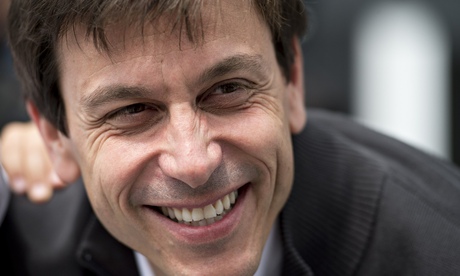
Toto Wolff has appealed to Formula One to stop being so self-critical. On the eve of the British Grand Prix, one of the season’s highlights, the Mercedes team principal has called for the sport to pull out of a vortex of criticism. “We have got into a spiral where everybody with a negative message to deliver has found an ear,” he told the Observer. “All of us involved in the sport are stakeholders and our duty is to help to promote it and make it attractive.”
Wolff is an increasingly calm figure at the vanguard of F1, but he is cross to the point of incandescence at the way his sport has been attacked by officials, drivers and commentators. F1 has been something of a soft target this year as his Mercedes team have dominated, with none of the other nine teams – even Ferrari – capable of mustering a meaningful challenge.
Bernie Ecclestone, F1’s chief executive, last month used the word “crap” to describe the “product” he has to sell. On Saturday Ecclestone said: “We are damaging it ourselves and I am as guilty as anyone.” This past week, Max Mosley, a former president of the FIA, the sport’s governing body, and the man who worked closely with Ecclestone to turn F1 into a global empire, said: “There are no two ways about it, if Formula One continues on its current path, it is headed for a major crisis.
“The futures of six out of 10 teams on the grid are uncertain, there is too much artificiality in the racing, costs are far too high, and all that is giving us uncompetitive – and at times – boring racing.”
Drivers, past and present, have also lined up to attack the sport. Wolff, however, says: “The way we are speaking about, it or writing about it, determines the way it is perceived. Because how many people have access to the paddock and are able to look at cars and make a judgment? The answer is very few. But there are tens of millions watching a grand prix at weekends and what we tell them is what they perceive to be happening. If we are our own worst salesman how will they ever buy into our product? It’s like a CEO of a car company saying: ‘My car is a crap car. Who is going to buy that car?’ I know people will say about me: ‘Of course he’s not criticising because he’s winning.’ But we are developing a negative momentum. If you’re in a spiral of nonstop criticism it will trigger opinions from people who have no clue.”
There is a worry in the paddock that there may eventually be no product to sell, that more teams could disappear, together with sponsors. “It’s like putting your profile on Facebook,” Wolff said. “You’re not going to put your most ugly picture on Facebook and you’re not going to say that actually I’m not sporty, and I’m not very intelligent, and I’m not very good looking either. But please like me. You have to show your best side, try to promote yourself – even if you think you are ugly and you should be losing weight.” He added: “We need to take criticism on board. But we also need to be positive.”
Wolff has been particularly angered by suggestions that the current cars are too easy to drive. Nigel Mansell, the 1992 champion, said recently: “Drivers can drive with a couple of fingers.” David Coulthard said after last month’s Canadian Grand Prix: “The sport has gone from the bucking bronco cars driven by Ayrton Senna, Alain Prost and Nigel Mansell to an exercise in systems management which Fernando Alonso likened to piloting airliners. The drivers are just not tested sufficiently.”
To those criticisms, Wolff said: “It’s fair enough to ask are the cars loud enough. But when I hear people say they are easy to drive that is absolute nonsense. Go and ask any driver. He will tell you that the car is difficult to drive.
“I had lunch with Nico [Rosberg] recently and he told me that these cars are mind-blowingly fast and so hard to drive. The cars are very difficult, intellectually and physically.”
Yet, as Wolff concedes, this hardly matters if most of the fans find the sport too “expensive,” “technical” and “boring”, as revealed in a recent survey. Tellingly, 89% said that racing had to become more competitive.
The best news for F1 in the past week came at Wednesday’s meeting of the habitually hopeless Strategy Group, which is made up by the six leading teams, plus Ecclestone and the FIA president, Jean Todt. It came up with some positive ideas for once – although the most important issue, that of costs and the distribution of money, has still to be resolved.
Speaking about the most significant of the proposed changes, Wolff said: “It would be good to stop all radio communication with the driver, which makes the car appear remotely controlled from the pitwall. We are also going to make the cars noisier. We should also do more stuff with the drivers. We’ve said to Bernie to bring the drivers downtown and show them to the people. There’s no reason why the drivers should not be more accessible. The more we can have them with the fans the better.”
The torrent of criticism has undoubtedly damaged F1, but if that has finally provoked a reaction – especially from Todt and Ecclestone, who have shown a lack of leadership – so much the better.
Meanwhile, the best response to Ecclestone’s disparaging comment at Silverstone this weekend came from the Force India’s team principal, Vijay Mallya, who said: “He shouldn’t be selling the product if he thought it was crap. But considering that he sells the product – that he calls crap and makes billions out of it – he needs to work with the participants to uncrap it!” Precisely.
WHAT’S WRONG WITH FORMULA ONE?
Mark Webber, former Formula One driver “There’s two things essentially wrong: First, on the sporting front F1 needs to get rid of Pirelli. The tyres have no grip, which means the drivers aren’t able to follow each other because when you do, you damage the tyres. Even if Pirelli increased the grip of their tyres, we would need three or four pit stops per race and that would be comical too. What the sport needs is more noise and more grip.
Second, there is the commercial concern. F1 is a business model that hasn’t moved with the times. Sponsors want their pound of flesh, access and more rights and unfortunately F1 doesn’t deliver. It means the teams are becoming ever more reliant on drivers bringing their own budgets so F1 is no longer the place it was for the best drivers in the world. Unquestionably, the top half-dozen are the crème de la crème of the sport but we’ve never had so many ‘pay’ drivers on the grid as wedo now.”
Derek Bell, five-time winner of Le Mans 24 Hours “What people are overlooking is that Formula One is a spectator sport: we are out there to entertain the public and we are in the entertainment business and we must never forget that. For the spectators to have to read a handbook to their son or daughter trying to explain why the guys are coming in for this, that and the other and some are slower than others and the difference between the tyres that have yellow lines and those that have red lines.
Equally, technically it’s gone too far. I know the manufacturers have to show willingness to do hybrids but it doesn’t help racing. There is also a need to restrict the ridiculous rise in the technical costs of running the cars and we need to make them not so technical to drive, so the public can understand what the drivers are doing. Make it simpler.”
Roger Davis, Formula One fan “I’ve followed Formula One and motor sport generally all my life. My first British Grand Prix at Brands in 1978 cost about £6 and was fantastic. It was a real spectacle then, there were 30 cars on the grid, it was the pinnacle of motor racing. But really I miss the characters. F1 now is all a bit too corporate, it’s sanitised. It’s all spin and corporate speak. For me, Niki Lauda and Kimi Raikkonen are the best people in F1 because they speak their minds.”