After two Tests the boot is firmly on the other foot. The balance of power shifted alarmingly from England, after their exhilarating win in Cardiff, to Australia, who repaid the hosts at Lord’s with a level of interest that would have embarrassed Wonga. Such has been the change, and the reaction to it, that we need reminding that the series actually does stand level. So what we have now, effectively, is a three-Test series.
If England could have picked a ground on which to seek retribution they might well have chosen Edgbaston, their most successful home venue of those that have staged a significant number of matches. Of their past 10 matches here they have won six, and lost only that match in which, in the fourth innings, Graeme Smith played one of the great captain’s innings to take a game for South Africa in 2008 they had no right to win.
Here it was, a decade ago, that England overturned their loss at Lord’s to Australia, and snatched a last-ditch win which changed the course of that famous series. The team respond to a raucous crowd, and this contest in particular will not be played out to the background of a gentle St John’s Wood hum.
England have made changes, an inevitability given the nature of the performance in the second Test. Gone is Gary Ballance, whose quirky technique has been brutally exposed and needs serious reconstruction if he is ever to regain his place as a first-choice batsman, and Ian Bell, on his home ground, is charged with leading the way from first wicket down.
He is to be envied the honour (it should be the pinnacle of any batsman’s career to occupy the pivotal position for his country) if perhaps not the circumstance. If the No3 has to be an opener or a middle‑order dasher, according to the situation, then he does not, currently, have a secure opening partnership above him as Steve Smith has, and he will find Australia’s bowlers, with a new ball, a torrid proposition, particularly during his early overs when he has become increasingly vulnerable. At his best Bell is a wonderful player who has hurt the Australians in the past, but his career might just be at a watershed.
Ballance’s replacement, Jonny Bairstow, has earned his place through the sheer weight of runs he has scored for Yorkshire this summer. There will have been discussion as to whether he should have been picked at No5, as is the case, or put at No6, with Ben Stokes moving up. Certainly he is surfing the wave of confidence, amply demonstrated when he came into the one-day side at Chester‑le‑Street as a replacement against New Zealand and won the game.
His strength is in the character that allowed him to do that. Whether his prolific run-scoring is down to an eradication of hitherto weaknesses – against the short ball, and with a dominant bottom hand that has tended to drag his bat round his front pad – remains to be seen: these are the areas the Australia bowlers will target.
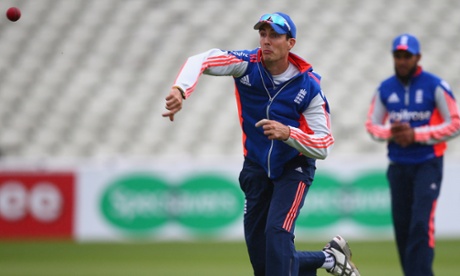
England may yet make a further change, with Steven Finn a possible replacement for Mark Wood who has an ankle niggle. Wood, in his formative international years and as a full-on robust bowler, is going to need careful management, as much to protect him against himself as anything. If it was understandable that England did not want to change the team after Cardiff then there was a lesson to be learned from the New Zealand series when, with back-to-back matches, he was shown to be down on pace in the second match at Headingley. It might have been more prudent to have left him out there and subsequently at Lord’s. Should Finn play instead it will be his first Test since that against Australia at Trent Bridge two years ago, when Alastair Cook dared not bowl him as the game headed for a dramatic finale.
Finn’s traumas have been well documented, with blame apportioned where it should not have been, and there is no evidence to suggest that he is close to the pace he generated from a shortened (not short) run in New Zealand two years ago. But he does have a wicket-taking knack, if an expensive one at times, with a Test strike rate of under 50 balls per wicket.
Along with the other seamers in the match, he, or Wood, are unlikely to have a pacy pitch on which to operate. But if the surface that was unveiled in the afternoon on the eve of the match plays as it looks – the colour of a hessian sack, with not a tinge of green, which, given the weather over the past week, means it will probably start clammily damp – then there should be some considerable sideways movement.
If this in no way negates the impact that Australia’s pacemen could have, then it will give Jimmy Anderson and Stuart Broad in particular something with which to work. Thus far in this series Anderson has found wicket-taking elusive and has been outbowled by Broad, who requires only four more wickets to join Anderson, Ian Botham, Bob Willis and Fred Trueman as the only England bowlers to reach 300 Test wickets, a landmark incidentally that Mitchell Johnson is within a single wicket of attaining.
It was the movement that the England bowlers managed in Cardiff, and the inability of the Australians to find the right lengths, that was a crucial difference between the sides then. At Lord’s though, that had been rectified, and their extra pace was the deciding factor on a generally unforgiving shirt front. Helpful pitches, used properly, can be a great leveller and England really do need that help. This may be a big toss, though.
Edgbaston prospects
England (probable) Cook, Lyth, Bell, Root, Bairstow, Stokes, Buttler, Moeen Ali, Broad, Finn, Anderson
Australia (probable) Clarke, Warner, Rogers , Smith, Voges, M.Marsh, Nevill, Johnson, Starc, Hazlewood, Lyons.
Pitchwatch Looked clammy and damp on the eve of the match, with no green tinge. Both captains will surely think about bowling first and batting could be a challenge.