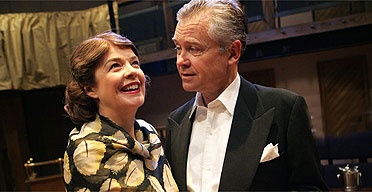
The conflict between moral principle and realpolitik always makes for good drama. But, while Kenneth Jupp's play, dealing with the Nuremberg trials, makes fascinating viewing, it could be even better: accusation sometimes supersedes argument.
Jupp's focus is on Rebecca West, who arrives in Nuremberg in 1946 to report on the war trials. Expecting justice, West finds only political compromise. In particular Hjalmar Schacht, Hitler's economics minister, is spared in order that he may lend his expertise to the post-war world. Francis Biddle, the American judge with whom West had an affair, endorses this act of clemency; but both West and Tom Morton, Schacht's American prosecutor, see it as betrayal.
The cross-examination of Schacht himself is riveting. Played with stony impassivity by Charles Kay, he at first accepts many of the charges against him; but later argues that national socialism could never have survived without international support.
But, while Jupp's play is intended to rattle our complacency, it overstates its case. The invocation of Puccini's Tosca introduces a note of gratuitous melodrama as Biddle is hardly comparable to the opera's evil police chief, Scarpia.
Julia Watson lends West the right mixture of reportorial watchfulness and intellectual idealism, and David Yelland turns Biddle into a smooth apologist for economic realism. It was only when I got home that I realised Jupp's case was even stronger than he makes out: Germany's industrialist war criminals were all shown clemency and Alfred Krupp recovered his assets on the grounds that "property forfeiture was somehow repugnant to American justice". That may lie outside the play's chosen parameters but is at the heart of its argument about the mercenary nature of Allied mercy.
· Until June 3. Box office: 020-8940 3633.