It’s a “plot”, a “coup” and a “secret plan”: two days before an election so close no one can call it, the rightwing press is already questioning the legitimacy of a Labour-led coalition if the Tories fail to win an outright majority.
The big question is whether by presenting as fact the idea that a combination of the second, third and maybe fourth most popular parties would be illegitimate, the papers are likely to dictate the agenda in the crucial and sleep-deprived 24 hours after the polls close. As always with the press, the constitutional argument for this could be less important than the mood music.
Tuesday’s Daily Telegraph story has all the elements of the new campaign theme, focusing on Ed Miliband’s desperate hope to move into No 10 despite “electoral defeat” and his dodgy bid to work out a way of governing in the event of a split parliament.
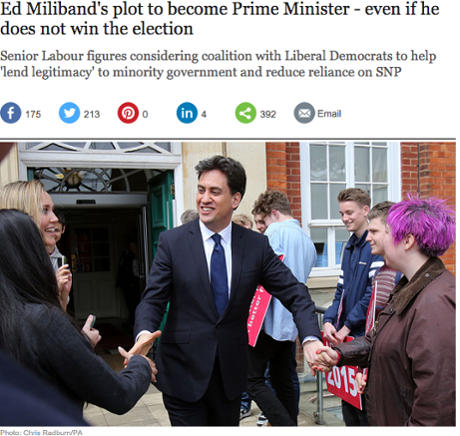
No one seems to have pointed out that it would be perfectly possible to swap the names and parties of the two leading prime ministerial contenders in the headline and standfirst. Just imagine the Telegraph running a scare story headlined “David Cameron’s plot to become prime minister – even if he does not win the election. Senior Conservative figures considering coalition with Liberal Democrats to help ‘lend legitimacy’ to minority government” to realise how biased political reporting can be.
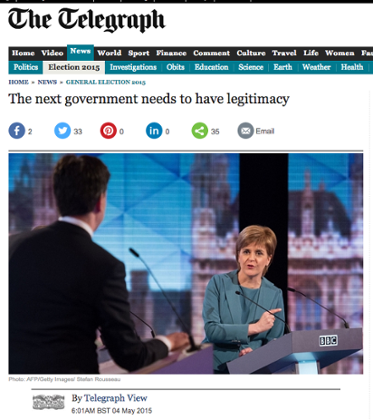
The paper, which ran a story straight from Conservative central Office last week, rams home the message with an opinion piece that neatly posits the question of legitimacy above a picture of Ed Miliband and Nicola Sturgeon.
Although the Telegraph has been the most hysterically pro-Conservative paper so far during this election (its other lead story quotes a Tory minister as saying that a vote for Ukip would be a “suicide note for Britain”), it is the Times which has splashed on the dangers of a “minority” party coming to power for two days in a row.
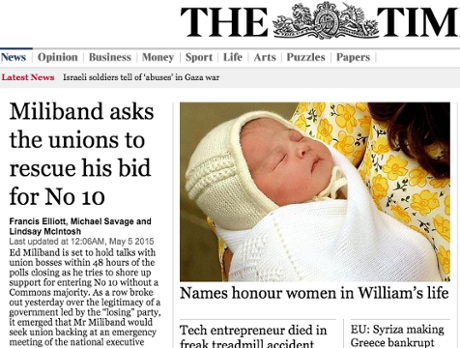
Tuesday’s story brings in two bogey figures for the paper owned by the man proud of having broken the print unions, with organised labour and the SNP the focus of “Labour’s secret plan to justify minority rule”.
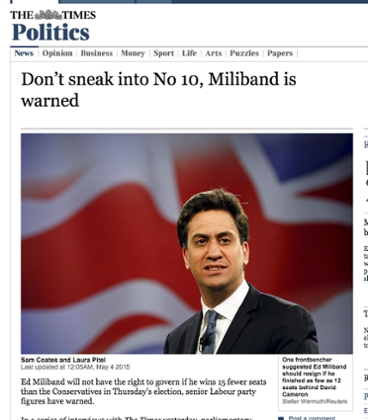
On bank holiday Monday, the Times led on the unnamed Labour frontbenchers warning their leader against a “minority path to power”.
James Graham, author of the TV drama Coalition, has written about how much more important the narrative is than the facts in politics. “I can see the Sun’s mockup of Miliband now – a swag bag, a black-and-white top: ‘Thief!’”
And the harping-on about the illegitimacy of a Labour-led coalition is reminiscent of the press campaign immediately before the 2010 polls, when disgruntled Labour figures were pressed upon to say how disappointing it would be if Gordon Brown did not win a landslide victory given that he was the incumbent. The same is being said about David Cameron, of course, but not frequently in the pages of most British newspapers.
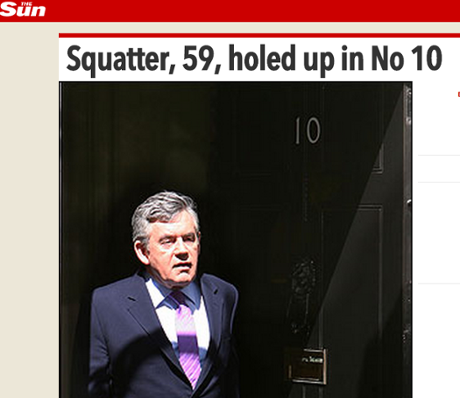
Immediately after the last election, the papers pushed for Brown to leave his post as soon as possible despite the fact that he was constitutionally entitled to stay in Downing Street until the alternative was confirmed. He was accused of squatting in No 10 by the Tories and the rightwing press.
While the UK’s new baby princess provided some election relief for most tabloid newspapers on Tuesday, the anti-Labour attacks are likely to increase before the end of the week.
The debate about how much this style of campaigning affects the way people vote has waged for years. The key this time, in an election not expected to be decided until late into the early hours on Friday, will be how the expected post-poll negotiations are covered by broadcasters.
Here, the performance of the BBC, which dominates viewing on election nights, will be central. Bound to strict non-partisan broadcast agreements before the election, will its news reporters and editors be able to withstand an agenda peddled hard by the biggest-selling papers on Friday?
Robert Peston, the BBC’s economics editor, used an industry speech last year to claim that the corporation was “completely obsessed” by the agenda set by newspapers and followed the lead of the Daily Mail and Daily Telegraph too closely.
More recently, a Telegraph splash about the 100 leading businesses backing the Tories led the broadcast agenda that day, whereas a story about NHS staff supporting Labour did not.
An organisation faced with the immediate start of charter renewal negotiations after the election is particularly unlikely to want to upset the leading party of the day, especially a Conservative party which put its desire to freeze the licence fee in its manifesto. Hardly a rallying cry to voters unhappy with the £145.50 cost as much as a warning shot to the leading BBC broadcaster over alleged bias.
The culture minister, Sajid Javid, took time out from campaigning last week to complain about perceived anti-Tory bias at the BBC in a three-way debate with non-BBC personnel at the end of the Today programme. The BBC should be in little doubt that it has been warned. It remains to see how much the pressure affects its reporting on 8 May.