Afternoon summary
- David Cameron has responded to growing international and domestic pressure for Britain to take more refugees fleeing the Syrian civil war and other conflicts by saying that the UK would fulfil its moral responsibilities. In a brief interview he said that Britain would take in thousands more refugees, but without clarifying what this meant. He could just be talking about Britain carrying on with its existing asylum reception programme, although he implied that it would be escalated. See 3.15pm.
- Cameron has come under public pressure from Conservatives to take more refugees. Boris Johnson, the mayor of London, Ruth Davidson, the Conservative leader in Scotland, Lady Warsi, the former party chairman, have all spoken out, as have several backbench MPs.
- The SNP and Labour have condemned Cameron, in sometimes harsh terms, for not doing enough to tackle the crisis. Alex Salmond, the former Scottish first minister, said that Cameron was “shaming the country” because he was not taking in more refugees.
- The Council of Europe, has expressed “serious concern” about the government’s stance on the refugee crisis. It suggested Britain was in danger of not meeting its legal obligations. (See 2.08pm.)
-
David Miliband, the former Labour foreign secretary who now chairs International Rescue, the American aid organisation, said Britain should take in “tens of thousands” of refugees. Speaking on the PM programme, he said:
I think there is scope for the UK to play a much larger role. I would certainly say that the figure of 10,000 that I think has been floated is certainly the minimum when it comes to discussing what would be an appropriate British response.
If it’s correct that the European Commission is proposing a figure of about 160,000 for the whole of Europe, Britain - as one of the larger countries in Europe - is going to have to be in the tens of thousands, not the tens.
Asked if this could mean 20-40,000 refugees coming to the UK, Miliband replied: “Exactly.”
-
Ukip has said it is investigating comments about the migrant crisis posted on the Twitter feed of one of its election candidates which suggested that three-year-old Aylan Kurdi died because “his parents were greedy for the good life in Europe”. As the Press Association reports, the remark, on the account of former Wimbledon election candidate Peter Bucklitsch, sparked outrage on the social media site and was condemned as “grotesque and awful” by Ukip MP Douglas Carswell. The post tweet: “The little Syrian boy was well clothed & well fed. He died because his parents were greedy for the good life in Europe. Queue jumping costs.” It sparked floods of angry responses from Twitter users, who described the comment as “evil”, “disgusting” and “horrendous”. But its author did not back down, posting a second message reading: “Predictable unthinking outrage. Turkey is not a place where the family was in danger. Leaving that safe place put the family in peril.”
That’s all from me for today.
Thanks for the comments.
Royston Smith, a Conservative MP, says on his blog that Britain should “do more” to help refugees. But he also says it would be easier for Britain to welcome refugees if he did not have to admit so many EU workers under EU rules.
In order for Britain’s relationship with the European Union to continue beyond 2017 Brussels needs to take note of the anger and frustration that this current crisis has caused and realise that the generosity of the British people can only go so far when EU economic migration is reducing our ability to help.
Andrew RT Davies, the leader of the Welsh Conservatives, has said in a blog that Britain must “take its share” of refugees.
Ultimately, though, the United Kingdom must be willing to take its share. We have always done so in the past.
In the 1970s, when Idi Amin ordered the ethnic cleansing of Indians in Uganda, Britain offered sanctuary to more than 27,000 refugees.
In the 1980s, the UK became home to around 19,000 Vietnamese refugees who fled the country by boat and ship after the Vietnam War.
Once again we find ourselves with a role to play, alongside our friends in Europe.
Here is a refugee crisis reading list.
The cry has gone up for the government to do more about the refugee crisis and David Cameron’s insouciant, if technically correct, performance on television on Wednesday, saying the answer to the crisis was primarily achieving peace inSyria, was not the prime minister’s most sensitive moment.
There will also be some anger in No 10 at the speed with which newspapers – for decades demanding more action to create a hostile environment to migrants – can overnight conduct a total U-turn and demand the government show greater charity to refugees. But no one in politics should expect the press to display consistency, or logic. It is their prerogative, and almost democratic duty, to capture the contradictory public mood.
While we were in Messina, an Italian coastguard vessel put in with 693 boat people on board, mainly Eritreans. I have seen refugee columns before, and they tend to be made up disproportionately of women and children. But more than 80 per cent of the people disembarking here were young men – the classic indicator of economic migration.
Of course, those fleeing squalor deserve our fellow-feeling no less than those fleeing persecution. These young men are guilty of nothing worse than courage, resourcefulness and optimism. But if we plan to open our doors to anyone who wants to get away from a hardscrabble life, we are inviting hundreds of millions of people to settle here.
What, then, is the solution? Well, one of the first acts of Tony Abbott’s government in Australia was to have illegal boats towed to an offshore centre, where migrants could make an asylum application. Those whose claims are rejected are free to return home, but not to enter Australia. Only one boat has reached that country illicitly since 2013; and not a single migrant has perished over that period. Indeed, it’s partly because of Tony Abbott’s success that migrants from as far afield as Bangladesh and Burma are now taking the long overland route to Europe instead.
Over the past few years, as the crisis in their homeland has deepened, I have watched many Syrians go through several layers of anguish before taking the painful decision to leave and try to reach Europe.
The first stage was denial. Syrians are incredibly proud of their country and none that I know wanted to leave. Initially, they often refused to accept the magnitude of the crisis, moving around internally inside Syria if they had to.
The second phase was determination. When they eventually fled to neighbouring countries, all were desperate to make it work so they could return home as soon as possible. In 2012 and even into 2013, the refugees I spoke to overwhelmingly believed it would only be a matter of time – they just needed to survive the coming few months.
Finally, came desperation. In Lebanon, Syrian refugees have recently been banned from working. In Jordan, they have never been allowed to do so. Turkey has done more than any other nation, but it too is starting to limit refugees’ freedom of movement. The humanitarian response – only ever a sticking plaster on a gaping wound – has been ravaged by funding shortages. Four-and-a-half years after the conflict erupted, hopes of returning have been extinguished for most Syrian refugees. Even if the war ended tomorrow, millions have no homes to return to. As a grim future in neighbouring countries reveals itself, more and more Syrian refugees opt to take the risk of leaving for Europe, for the best chance of a proper life.
If you are interested in what you can do to help refugees, this post on the Migrants’ Rights Network website is very helpful.
Here are some of the politicians supporting the Independent’s #refugeeswelcome petition and campaign by posting pictures of themselves with a “Refugees welcome” sign on Twitter. (This petition has attracted more than 100,000 names. It is on change.org. It is not the same as the one on the parliament website which has attracted more than 200,000 names.)
Yvette Cooper, the shadow home secretary and Labour leadership candidate
We must do more to help refugees.Pls sign petition urging government to act. http://t.co/0YLnScIjIT #refugeeswelcome pic.twitter.com/RM4tXL9Llc
— Yvette Cooper (@YvetteCooperMP) September 3, 2015
Sadiq Khan, the Labour MP seeking to become Labour’s candidate for London mayor
Where we lead, others follow. David Cameron, we can & must do more. #refugeeswelcome https://t.co/VJ6rGD7FQc pic.twitter.com/VExt4prRUO
— Sadiq Khan MP (@SadiqKhan) September 3, 2015
The SNP MP Alison Thewliss
Been overwhelmed by tweets and emails about the refugee crisis. I will to all I can to help #refugeeswelcome pic.twitter.com/uFxFsdsVoP
— Alison Thewliss (@alisonthewliss) September 3, 2015
The Labour MP Yasmin Qureshi
Join me & sign the @IndyVoices #refugeeswelcome petition http://t.co/3ylJKe2fqL @David_Cameron we can & must do more pic.twitter.com/aogwK5gzGM
— Yasmin Qureshi MP (@YasminQureshiMP) September 3, 2015
The Labour MP Andrew Slaughter
Britain must accept its fair share of refugees seeking safety in Europe. https://t.co/LpxYV8uBbZ #refugeeswelcome pic.twitter.com/02wBMb0eTo
— Andy Slaughter MP (@hammersmithandy) September 3, 2015
The Green party leader Natalie Bennett
I'm pleased to join in: Sign The Independent's petition to welcome refugees - http://t.co/zYG0B2vyBl pic.twitter.com/hvk6b6IeC7
— Natalie Bennett (@natalieben) September 3, 2015
The Green party deputy leader Amelia Womack
This is a refugees crisis and needs to be treated as such. #refugeeswelcome pic.twitter.com/3xwGBohWVb
— Amelia Womack (@Amelia_Womack) September 3, 2015
The Conservative MP Jo Churchill wants Britain to take in more refugees.
Our country has rightly earned a reputation for compassion. We must not fail those seeking our help. We must do more. #refugeecrisis
— Jo Churchill MP (@Jochurchill4) September 3, 2015
The Muslim Council of Britain is urging people to sign the petition urging the government to take in more refugees. (See 1.25pm.) Here is the press statement. And this is from Dr Shuja Shafi, the MCB secretary general.
Britain has long prided itself in being a humanitarian country on the world stage and offering refuge to those who need it most. We remember this most famously during the Second World War and the Kindertransport rescue efforts. We need to rekindle these values once more and ensure the UK takes its fair share of refugees. We are not calling for open borders, but open hearts. I call upon Muslim charities and families to do what they can to help refugees arriving here. And I call upon fellow Britons, interfaith, civil and political leaders to come together to see what we can do to address what is clearly a pressing humanitarian need.
The petition has now received more than 200,000 signatures.
Here’s the text of the letter that Harriet Harman has sent to David Cameron. (See 11.24am.) And here’s an extract.
We are all proud of Britain’s historical role of offering a sanctuary to those fleeing conflict and persecution. We are an outward-facing, generous-hearted nation, not one that turns inward and shirks its responsibilities. I know you will not want to be the prime minister of a government that fails to offer sanctuary while our neighbours are stepping up to respond.
I disagree with the conclusion you appear to have drawn, that there is somehow a choice to be made between building stability in the region through greater humanitarian support, and playing our part in helping desperate refugees who have fled the horror in Syria. There isn’t. I strongly support the government’s continued aid for the refugee camps in the region and agree with you that we need much tougher action against people trafficking, but it is clear now that we also have a moral duty to act to take in more of these people and help them to rebuild their lives.
Sutton council in London says that it is willing to accept refugees and that it has already started work on the project. “Local authorities across the country, including London, should respond by taking in refugees,” said Ruth Dombey, leader of the Lib Dem-run authority. “We have a moral and humanitarian duty to do so and I am sure other councils share my views.”
Two MPs, Labour’s Jess Phillips and the SNP’s Drew Henry, have said they would be willing to take a Syrian refugee into their home, BuzzFeed reports.
Archbishop of Canterbury says urges government to accept more refugees
Justin Welby, the archbishop of Canterbury, has put out a lengthy statement on the refugee crisis.
It is much more diplomatic than most of the government-bashing interventions we’ve seen from non-Conservative politicians. Welby stresses that there are no “easy answers”, he praises the government for its record on aid spending and explicitly commends it for its “moral leadership” in getting the Royal Navy to contribute to the Mediterranean rescue effort.
But he also calls for “a renewed commitment to taking in the most vulnerable” and calls for Britain to take in more refugees. Here is his conclusion.
The Church has always been a place of sanctuary for those in need, and Churches in the UK and across Europe have been meeting the need they are presented with. I reaffirm our commitment to the principle of sanctuary for those who require our help and love. The people of these islands have a long and wonderful history of offering shelter and refuge, going back centuries — whether it be Huguenot Christians, Jewish refugees, Ugandan Asians, Vietnamese boat people or many, many more.
It has always been controversial at the time it happened, always been seen as too difficult. Yet each time we have risen to the challenge and our country has been blessed by the result.
We cannot turn our backs on this crisis. We must respond with compassion. But we must also not be naïve in claiming to have the answers to end it. It requires a pan-European response — which means a commitment to serious-minded diplomatic and political debate, but not at the expense of practical action that meets the immediate needs of those most in need of our help.

Cameron's full interview on the refugee crisis - Summary and analysis
Here is a full version of what David Cameron said in this clip on the refugee crisis.
In policy terms, his comments were relatively opaque. But, in terms of tone, the whole intervention was very different from yesterday’s, which was interpreted as Cameron ruling out taking more refugees (even though he did not quite say that).
Here are the key points from today.
-
Cameron said Britain would take in thousands more refugees. Asked why Britain would not take in any more, he replied:
We are. We are taking thousands of refugees and we have always done that as a country, running our asylum system properly and giving a proper welcome to people and helping them when they come to our country.
When pressed on whether he would commit to Britain taking in more refugees, he replied:
We keep it under review, we work with our partners and we are taking thousands of people and we will take thousands of people. And what matters is when they come that they get a proper welcome and that we will look after them. And that’s exactly what we will do.
When pressed a third time, and asked if he felt compelled to do more by the picture of the drowned refugee boy, he replied:
And we will do more, we are doing more.
What, in practice, this means is not clear. The UK has accepted asylum applications from more than 1,000 Syrian refugees in the last year and Cameron could just be implied that it will carry on accepting applications at that rate. Or he could be hinting that the government will accelerate the rate at which people are granted asylum.
-
He rejected the suggestion from the Council of Europe that Britain was not fulfilling it obligations towards asylum seekers. (See 2.08pm.) Asked about this, he replied:
I think Britain is a moral country that always fulfils its moral obligations, not least spending 0.7% of GDP on aid, a commitment other countries have given, but of the major countries, only Britain has actually succeeded in meeting.
The line about “moral obligations” also suggests that Cameron is preparing for Britain to increase its refugee intake.
-
He said there had to be a “comprehensive solution” to the problem.
We will do more, we are doing more. That’s why we sent the Royal Navy to the Mediterranean. That is why, uniquely amongst European countries, we are spending 0.7% of our GDP on aid, much of which goes to those countries. We have to try and stabilise those countries from which these people are coming. As I said yesterday, we keep numbers under review, and there is always more we can do, but there isn’t a solution that is simply about taking people. It has got to be about a comprehensive solution that solves every part of the problem.
At another point he said:
We need a comprehensive solution; a new government in Libya, we need to deal with the problems in Syria.
Again, what this means is not clear. Until now Cameron has strongly rejected calls for Britain to be part of an EU-wide resettlement programme. But he did not talk about a “comprehensive solution” in his comment yesterday, and so perhaps there could be some movement on this front.
-
He said that he was “deeply moved” by the pictures of the drowned refugee boy.
Anyone who saw those pictures overnight could not help but be moved and, as a father, I felt deeply moved by the sight of that young boy on a beach in Turkey. Britain is a moral nation and we will fulfil our moral responsibilities.
That’s why I sent the Royal Navy to the Mediterranean and saved thousands of lives. That’s why Britain meets our commitment of 0.7% of our economy spent on aid, much of which goes to North Africa, goes to the Middle East to help those countries. That is why Britain is the second biggest bilateral donor in the world to those Syrian refugee camps. And that is why, yes, we are taking thousands of Syrian refugees, and will continue to do that. As I said yesterday, we keep that under review.
-
He said that President Assad, Isis and the people smugglers were to blame for the deaths of people trying to cross the Mediterranean.
I would say the people responsible for these terrible scenes we see, the people most responsible, are President Assad in Syria and the butchers of Isil [Islamic State] and the criminal gangs that are running this terrible trade in people. And we have to be as tough on them at the same time.
This is the “blame Isis” line that George Osborne road-tested earlier. See 12.24pm.
-
Cameron rejected claims that he did not care about the refugees. When this was put to him, he replied:
We do care, because we sent the Royal Navy job to save lives
Updated
Cameron says Britain 'is a moral nation & will fulfil our moral responsibilities'
Here is more from David Cameron.
Anyone who saw those pictures overnight could not help but be moved and, as a father, I felt deeply moved by the sight of that young boy on a beach in Turkey. Britain is a moral nation and we will fulfil our moral responsibilities.
Cameron says he was 'deeply moved' by pictures of drowned refugee boy
The Press Association has just snapped this.
David Cameron said today that “as a father I felt deeply moved” by the pictures of Syrian boy Aylan Kurdi lying dead on a Turkish beach and promised that Britain would fulfil its “moral responsibilities”.
Updated
Council of Europe expresses 'serious concern' over Cameron's stance on refugees
The Council of Europe, the 47-nation human rights body that oversees the European convention on human rights, has criticised David Cameron’s stance on the refugee crisis. This is from Nils Muinieks, its commissioner for human rights.
I am seriously concerned by the British prime minister’s position that the UK should not provide protection to more refugees from the Middle East.
While it is true that long-term peace should be brought to Syria and other war-torn countries, it is also true that the UK has a legal and moral obligation to offer shelter to those who flee war and persecution.
The truth is that at the moment the UK is doing much less than other European countries, like Germany or Sweden, which give refuge to thousands of Syrians.
Additional tragedies and shocking pictures could be avoided if political leaders had the courage and determination to uphold human rights standards and common European values.
Earlier Diane Abbott, the Labour MP, said Britain could be in breach of its legal obligations on this issue. (See 1.40pm.) That was a strong claim, but she will be able to cite this statement to help back it up because it is exactly what the Council of Europe is suggesting too.
Updated
The Conservative James Berry has praised his council for its willingness to take in more refugees.
I'm very concerned about the #SyrianRefugees crisis. Kingston Council is leading the way in calling on local authorities to take 50 refugees
— James Berry MP (@JamesBerryMP) September 3, 2015
The Times’s Tim Montgomerie says the fact that the government refused to put up a minister to discuss the refugee crisis on the World at One (see 1.49pm) could be a sign that policy is being rewritten.
This *may* be a good sign. Consideration might be being given to a shift in policy. Lobbying of Number 10 is intense https://t.co/Qrm0TbPF9D
— Tim Montgomerie ن (@montie) September 3, 2015
Here is more from Alex Salmond’s interview on the World at One. (See 1.04pm.) He said:
When human being see other human beings in distress, when we see pictures of young toddlers lying dead on the beach, then the natural human instinct is to help. David Cameron’s natural instinct is to walk by on the other side. That is why is he shaming the country.
He also said that the UK as a whole should take 10% of the refugees seeking asylum in the EU and that 1% should go to Scotland. And Britain should insist on all other EU countries taking their fair share too. He said Scotland could not act on its own because it did not have control over immigration policy.
He said he could not put a number on how many refugees this would involve in total. But, asked if the people of Scotland were really ready for such a large influx, he replied: “Yes I do. And I think the people of England are as well, if they get some leadership.”
Edward Stourton, the World at One presenter, said that the programme had tried to get a minister to come on to discuss the issue, but that the government had said no. It was the third day in a role that the Home Office had refused to put up anyone to answer questions on the programme, he said.

Diane Abbott, the Labour MP and a candidate seeking the party’s nomination for London mayor, claims Britain could be in breach of international obligations by refusing to take more refugees. In a statement she said:
This is a human catastrophe and tens of thousands of people, children, women and men need our country’s help, and that of all the richer Europe countries. We have duty under international law to provide refuge, which we are in danger of breaching. I will be demanding the prime minister come to the House of Commons to make a statement on this crisis as soon as it returns.
A petition on the parliament website saying Britain should accept more asylum seekers is attracting new signatures at a remarkable rate.
Just refreshed last night's page showing the UK refugees petition. Up from 35K to 79K overnight. Good, lets get more https://t.co/EKRDeC8vkH
— Oliver Bullough (@OliverBullough) September 3, 2015
It has now passed the 100,000 signature mark, which means that it will be considered for debate in the Commons, and as I write it has almost reached 160,000.
The World at One reports that it has spoken to an unnamed government minister who says he is unhappy with the government’s position on refugees.
One minister told us off the record - not been happy with govt's position for some time & lobbying behind the scenes to change it. #wato
— Nick Sutton (@suttonnick) September 3, 2015
My colleague Mark Tran has more detail about what Britain has done to help Syrian refugees.
The UK has allocated £900m since 2012 to meet needs of people in Syria and refugees in the region - the largest UK response to a humanitarian crisis. The money has gone to some 30 partners such the UN’s World Food Programme and the Red Cross, which have been able - under extremely difficult conditions - to deliver food and water inside Syria.
Almost half of Britain’s aid money for the Syria crisis goes to Syria itself - £440m. Lebanon has been allocated £211m and Jordan £177m. According to the department for international development (DfID), from February 2012 to March 2015, British aid has provided 13m food rations to Syrians and supported 224,972 children in formal and informal education.
In Jordan, which is hosting 600,000 Syrian refugees (1/10th of Jordan’s population) UK aid money is providing food, water and shelter to people across the country, as well as supporting basic services, such as education and healthcare.
Justine Greening, the international development secretary, said in July: “Despite the difficult conditions they face, the many refugees I have met on my visits to the region say they just want to remain close to their homes. Our aid is helping those people - families whose normal lives have been turned upside down - cope with their shattered lives and stay safe.”
Corbyn says government's response to refugee crisis has been 'shameful'
Jeremy Corbyn, the favourite in the Labour leadership contest, has put out a statement saying that the government’s response to the refugee crisis has been “shameful”. Here it is in full.
Nobody could fail to be moved by this heartbreaking crisis. Millions are desperately fleeing a terrible civil war, risking their lives and the lives of their children to seek only the most basic sanctuary.
This government’s response has been shameful. David Cameron must shoulder his responsibility and begin urgent talks with our European neighbours and the UN so that the UK takes its fair share of refugees. He should immediately bring together civil society and religious leaders, devolved administrations, councils and charities to properly plan and co-ordinate our humanitarian response.”
It is our duty as a signatory to the UN refugee convention, but also as human beings, to offer a place of safety, to play a role internationally to share our responsibilities, and to work to end the conflict. We must also make sure that people who have risked their lives seeking refuge here are treated fairly when they arrive.
Currently we are failing on all of these counts. This is far too serious to keep getting wrong. As a first step, we must urgently pool our expertise and resources to plan a proper humanitarian response.
In the longer term we must stop supplying the arms fuelling the conflicts which the refugees are fleeing and take meaningful action to tackle climate change and the very serious implications this will have on refugee flows if left unaddressed.

Boris Johnson says Britain has 'moral responsibility' to take more refugees
Boris Johnson, the mayor of London, is joining those calling for Britain to take more refugees.
He also suggests that he would back military intervention in Syria.
Boris Johnson adds to pressure on PM to take more Syrian refugees saying it is our "moral responsibilty" to take those fleeing persecution.
— Pippa Crerar (@PippaCrerar) September 3, 2015
But while welcoming genuine refugees the Mayor adds that the UK must not become "a magnet or pole of attraction" for economic migrants.
— Pippa Crerar (@PippaCrerar) September 3, 2015
Boris adds it's "time to look harder" at resolving Syria problem "at source" adding: "No one could say that non intervention was working.."
— Pippa Crerar (@PippaCrerar) September 3, 2015
"We should take our quota, our 10%" @AlexSalmond calls on PM to take in more refugees on #wato http://t.co/eSEy8AeoJ8 pic.twitter.com/inbA7qUURa
— The World at One (@BBCWorldatOne) September 3, 2015
Alex Salmond, Sturgeon’s predecessor as Scotland’s first minister, has told the World at One that David Cameron is “shaming the country” over the refugee crisis.
The full interview will be broadcast shortly. I will post more when I’ve heard it.
Sturgeon slams Cameron's 'walk on by on the other side' approach to refugee crisis
The Westminster parliament is not sitting today, but the Scottish parliament is, and Nicola Sturgeon has used first minister’s questions to launch a powerful and emotional attack on David Cameron for his stance over the refugee crisis.
She said she was in tears when she saw the picture of the drowned Syrian boy, and that she was “very angry, at the ‘walk on by on the other side’ approach of the UK government”.
As first minister of Scotland I pledge that I will ensure that Scotland does everything possible to help this refugee crisis. I will be far from the only person reduced to tears last night at the picture of a little boy washed up on a beach. That wee boy has touched our hearts. But his is not an isolated tragedy. He and thousands like him whose lives are at risk is not somebody else’s responsibility; they are the responsibility of all of us.
So, yes, I am angry, very angry, at the ‘walk on by on the other side’ approach of the UK government. I implore David Cameron to change his position and change it today. And I pledge as first minister of this country that we stand ready to help offer sanctuary to refugees who need our help.
She also said that she was writing to Cameron again today calling for the UK to play its “full part” in responding to the crisis and that she was holding a summit in Edinburgh of humanitarian organisations, council leaders, charities and churches to discuss what could be done. Opposition leaders would also be invited, she said.
Sturgeon was responding to a question from Kezia Dugdale, the new Scottish Labour leader, who also criticised Cameron for saying that taking more refugees was not the solution.
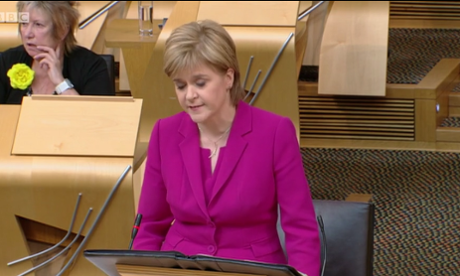
You can watch Sturgeon here.
Updated
Osborne says Isis and people smugglers ‘killed’ the drowned refugee boy
George Osborne, the chancellor, has given a comment to Sky News about the refugee crisis.
He did not really go beyond what David Cameron said yesterday on the issue of Britain taking more refugees (see 11.53am), although he confirmed that the matter was “under review”.
But he did talk about the picture of the three-year-old Syrian boy who drowned in the sea off Turkey. He was “very distressed”, by the picture, he said. But he insisted that Isis and the people smugglers were to blame.
[There is no person who would not be] very shocked by that picture - and I was very distressed when I saw it myself this morning - of that poor boy lying dead on the beach.
We know there is not a simple answer to this crisis. What you need to do is first of all tackle Isis [Islamic State] and the criminal gangs who killed that boy, you’ve got to make sure the aid keeps coming. We’ve put £1bn of overseas aid in to help these desperate people. And, of course, Britain has always been a home to real asylum seekers, genuine refugees. We’ve taken 5,000 people from the Syrian conflict. We will go on taking people and keeping it under review. Britain has been playing a leading role and it will continue to do so.
Updated
The Conservative MP Andrew Percy says the newspapers urging Britain to take more refugees (see 11.14am) are out of touch with public opinion. He has set out this argument on Twitter.
Email received from a constituent, one of a number 'The media does not reflect the grassroots opinion of the majority of the electorate'.
— Andrew Percy (@andrewpercy) September 3, 2015
It is incredible comparing the media coverage of migrant crisis with the emails I am receiving from constituents. Some contrast indeed.
— Andrew Percy (@andrewpercy) September 3, 2015
I suppose the real question for this migrant debate is does the west have the balls to actually tackle groups such as Isis at source ...
— Andrew Percy (@andrewpercy) September 3, 2015
... Or do we just argue over an arbitrary figure and leave millions more to suffer the horror of Isis. Where is the western leadership?
— Andrew Percy (@andrewpercy) September 3, 2015
David Cameron seems reluctant to perform a full U-turn in response to pressure from the likes of the Sun and the FT (see 11.14am), Lady Warsi (see 8.59am), Yvette Cooper (see 9.27am) and assorted Tory MPs, but it does look as though we may get some movement from him on this issue.
According to a Number 10 source, he feels his comments yesterday were slightly misinterpreted. He did not rule out Britain taking more refugees, and he specifically said that the situation was being kept under review. Cameron is on a regional visit today and, when he speaks to the media, we may hear a modest change of tone from what we heard yesterday.
On the broader point, Cameron is not backing down. According to the source, Cameron does not believe that getting Britain to take more refugees is the solution to the crisis. The source said:
When you have got more than 7m displaced people within Syria, and another 4m displaced into neighbouring countries, it would be misleading to people to suggest that, if Britain were to take a few thousand, that would solve the problem.
The source stressed that Britain was second only to the US in contributing aid to help the refugees in the camps outside Syria (around £900m has been spent) and he said the government could only spend this amount of money because of the decision to increase the aid budget (which was highly controversial in Tory circles). He also said that Britain had granted asylum to almost 5,000 Syrians since summer 2011, and that last year, of the 2,000 Syrians who applied for asylum, 1,180 had their applications accepted.
However, the source also conceded that talks on the crisis were taking place within government and that ministers are likely to have something to say on this to parliament when MPs return from recess next week.
Updated
Labour says Cameron should demand emergency EU summit to discuss refugee crisis
Labour is urging David Cameron to convene a meeting of the government’s emergency committee, Cobra, to discuss the refugee crisis and to request an emergency EU summit. Harriet Harman, the acting party leader, has made the call in a letter she has sent to the prime minister. (His in-tray must be filling up with Labour letters. See 9.27am.)
There is already a meeting of EU interior and justice ministers scheduled for next weekend, but Harman wants EU leaders to meet as a matter of urgency.
The party is acting in other ways too. Yvette Cooper, the shadow home secretary and leadership candidate, is organising a meeting of councils, charities and faith groups next week to discuss what can be done about taking in more refugees. And Glenis Wilmott, the leader of the Labour MEPs, is writing to Martin Schulz, president of the European parliament, asking him to schedule an emergency debate on the crisis next week.
A Labour source said:
David Cameron must now stop dragging his feet. It is high time Britain starting living up to its international responsibilities and proud tradition of helping those who need it most.
Updated
Refugee crisis - What the papers are saying
This is what the papers are saying in their editorials about the migration crisis.
Interestingly, for once the Financial Times and the Sun are united - both saying Britain should take more refugees. But this is not a unanimous Fleet Street view.
Europe is facing the most serious refugee crisis since the end of the second world war. In response, EU leaders are acting in very different ways. Angela Merkel, the German chancellor, has taken the humanitarian high ground, declaring that her country will receive up to 800,000 asylum applicants this year and confronting the anti-immigrant voices in her country. By contrast, David Cameron seems to be taking a mean approach, strictly limiting the number of refugees Britain will receive. The prime minister may think his stance is well judged, given how neuralgic an issue immigration has become in British politics. But it is a political miscalculation and one that he should reconsider.
Today The Sun urges David Cameron to help those in a life-and-death struggle not of their making.
Britain has rightly held back the thousands massed at Calais — many of them merely economic migrants — and is making our welfare system less attractive to those tempted to join them.
But there are others who, with their kids, have fled imminent danger in Syria either from its genocidal dictator Assad or the bloodthirsty savages of IS.
We know well the pressure from Britain’s soaring population on our public services and housing. We have made those arguments ourselves often enough.
But our nation also has a proud record of taking in desperate people and we should not flinch from it now if it is beyond doubt that they have fled for their lives.
Thursday's Sun front page: It's life and death #tomorrowspaperstoday #bbcpapers pic.twitter.com/qzQkGfCi6n
— Nick Sutton (@suttonnick) September 2, 2015
Now, we call on our readers to sign a petition which urges the Government to accept Britain’s fair share of refugees fleeing war-torn countries. And we encourage you to join our social media campaign to prove that those in real need of a safe haven will receive a compassionate welcome from many of us here.
And to political leaders in this country and across the EU we say this: if ever there was a time for Europe to work together – and to show how far the continent has come since the dark days of the last world war – it must be now.
And here is the link to our petition: change.org/refugeeswelcome
Thursday's Independent front page: Somebody's Child (via @amolrajan) #tomorrowspaperstoday #bbcpapers pic.twitter.com/nxHPNn1jEn
— Nick Sutton (@suttonnick) September 2, 2015
Downing Street is resisting refugee quotas for the good reason that they would amount to an open invitation to the thousands of refugees already on the move across the Continent and to millions more from Syria to Afghanistan. These people need practical help in situ. They do not need false hopes of a fantasy life in Europe when the reality so often is the appalling risk of death by trafficking or, at best, a twilight existence in an asylum system being tested to destruction ...
Germany’s welcome to Syrian refugees is inspired at least partly by anguish over the neo-Nazi anti-immigrant demonstrations in its eastern cities. Even in former West Germany, consciences are troubled by the treatment of the 3.5 million Turkish guest workers granted visas but never citizenship in the Sixties and Seventies.
While Britain’s foreign-born population doubled and doubled again between 1951 and 2011, Germany officially accepted only long-term immigrants of German descent until the EU expansion of 2004. Ten per cent of its population is now foreign-born, compared with 13.4 per cent for Britain. This is not a reason to keep out legitimate refugees, but it is a reason to stand firm against half-formed policies that would only risk more lives and cause more misery.
Thursday's Times front page: Europe divided #tomorrowspaperstoday #bbcpapers pic.twitter.com/10qfrNfJS3
— Nick Sutton (@suttonnick) September 2, 2015
If Mr Cameron had only engaged with his partners, instead of posturing, he would have found propitious circumstances for his agenda. From strains in the eurozone to immigration, it is plain that the emergencies of the day are pushing the EU in the direction of a Europe of nations. Ever closer union is for the moment a pipe dream, and a constructively engaged prime minister could be building the allies to rewrite rules to fit in with changing realities. Mr Cameron, however, has failed to do this. Instead he keeps an obsessive eye on his backbenches, while watching events on the continent drift.
Thursday's Guardian front page: The shocking, cruel reality of Europe’s refugee crisis #tomorrowspaperstoday pic.twitter.com/jdbwKWEoYE
— Nick Sutton (@suttonnick) September 2, 2015
To listen to Angela Merkel and the European Commission trying to blackmail the UK into accepting more Syrian asylum-seekers, one might think they were secretly working for Ukip.
Leave aside that Germany has no business lecturing jam-packed Britain on our moral duty to refugees, with our far more consistent record of offering sanctuary to the world’s desperate.
Forget, too, the commission’s monstrous threat to slash funding for projects in the UK – which makes a £12billion net contribution to Brussels – if we refuse to accept a quota.
Like the car-crash of the single currency, this crisis has brought out the worst in the EU – that supposed brotherhood of nations, now clawing at each other’s throats, incapable of making a decision.
On only one point do our 27 partners agree. As they fight to put national interests first, all think that someone should take responsibility. Anyone but themselves.
Thursday's Daily Mail front page: Tiny victim of a human catastrophe #tomorrowspaperstoday #bbcpapers pic.twitter.com/16ZIMpaJZf
— Nick Sutton (@suttonnick) September 2, 2015
The dehumanising of the desperate by the likes of David Cameron, the Prime Minister’s “swarm” insult the politically motivated jibe of a cold heart, or the toxic tub-thumping of Ukip’s Nigel Farage will go down in history as the poisonous indifference of callous politicians to the suffering of the persecuted.
Europe must do more. Britain must do more. Waiting for peace in the Middle East is the excuse of the coward.
Britain has a proud history of giving refuge. Britons are a kind, open, generous people.
To save others let the awful death of that boy be the moment we all stood up to be counted by doing the right thing.
Thursday's Daily Mirror front page: Unbearable #tomorrowspaperstoday #bbcpapers pic.twitter.com/FsaP405Fqp
— Nick Sutton (@suttonnick) September 2, 2015
The Lib Dems are calling for an urgent debate in parliament on the refugee crisis when the Commons returns next week. They want Britain to take in more refugees. Tim Farron, the party leader, said:
We can and must do more with our EU partners to tackle the problem. This is a humanitarian crisis which shames our country. We must step up to the plate to tackle it.
On Twitter a reader points out that Jeremy Corbyn has consistently defended the rights of refugees. The Corbyn for leader Facebook page has posted a link to what he said about this on Question Time last month. He said:
Are we actually going to see armed guards all around Europe keeping out the poor and the desperate? Some of whom are victims of impoverishment which is a product of a whole lot of economic circumstances. Some are victims of wars which we have been involved with such as Iraq and the bombing of Libya. There has to be a much better, much bigger, much stronger, global response to deal with the issue of instability and desperation of people all around the world.
Europe as a whole has to be prepared to accept more people, but Europe [must also] be prepared to do far more to deal with the issue. At the end of the Second World War there was a coming together of all of the wealthy nations to accept very large numbers of refugees because they saw that as a humanitarian crisis. Is it different because so many of these people come from Africa opposed to Europe?
The Conservative MP Nicola Blackwood is also calling for Britain to take more refugees.
In 2013 I met these refugees in the Bekaa Valley. Lebanon have taken in 1.1m Syrians. Imagine if they'd refused 1/3 pic.twitter.com/8hJ9pSx8IQ
— Nicola Blackwood (@nicolablackwood) September 2, 2015
Britain has a proud history of giving sanctuary to those fleeing conflict & protecting the persecuted. 2/3
— Nicola Blackwood (@nicolablackwood) September 2, 2015
We cannot be the generation that fails this test of humanity. We must do all we can #refugeecrisis 3/3
— Nicola Blackwood (@nicolablackwood) September 2, 2015
There are plenty of figures in other parties saying similar things, but I am particularly highlighting the Conservative ones because they are likely to carry more weight with David Cameron.
Ruth Davidson, the Scottish Conservative leader, has used Twitter to argue that Britain should take in more refugees.
The UK I know has always shouldered its burden in the world. DfID is doing life-saving work abroad but we can - & must - do more at home 1/2
— Ruth Davidson MSP (@RuthDavidsonMSP) September 3, 2015
2/2 This is not an immigration issue, it's a humanitarian one, and the human response must be to help. If we don't, what does that make us?
— Ruth Davidson MSP (@RuthDavidsonMSP) September 3, 2015
The Conservative MP Jeremy Lefroy has backed Yvette Cooper’s calls for Britain to take more refugees. In a post on his blog, he says that, while he agrees with David Cameron that Britain needs to address the root causes of the crisis, he also agrees with Cooper’s call for more refugees to be admitted to the UK.
Here’s an extract.
The UK has played a major role from the very beginning in assisting Syria’s neighbours, in particular Jordan and Lebanon, as they cope with the millions of refugee within their borders. Without the £900 million contributed so far by the UK – more than any other European country – the situation for the refugees there would be even more difficult.
But I believe we must do more to help provide sanctuary in the UK to those fleeing this present terror in Syria. The UK has been over centuries an open and welcoming country to those in peril and this should be no exception. At the same time, we can work with the United Nations and our European partners to develop the ‘safe havens’ closer to the countries in conflict, as Guy Verhofstadt, the former Belgian prime minister, has called for.
I have little doubt that, throughout our generous country, there are very many people and groups willing to offer help and hospitality to refugees. If they were widely spread throughout hundreds of host communities, it would not become a large imposition on local or national government.
Yvette Cooper, the Labour leadership candidate and shadow home secretary, won plaudits on Tuesday with a powerful speech saying Britain should take in more refugees. The country could take in 10,000 in a month with little difficulty, she suggested.
Last night she released the text of a letter she had written to David Cameron repeating this argument. Here’s an extract.
This is the greatest humanitarian crisis to reach our continent since the second world war. You and I are both proud of Britain’s role in generations past offering sanctuary to those fleeing conflict and persecution from the Huguenots to the Kindertransport where we welcomed 10,000 Jewish children fleeing Nazi oppression.
Do not be the British Prime Minister who turns his back on the refugee crisis of our generation or who failed to do the right thing in the face of crisis and desperation. Do not be the British Prime Minister who turns our country into a darker, narrower, more inward looking place. You must act now and not close your eyes to the tragedy on our doorstep.
And she asked him to do six things. Here they are
I am therefore asking you to do six things:
- To agree now that Britain will take more refugees both directly from Syria and from the Southern European countries where most refugees have arrived
- To invite councils to come forward with suggestions of how many refugees they can help and to ask the home office to call a conference of councils, community organisations and faith groups on the support Britain could give
- To urge all councils to help - as you know currently some councils do far more than others to support refugees and asylum seekers - and as a starting point to ask cities, counties and London boroughs to consider taking at least 10 refugee families
- To work with European countries on the asylum assessment process - perhaps involving the UN - Britain would need in order to take refugees
- To change the Home office support arrangements for refugees so that there is more stable and longer term funding as many councils have been deterred from helping by the current short term arrangements
- To immediately remove refugees from your net migration target, as when there is such a huge crisis it is deeply immoral to include refugees in a reduction target.

Yesterday David Cameron indicated that he was opposed to Britain taking more refugees in response to the Europe-wide migration crisis. “I don’t think there is an answer that can be achieved simply by taking more and more refugees,” he said. Normally the prime minister has quite a good feel for public opinion, but there are some signs from today’s papers - and I’ll be looking at them in more detail later - that on this topic the mood could be swinging against him.
Interesting, Tories are joining the calls for Britain to do more.
Here’s the Conservative MP David Burrowes on Twitter last night.
..at the very least we should accept more than 1% Syrian refugees because we accept more than 1% responsibility.. pic.twitter.com/fEmLqHJB2X
— David Burrowes (@davidburrowesmp) September 3, 2015
This is from the Conservative MP Nadim Zahawi:
We r nothing without compassion. Pic should make us all ashamed. We have failed in Syria.I am sorry little angel,RIP. pic.twitter.com/H2Pd7TL2tn
— Nadhim Zahawi (@nadhimzahawi) September 3, 2015
The Conservative MP Tom Tugendhat has posted this.
@montie I've spoken to many in W Kent who want us to do more and I agree with them. Our common humanity demands action at home and abroad.
— Tom Tugendhat MP (@TomTugendhat) September 2, 2015
And Johnny Mercer, another Tory MP, said: “We have always led the world in looking after people who can’t look after themselves,”
And within the last hour Lady Warsi, the former Foreign Office minister and former Conserative party chairman, told the Today programme that she also thought Britain should take in refugees. Or at least some; she specified unaccompanied children, and women. According to PoliticsHome, she said:
We have to respond to this now in a practical and a realistic way. it means first of all having a much more informed debate about who these people are who are coming and travelling across Europe and being incredibly firm with those people who are simply economic migrants wanting to jump the queue but also responsive and humane to those who are genuinely fleeing war-torn regions and fleeing persecution.
That’s why I think it’s important for us to say that just because we can’t resolve everything doesn’t mean we mustn’t do something, something more than we’re doing now, and that means using the expertise that we have, for example when we responded during the Second World War to unaccompanied minors and the Kindertransport.
That tragic picture that we’ve seen overnight could be a moment where we say, actually, Britain does have a historic tradition of responding to unaccompanied minors and that is where we should be prepared to take more. We also have an international reputation on our work on preventing sexual violence in conflict and what we could be saying is Britain could take more women, for example, from those areas where they have been subjected to sexual violence.
We have an unfolding crisis in Europe and we can either say ‘look, it’s not our problem, we can’t do more’ or we can be realistic and practical and say we have a long and proud history and tradition of responding when these situations arise, we do so in a humane way, we do so when we have expertise and in doing so we do say to the rest of Europe ‘we will too share the burden’.
I’ll be covering more on this issue throughout the day.
As usual, I will also be covering breaking political news as it happens, as well as bringing you the best reaction, comment and analysis from the web. I will post a summary at lunchtime and another in the afternoon.
If you want to follow me or contact me on Twitter, I’m on @AndrewSparrow

Updated