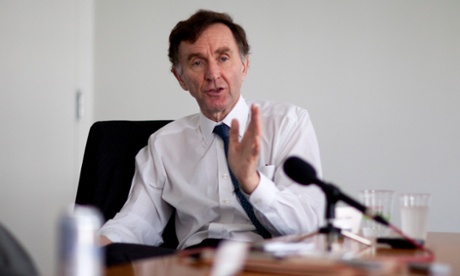
Tory MPs have been accused by Labour of blocking moves to summon former HSBC boss Stephen Green to the Treasury select committee to account for the controversy surrounding the Swiss operations of Europe’s largest bank.
Lord Green, who left HSBC to join the House of Lords as a Conservative peer and trade minister in 2010 after nearly three decades at the bank, has yet to be called by any of the parliamentary committees holding inquiries into the scandal.
John Mann, a Labour MP who sits on the Treasury select committee, said: “The Tories will not allow [Green] to be called. They are trying to palm this off until after the election.”
Green stepped down as a trade minister at the end of 2013 but remains a Tory peer.
Mann said: “He was responsible, he was at the heart of things; it is even more important – because he then became a government minister – that he is held to account for his actions or inactions.”
A spokesman for the committee, said no formal proposal to call Green had been put to the committee. “We were considering who to call in our session a couple of weeks ago and it was decided we wanted to respond to HSBC as it stood now, a forward-looking approach.
“These allegations raise some important questions but we decided to focus on the current management and there were some strong questions during the session.”
Conservatives outnumber Labour on the 13-member committee by six to five, although the two Liberal Democrat and Scottish National party members could have been in favour of calling Green. But select committees prefer to proceed by consensus, in order to avoid splits and minority reports.
The committee heard from the current HSBC chief executive, Stuart Gulliver, and its chairman, Douglas Flint, last month.
On Monday the public accounts committee (PAC), which is chaired by Labour’s Margaret Hodge, will hear from Gulliver and the former head of HSBC’s global private banking division, Chris Meares.
It will also hear from the chairman of the BBC Trust, Rona Fairhead, who is also a non-executive director of HSBC. Fairhead earned £513,000 for her 50 days work at HSBC last year, and also draws £110,000 for chairing the trust, a job that is expected to take up the majority of her time.
Parliament will be dissolved on 30 March for the general election on 7 May, but MPs on the Treasury select committee and the PAC still have 14 working days in which to summon Green.
The Geneva subsidiary that routinely allowed clients to withdraw bricks of cash, held accounts for dealers in arms and drugs, and colluded with wealthy clients to conceal undeclared “black” accounts, was created on Green’s watch.
Green is an ordained minister of the Church of England and left HSBC with a £19m pension pot. He joined the board in 1998, when he was given responsibility for overseeing private banking and other operations. A year later, HSBC acquired the Republic National Bank of New York, which merged with other businesses to form the Swiss private bank.
In 2001, Green was appointed a director of the Swiss bank, and he stepped up to become its chairman in 2005, holding that position until he left HSBC in 2010. Green also had overall responsibility for HSBC, as group chief executive from 2003 and chairman from 2006.
The UK tax office, HMRC, received evidence of wrongdoing at HSBC’s Swiss bank in April 2010, just before the last general election and before Green was made a minister.
But the prime minister, David Cameron, and the chancellor, George Osborne, have repeatedly dodged questions about whether they were briefed on concerns about HSBC’s conduct before appointing Green a minister, and on whether they discussed mounting evidence against the bank with its former chief when he was in government.
Other names notable by their absence from parliamentary enquiries include Peter Braunwalder, the chief executive of HSBC’s Swiss private bank between 2002 and 2008, whose tenure overlapped with the wrongdoing.
Also missing is former HMRC boss Dave Hartnett, who retired two years after the data was handed over, leaving the tax office to take a job at HSBC, where he advised the bank on how to spot fraud.
The bank’s financial system vulnerabilities committee was set up the year after HSBC was fined nearly $2bn (£1.3bn) by the US authorities for laundering money for Mexican drug cartels and flouting Iranian sanctions.
Hartnett had been originally due to appear at Monday’s PAC hearing but it is understood he is abroad advising the Ukrainian government. He is likely to appear before the committee in the final week of parliament.
The whistle was blown on HSBC by former employee Hervé Falciani, who handed thousands of files to the French government. The files, later obtained by France’s Le Monde newspaper, were passed to the International Consortium of Investigative Journalists, the Guardian and other media organisations and published in February.
Falciani’s data has been used governments around the world to expose tax evasion and bring offenders to book. But the UK has left itself open to accusations of a coverup because in five years the Falciani files have been used in only one prosecution.