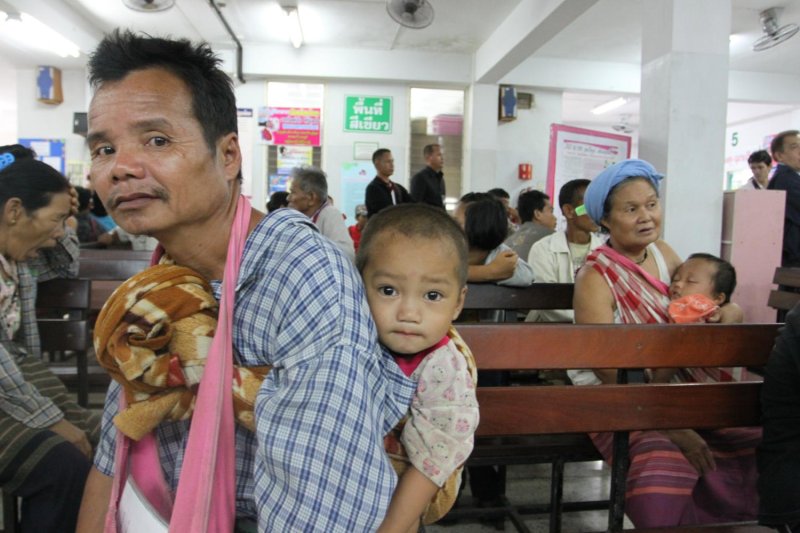
The native Thai social structure, by which the elderly are not shunted away to old age homes but live with their extended families and continue to interact with the community, is a good one.
That's how National Health Security Office's Secretary General Jadej Thammatacharee, steward of Thailand's universal healthcare programme, put it to me. The persistence of friendship and companionship in old age lends a statistical boost to longevity. A Thai blessing hiding in plain sight.
I think of this as I go to interview the 92-year-old Krasae Chanawongse -- a doctor who launched the "one baht" medical treatment programme several decades ago.
Dr Krasae asked me to meet him at Kluay Hom, a small restaurant in Pak Kret district in Pathum Thani province, where old friends, retired colleagues and musicians gather over karaoke and conversation.
The nonagenarian affectionately known as "Mor Krasae" is a superlative example of the Thai embrace of productive community life that continues well into old age.
When I start out by noting that he was sometimes seen as Thailand's answer to China's barefoot doctors, he is quick to disagree. "I was a doctor, not a barefoot doctor. I was inspired by Tom Dooley and Albert Schweitzer."
The distinction matters to him, and not just because the Cold War derailed his career several times.
Dr Krasae's life journey took him from farm to foreign minister, from Sirirat Hospital to a one-room clinic, from the Ivy League to rural vocational schools.
He is dismissive about awards and accolades. Instead he's eager to share what it was like to be one of eight children in a poor rural family in Isan, where cycles of drought, flood and rain shape the landscape. He grew up in Phon district, Khon Kaen, devoted enough to his studies while working as a delivery boy to land a place at Chulalongkorn University and train as a doctor at Siriraj Hospital.
He could have had a lucrative practice in Bangkok, but a family tragedy sent him back to his roots.
Elder brother Nivat sold newspapers and groceries at the local market; sister-in-law Somboon sold food. While pregnant, Somboon developed toxaemia, a condition manageable with proper care, fatal without it.
The village had no doctor, and the local "mor tuan" or quack just dispensed some pills. By the time she got treatment in the hospital in Korat, she had two days left. And then she was gone.
The conversation paused. Talking about it still tears him up well over a half century later.
Despairing for the people of the countryside, he took up the post of Mor Thetsaban, municipal doctor, in Muang Phon.
His mandate, unspoken but personal: maternal and child care -- the kind that could have saved Somboon. He spent the next 12 years there, and three more with the Ministry of Health in Khon Kaen.
The "clinic" was dilapidated. He cleaned it, whitewashed it, opened it. It was deemed a first-class health centre, he says with dry humour, because it had one doctor -- a rare resource in the countryside.
His first colleague was a 59-year-old sanitation worker who had been running vaccines and rabies shots for the municipality long before Dr Krasae graduated. Together they built the clinic. "He was much older but made room for me," Dr Krasae says. "An example of my lifelong creed: to lead is to follow, to lead is to serve, to lead is to put others first."
Word got out there was a doctor in town and soon he had 100 patients a day. He instituted a fee of one baht per registration, return visits free. The payment was a pittance, barely enough to cover bus fare for volunteers, but it struck a chord of popular engagement.
Donations followed. "Five baht, 25, 2,500 from headmen, teachers, policemen, merchants and the poor" giving without being asked.
"It was enough to build a sick room, then expand into a proper clinic serving a community of 140,000 people."
Dr Krasae tapped rural youth to volunteer in health care, arranging hospital internships to build clinical support. The family planning programme became a national model. Interior Ministry reports took notice. Newspaper stories followed.
Dr Krasae showed that universal healthcare was not just desirable, but actually doable. He distilled his approach into four pillars: science-based, socially acceptable, financially viable and citizen participation.
His one-baht programme anticipated the philosophy behind the 30-baht universal health scheme by decades. In 1973 he received the Ramon Magsaysay Award for Community Leadership. "Prizes are not about honour or privilege," he says. "They promote the spread of ideas."
He entered politics, co-founding the New Force Party, Phalang Mai, in 1974 with Pramote Nakornthab and Athit Ourairat, winning his first seat the following year.
The party was liberal progressive; right-wing detractors called it socialist. Dr Krasae relates, only half jokingly, that it was arranged for him to pursue a PhD at Columbia because his life was in danger. A colleague, Dr Bunsanong, a Cornell-trained scholar, was shot dead in February 1976. Bangkok saw massive bloodshed in the crackdown of Oct 6.
Dr Krasae supported the work of his friend Dr Prawase Wasi, who helped launch the Bare-headed Doctor scheme in the 1970s, training monks in basic healthcare.
It is significant that this expansion of primary care was rooted in the sangha -- reformers of that era could not get anywhere if they were branded socialists, and Dr Krasae and Dr Prawase were stubbornly independent. Just being "for the people" was red enough for the red-baiters.
He served as deputy public health minister, later as Bangkok deputy governor and foreign minister.
When Thaksin Shinawatra came to power, Dr Krasae served as adviser from 2001–05, largely as a symbol of Isan, and a health care pioneer who helped pave the way, but was not directly called on to institute the 30-baht programme when the scheme came together in 2002. Life expectancy in Thailand rose to among the highest in the world. The United Nations and World Bank took note.
Dr Krasae does not diminish what was achieved, but he doesn't pretend it solved everything.
"Working for years in a rural clinic where you see 100 people a day drives home how poor people are. The 30-baht scheme addresses the cost of care, an important step, but it does not address the extreme income disparity that continues to plague the nation.
"That's why education matters most. Without knowledge, the economy doesn't improve, earnings stay low, and people are easily deceived. Education of rural folk is the future of the nation."
Long after retirement age, Dr Krasae sits on the boards of several Isan colleges and gives frequent talks, hoping to motivate today's youth.
The party goes late. When a mor lam singer takes the stage, the eclectic crowd -- retired magistrates, professors, workers, merchants, many pushing 80 -- is on its feet. The room comes alive, guests dance with outstretched palms, and the soulful beat works its magic. As Mor Krasae gets up, he is saluted not just with the traditional wai, but with smiles, arms grasped and hands held.
Philip J Cunningham is a media researcher covering Asian politics. He is the author of 'Tiananmen Moon'.