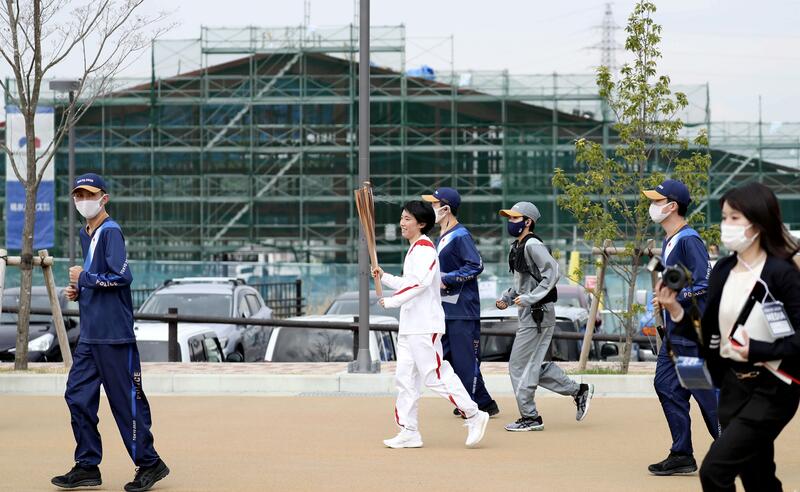
A flame symbolizing hope passed through several areas hit hard by the 2011 Great East Japan Earthquake and tsunami at the start of the Tokyo Olympics torch relay, which began on Thursday. Although the disaster has left deep scars, there were many indications that people are trying to stay strong to rebuild their lives.
One hundred torchbearers kicked off the relay on the first day, carrying the torch through coastal parts of Fukushima Prefecture, where many areas were evacuated after the major accident at the Fukushima No. 1 nuclear power plant operated by Tokyo Electric Power Company Holdings Inc.
In Okuma, which was evacuated following the accident at the nuclear plant in the town, the torch was carried past public housing for disaster victims and the town's new government building, which opened in the Ogawara district in 2019.
Fields of rice and other crops covered the district before March 2011. Two years ago, the evacuation order for the district was lifted, and since then, the construction of new facilities has progressed in the district as radiation levels are relatively low. The relay course went past a community center being built for residents who have returned to the area and a shopping complex that is scheduled to open next month. However, the town's population, which was about 10,000 before the catastrophe, is now only about 800.
Hikaru Murai, who lives alone in a public housing unit, had mixed feelings as he watched a relay runner jog past. "The reconstruction of Okuma still has a long way to go," said Murai, 71.
Displaced residents of Futaba who now live elsewhere in Fukushima Prefecture watched the relay as it passed through their hometown, where an evacuation order remains in place.
Sora Yokota, a first-year student at municipal Futaba Junior High School, which has reopened in Iwaki in the prefecture, was visiting Futaba for the first time since the disaster. Empty lots where buildings had once stood and still-damaged homes and shops made an impression on 13-year-old Yokota.
"Was this really my hometown? My feelings are a bit complicated. But I'm grateful that people are running to support the reconstruction efforts," Yokota said.
-- Cluster fears
The central government and other entities decided on March 20 that spectators from overseas would not be allowed to enter Japan to watch the Olympics. The government plans to decide in April how many Japanese fans will be permitted at competition venues, based on the overall coronavirus situation and the results of measures in place at professional baseball games and other events. A plan to restrict competition venues to a maximum of 50% of capacity has been mooted.
An estimated 10 million people from Japan and abroad were expected to attend the Games. However, the organizers have been forced to make many changes, and opposition to the Olympics going ahead remains strong. If an infection cluster breaks out during the torch relay, it could have a major impact on the Games, so the organizing committee is implementing strict infection prevention measures.
Read more from The Japan News at https://japannews.yomiuri.co.jp/