Beset by questions about the US’s relationship with Israel and the new partisan rifts dividing it, the White House has sent an emissary to an American Jewish group to deliver a speech that may reveal changing contours in a decades-long marriage of unconditional support.
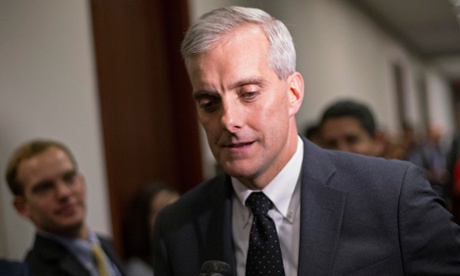
On Monday, White House chief of staff Denis McDonough will give the keynote address at the final event of J Street’s 2015 conference, a three-day gathering of students, activists and lobbyists who attend sessions such as “Beyond the Green Line: Are Settlements an Obstacle to Peace?” and a gala meant to inspire them to take their ideas into the halls of the Capitol.
McDonough, who is Catholic, has acted as one of Obama’s closest foreign policy advisers, peacemaker with top congressional Republicans, and a hard-driving presidential fixer for everything from the botched healthcare program to emergency aid for Haiti. By sending McDonough, a nearly direct line to the president, the White House has ordered a personal touch for a delicate crisis of relations – and sent an able micromanager to galvanize lobbyists who are critical of Netanyahu.
The Obama administration has not yet made clear what designs it has, if any, for a new definition of US-Israeli relations, but McDonough’s speech could herald changes that the president suggested are inevitable. “From our point of view, the status quo is unsustainable,” Obama told the Huffington Post.
“While taking into complete account Israel’s security, we can’t just in perpetuity maintain the status quo, expand settlements. That’s not a recipe for stability in the region.”
J Street represents a subset of Jewish Americans far closer to the views of Barack Obama than the rightwing platform of Binyamin Netanyahu. The advocacy group frequently criticizes Netanyahu for his policies on settlements, the Palestinian territories, Iran talks and inequality at home, and the Israeli prime minister has found a far more supportive audience in the American Israel Public Affairs Committee (Aipac), which had its annual conference in the same convention center earlier this month.
Some 16,000 people attended that event, including Obama’s national security advisor Susan Rice and ambassador to the UN Samantha Power, two relatively hawkish figures in the administration. Netanyahu also took the stage there and defended his controversial speech to Congress.
J Street organizers said they expect 3,000 people to attend the fifth annual conference, including about 1,000 students. Younger, smaller and more liberal than Aipac, J Street stands for, in the words of its president Jeremy Ben-Ami, “An end to occupation, for a two-state solution and for an Israel that is committed to its core democratic principles and Jewish values.”
On Saturday, Ben-Ami also praised Obama: “It is time for the United States to restate the view it has always had that settlements are illegal, and it’s time to give action to those words.”
Morton Halperin, chairman of the group’s board of directors, said Netanyahu could not be trusted in the aftermath of his re-election campaign. “We cannot proceed as if we believe in the third incarnation of Netanyahu, and believe he wants a two-state solution, or to believe that he is not a racist. We must react to this new reality,” he said.
On Tuesday, J Street will orchestrate an “advocacy day”, during which conference participants will gather on Capitol Hill to push their foreign policy ideas on lawmakers.
The Obama White House has been at pains to stress that relations with Israel at large remain undimmed, especially between US and Israeli security forces, even though it rarely disputes reports of mutual disdain between the president and Netanyahu.
Relations between the leaders dipped to a new low the day before Israeli voters took to the polls to re-elect Netanyahu, when the prime minister played to rightwing voters and ruled out a two-state solution for the Palestinian conflict, the preferred policy of American and Israeli leaders for decades.
After he won re-election, Netanyahu backed off those comments, but the White House had already said it took him at his word and would now “reassess” some policy decisions with regard to Israel and the Palestinian conflict. The US could allow the UN to pass a framework for Palestinian statehood, for instance, a resolution which Israel opposes.
The White House has also rebuked Netanyahu for “cynical, divisive” rhetoric on the campaign trail that a spokesman said “undermines the values and democratic ideals that have been important to our democracy and an important part of what binds the United States and Israel together”.
Former secretary of state James Baker, who is advising likely presidential candidate Jeb Bush on foreign policy, will also speak at the J Street conference. Baker served under Bush’s father, President George HW Bush, and had a sometimes discordant relationship with Netanyahu’s predecessor, Yitzhak Shamir.
Ben-Ami says the lobby works for people who were disappointed by the recent election and reject Netanyahu’s incendiary brand of politics. “And now they see that traditional and communal organizations are unable to criticize that – this will hurt those institutions and benefit J Street,” Ben-Ami told Haaretz.