ANALYSIS — When it comes to congressional earmarks, the big dogs usually eat first.
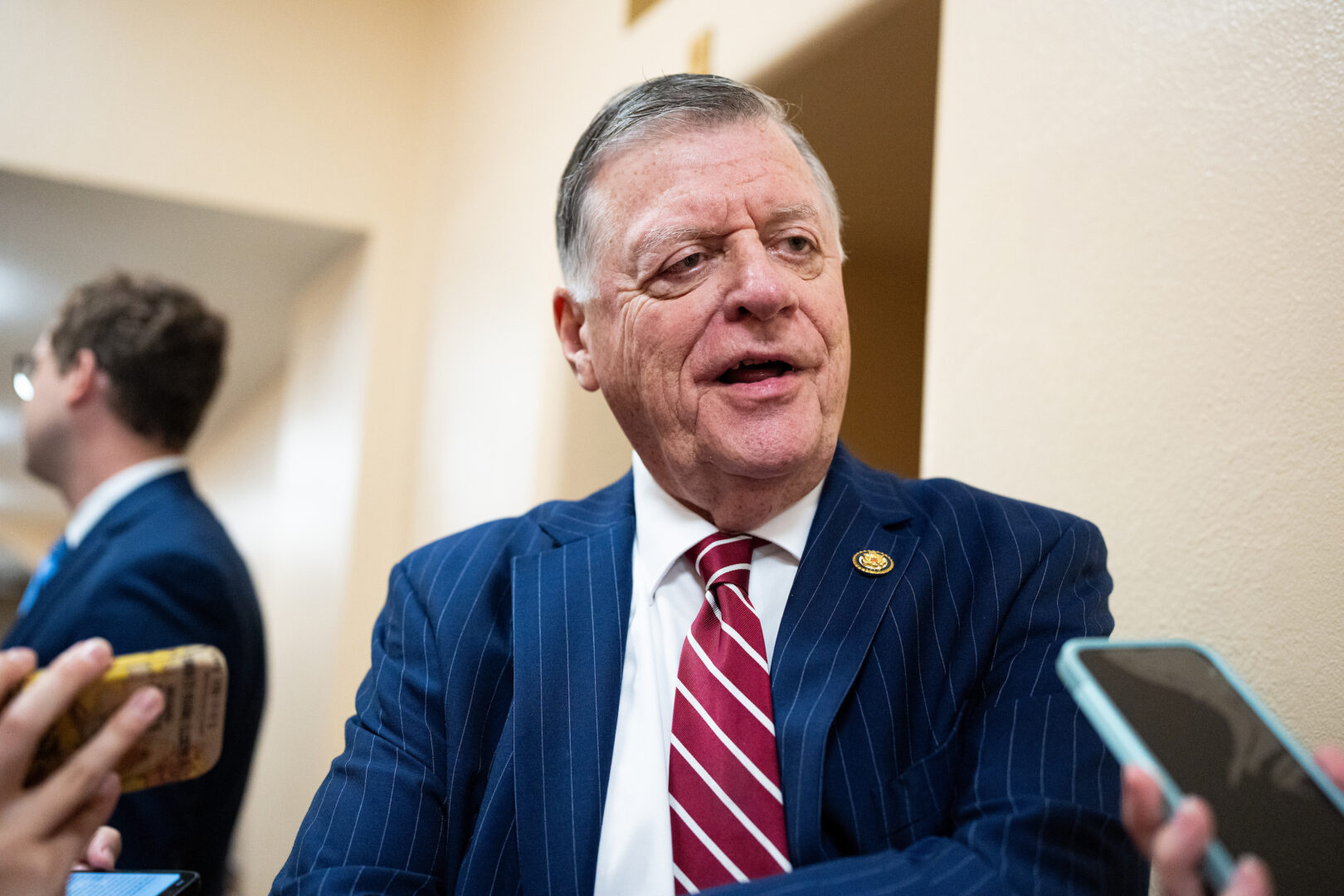
So it’s no surprise that House Appropriations Chairman Tom Cole, R-Okla., leads the pack on “community project funding” included in his panel’s fiscal 2027 spending bills, with $188.4 million.
The No. 2 House Republican, Majority Leader Steve Scalise of Louisiana, comes in a close second, with $186.5 million for his district.
Cole, Scalise and fellow House Republicans secured about 59 percent, or close to $4.9 billion, of the total $8.2 billion earmarked dollars across the chamber’s appropriations bills, a CQ Roll Call tally found.
GOP lawmakers put in about 39 percent of the 6,694 individual projects, so each member on their side is getting a larger share of dollars per district.
House Republicans have generally taken to earmarking with more gusto than they did when a then-Democratic Congress first brought back the practice in 2021, after a decadelong ban.
At that time, about one-third of members requesting earmarks were Republicans; now, the total is over 45 percent. Part of that has to do with new rules GOP leaders instituted limiting earmarks’ scope after they reclaimed the majority in 2023, and more time seeing the process operate scandal-free compared with the practice in the mid-2000s.
As intraparty controversy over earmarking subsided, Cole and GOP leaders decided to bring back a limited number of Labor-HHS-Education projects this year, for hospitals and other health care facilities.
The fiscal 2027 draft Labor-HHS-Education bill includes $16 million for providers in Cole’s district and $22.1 million in Rep. Robert B. Aderholdt’s district. That’s enough to push Aderholt, R-Ala., who chairs the Labor-HHS-Education Appropriations Subcommittee, up to No. 9 on the overall list with $71.5 million.
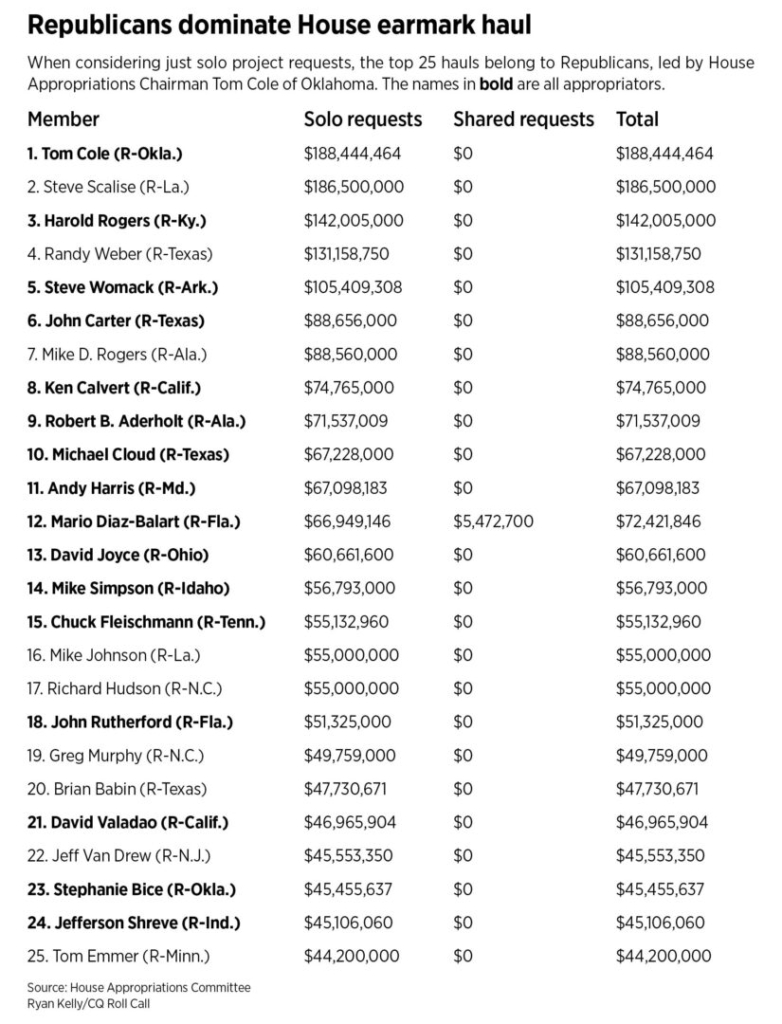
There are no House Democrats even in the top 50 when it comes to fiscal 2027 earmarks secured individually, without shared credit for joint projects. Rep. James E. Clyburn, D-S.C., the ranking member on the Transportation-HUD Appropriations Subcommittee, is the top earmarker on his side, coming in at No. 52, with $28.5 million.
HUD most popular
The Transportation-HUD bill alone is responsible for 3,014 earmarks worth $3.6 billion, or roughly 45 percent of the totals.
Department of Housing and Urban Development economic development projects are far and away the most popular earmarked account, with 2,257 individual projects worth a total of $2.5 billion.
Transportation-HUD bill earmarks make up more than half of Cole’s total amount, or $107 million, and account for nearly all of Rep. Steve Womack’s — $99.1 million out of $105.4 million. Womack, R-Ark., the Transportation-HUD Subcommittee chairman, ranks No. 5 on the overall list.
The largest individual earmark in the fiscal 2027 crop, $250 million, belongs to a trio of bipartisan lawmakers — Illinois Democrats Nikki Budzinski and Eric Sorenson, and Missouri Republican Sam Graves — for the Army Corps of Engineers’ Upper Mississippi River construction project. That makes up most of the $273 million set aside for seven bipartisan projects contained in the funding bills.
Scalise’s total is bolstered by $162 million for one megaproject: the Army Corps’ “Morganza to the Gulf” hurricane risk reduction project southwest of New Orleans. Cole’s projects are spread around a little more evenly, led by $55 million to build a facility at Tinker Air Force Base for stationing Boeing’s new E-7 Wedgetail airborne early warning and control aircraft.
Top GOP appropriators generally dominate the earmarks leaderboard, with exceptions here and there mainly for other senior Republicans.
Among the top 25 earmarkers, non-appropriators other than Scalise include Armed Services Chairman Mike D. Rogers, R-Ala., at No. 7 with $88.6 million; Speaker Mike Johnson, R-La., and Rep. Richard Hudson, R-N.C., who runs the GOP campaign arm, with $55 million each for military construction projects; and Majority Whip Tom Emmer, R-Minn., with $44.2 million.
Rep. Randy Weber, R-Texas, is not on Appropriations but comes in fourth at $131.2 million. That’s mainly thanks to $100 million for the Army Corps’ Sabine-Neches Waterway deepening project in southeast Texas, a critical shipping channel for the oil and gas industry.
Bringing it home
It also helps to be an appropriator if you’re an endangered member with a tough midterm race.
Rep. David Valadao, R-Calif., nearly broke the top 20, coming in at No. 21 with $47 million in earmarks. Inside Elections with Nathan L. Gonzales rates his race Tilt Republican. And Rep. Juan Ciscomani, R-Ariz., rated a Toss-up in November, secured the No. 27 spot at $42.1 million, just behind Emmer, the third-ranking House Republican, and Rep. Michael R. Turner, R-Ohio, who obtained $42.5 million.
Other at-risk Republicans in the top tier include New York’s Mike Lawler, a Toss-up who nearly broke the top 50, coming in just ahead of Clyburn with $28.8 million. Another Toss-up, Rep. Mariannette Miller-Meeks, R-Iowa, is in 67th place with $24.2 million.
Even the mysteriously absent Rep. Thomas H. Kean Jr., R-N.J., got some love from GOP leaders in the earmarking process considering his race’s Toss-up status. He procured $16.5 million, spread among 18 projects, despite not showing up at the Capitol to vote since March 5.
Earmarking prowess may be a factor in one key race featuring a Republican-vs.-Republican contest in November, at least if Rep. Ken Calvert, R-Calif., has his way.
Calvert, the Defense Appropriations Subcommittee chairman, is facing off against Rep. Young Kim, R-Calif., after redistricting drew them both into the Golden State’s new 40th Congressional District.
Calvert used his seniority to secure nearly $74.8 million in earmarks, good for No. 8 overall, whereas Kim is at No. 61 with $26.1 million. And while Calvert requested much more than Kim, his success rate in securing earmarked funds was about 80 percent, while Kim’s is 46 percent, based on the project requests listed on their websites.
On the Democratic side, other than Clyburn, only one member shows up in the top 100 — former Rep. David Scott of Georgia, who died in April. His office followed through and delivered $20.3 million.
Rep. Don Davis, D-N.C., whose race is rated Lean Republican, ranks 29th among Democrats at $16.4 million, but he was shut out of any funding for a massive $193.9 million construction project at Marine Corps Air Station Cherry Point.
Rep. Shomari Figures, D-Ala., whose seat is considered likely to flip, is the 45th-ranked Democrat with $15.8 million, followed closely by Rep. Marie Gluesenkamp Pérez, D-Wash., D-Wash., whose earmark funding rounds up to that amount. Gluesenkamp Pérez is an appropriator whose race is rated a Toss-up.
Rep. Marcy Kaptur, D-Ohio, a veteran appropriator and the most senior House Democrat after Rep. Steny H. Hoyer, D-Md., is in a race rated Tilt Republican. She secured $15 million, or 74th among Democrats.
The amount of earmarked funds secured by Reps. Michael R. Turner, R-Ohio, and Pat Ryan, D-N.Y., and their rankings among the top earmarkers have been corrected in this report.