Has it dated? That is the question one inevitably asks about Caryl Churchill's legendary 20-year-old play.
Watching Thea Sharrock's fine revival, I'd say in some ways it has. But that only adds a fascinating layer of historical irony to one of the key postwar plays.
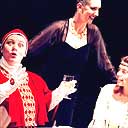
What strikes one still is Churchill's multi-faceted approach to the role of women in society. She starts, famously, with an historical fantasia in which Thatcherite top girl, Marlene, entertains five iconic women from the past to dinner: a scene I once questioned but which now seems a witty celebration of female resilience in the face of continuing oppression. The action then moves on to show Marlene becoming head honcho at an employment agency that slots women into top jobs. And in the emotionally stirring final act we see Marlene confronting the humdrum East Anglian world she left behind and, specifically, her sister Joyce who was left, in every sense, holding the baby.
Written at a time of rampant Thatcherism, the play clearly argues that feminism without humanity and compassion is meaningless: that a world in which women simply ape male role models or adopt the values of corporate capitalism is no kind of advance. I suspect we'd now buy that. Also the choice confronting Marlene between careerist individualism and family responsibility now seems unduly stark: certainly in the worlds I know best women are immensely skilful at reconciling what were once seen as polar alternatives.
But none of this makes Top Girls any less fascinating a play. We may laugh when Marlene cries "I think the eighties are going to be stupendous". But the scene between herself and Joyce still expresses an emotional truth: that the blood that is thicker than water also congeals faster and that in any family someone is always left tending the aged parent.
In short, Churchill's play still hits home and its arguments emerge loud and clear in Sharrock's touring production. The design by Rachel Blues, consisting of an elliptical chunk of moonlit rock, has a vaguely expressionist feel but within that there is a strong sense of living detail. The seven performers also do a fine job. Hattie Ladbury starts a touch too Sloaney as Marlene but becomes ever more truthful as she moves towards home territory. Helen Anderson lends her sister the right residual bitterness and there is good support from Sophie Shaw as Patient Griselda and an impatient executive and from Joanna Scanlan as the female Pope and a desperate middle aged jobseeker.
Times may have changed but Churchill's play impressively endures.
· Booking until February 2. Box office: 020-7379 3367.


.jpg?w=600)