Making a list of the top five labour issues is a challenge, because a lot has been going on in the labour sector and the businesses they work for this year.
In 2018, the government's policy of managing migrant workers remained at the front and centre. The issue had significant impact on the commercial fishing industry that is struggling with a labour shortage and hardened rules imposed by the government to fight illegal, unreported and unregulated (IUU) fishing activities.
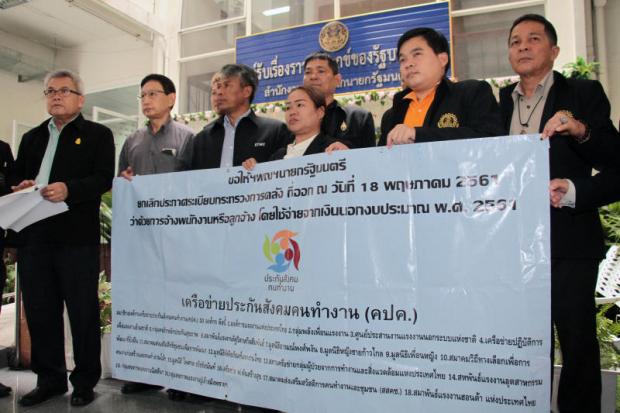
As labour protection and welfare go, two major amendments passed by the legislature will expand the safety net for workers, but there is also a controversial proposal backed by the Labour Ministry that critics say may compromise safety standards at workplaces.
Here are the five picks that serve as key indicators of significant developments on the labour front.
1 Migrant workers upgrade status
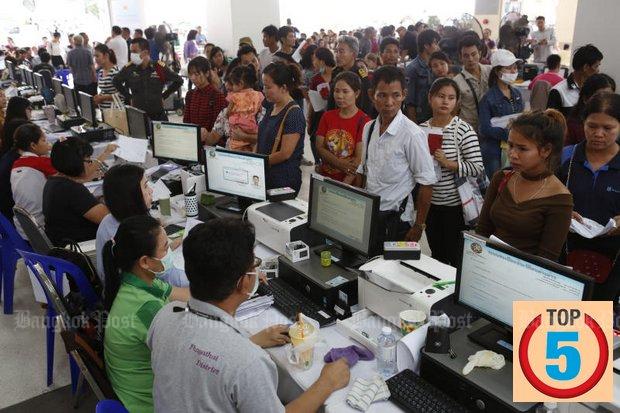
In an effort to streamline the management of migrant workers from Myanmar, Laos and Cambodia, the government introduced a policy requiring all of them to undergo a fresh registration process.
This involved going through nationality verification, receiving identification numbers, passing health exams and obtaining visas and work permits. The migrant workers had from Feb 5 to March 31 to complete the process.
With about 1.32 million migrant workers in the country -- some undocumented, or holding three to four different identification documents issued during previous registration rounds -- the process was plagued with problems and delays.
Many migrant workers waited for 10 hours and some had to make up to four trips to complete the process, despite the one-stop service (OSS) centres working around the clock during the final two weeks before the deadline.
When the deadline ended on March 31, only 961,946 migrant workers had managed to complete their registrations in time. This prompted the cabinet to extend the deadline to June 30, but only for those who had applied to register by March 31.
The campaign caused tension among employers, who feared that once their workers obtained legal status they would leave to find new jobs. Many employers claimed they had shouldered workers' expenses incurred in the registration process.
When the June 30 deadline ended, some 14,298 people were suspected to still be working in Thailand illegally and they would face a crackdown.
The campaign to have migrant workers register is expected to be its last as the government plans to hire migrant workers through an MoU system, a state-sponsored screening process. This will also provide them with better pay and proper social security benefits.
Those who had their status upgraded this year are allowed to work legally in Thailand for two years until 2020.
2 Fishing sector gets room to breathe
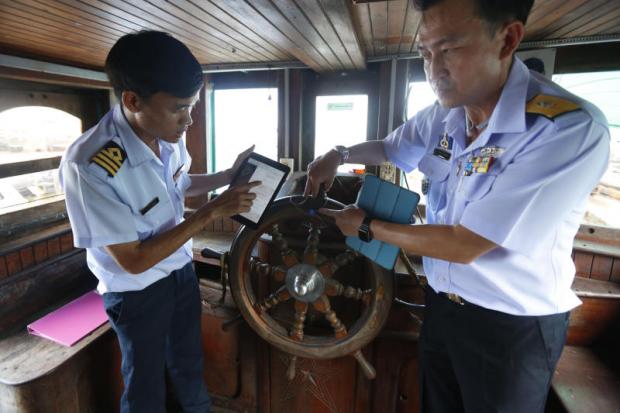
The commercial fishing industry has been hit hard in recent years by the government's tightened policies aimed at tackling IUU fishing activities and stamping out human trafficking.
The industry's woes were aggravated in 2018 by a shortage of fishing crews with the number of workers reduced from 110,000 to about 50,000.
The crews tend to abandon work randomly, forcing trawlers to constantly seek replacements. Due to the tightened regulations involving labour inspections in the fisheries sector, vessels were prohibited from venturing out to sea if there are not enough working crew on board.
The industry made repeated calls for the government to address the labour shortage, claiming many operators could go under. The demand was eventually met as the authorities feared the problem could force them to use the services of illegal migrant workers and put their efforts back to square one.
Among the measures the Labour Ministry adopted to ease the hardship was seeking to import workers from Myanmar under the MoU system, and renewing permits for those whose documents were about to expire.
But the industry is about to face a new challenge now that the government has announced its intention to ratify the International Labour Organisation Convention No.188 (Work in Fishing Convention, 2007), known as C188. This was originally pledged for June 2018.
If Thailand proceeds to ratify the deal, fishing operators will have to invest more to provide workers with significantly better conditions, which means they will have a heavy financial burden to shoulder.
3 Safety net for private employees
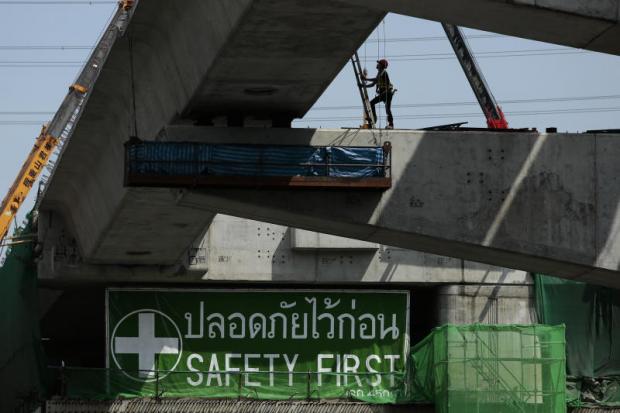
Welfare protection for private employees improved with the setting up of the Social Security Fund (SSF) some years ago, and last year the National Legislative Assembly (NLA) passed a bill to provide them with a safety net during times of contingency.
Under the bill, private employees and contracted workers at state agencies will receive more benefits from a compulsory compensation fund if they are injured at work or while carrying out their duties.
Under the existing law, temporary state workers -- around a million across the country -- have not been eligible for financial assistance after such accidents.
It is the first time the fund will be expanded to cover this group of workers, as well as local staff at embassies and international organisations.
The bill promises higher compensation rates, from 60% of current monthly pay to 70%, and the fund will pay out over a longer period to employees who are left severely disabled by work-related accidents, with the current 15-year cap on payments being a minimum threshold.
In the event of a death or disappearance, families can maintain their claims for up to 10 years, up from eight years at present.
However, throughout the year workers have heard reports about the Labour Ministry's plan to increase the monthly contribution ceiling to the Social Security Fund (SSF) from 750 baht to 1,000 baht a month.
The proposal has not yet been finalised but the ministry has stood firm, saying more contributions mean workers will receive additional benefits in return.
4 More severance for laid-off staff
The NLA's passage of an amendment to the labour protection law in December has been widely hailed by employees who have put in 20 years of service or more.
Under the change, workers laid off after 20 years of service will be entitled to receive an equivalent of 400 days of pay, up from 300 days now. The new rate is expected to come into force next month or early February.
It is estimated that the number of workers with at least 20 years of service in 2019 stands at around 300,000, or 3% of the 9.5 million workers in the system.
The amendment process kicked off in 2015 with various stakeholders taking part. Approved by the cabinet in August 2017, it was expected to be passed by the NLA in 2017.
However, the regulation has sparked fears that some business operators may terminate employment contracts before the amendment takes effect, to avoid paying the extra costs.
In addition to the severance pay, the bill increases other social welfare benefits, particularly maternity leave, which will be increased from 90 to 98 days.
5 Outcry at new law on safety officers
To ease the shortage of safety officers, the Labour Ministry plans to allow companies to hire anyone to work in this post rather than being required to recruit only staff with a degree in occupational health and safety.
The plan is opposed by students of health science and occupational health and safety, and their universities. They accuse the ministry of compromising safety standards at workplaces by relaxing the rule.
Every company with at least 100 employees is currently required under the act to hire a qualified safety officer who must hold a university degree in that field.
Safety officers are required by law to submit a report to the ministry every three months regarding the working conditions at their place of employment.
They are also responsible for any damage or injuries caused by substandard levels of health and safety.
The proposed relaxation of the 2011 Occupational Health and Safety Act appears in Section 13 (4) of the ministry's new draft regulations.
It allows any person with a bachelor's degree in any field of study with at least five years of work experience in any area to undergo 222 hours of specialised training to become a safety officer.
According to the Labour Ministry, the proposal is intended to offer an option to recruit safety personnel from a wider background although priority must be given to those graduates with a degree in occupational health and safety.
The issue will be discussed next month by a tripartite sub-committee under the Occupational Safety, Health and Environment Board. The board is said to be divided over the change as the job requires certain specialised knowledge.
Critics say the work safety training course, which lasts little over a month, is too short for trainees to be able to perform their jobs effectively.