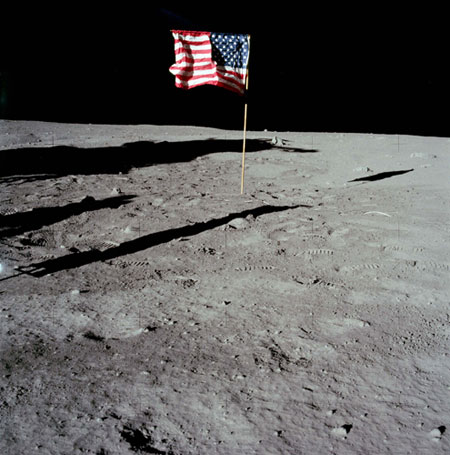
Believer: The flag did not need wind to move, and does not move in any of the videos unless touched. When it is set in motion, the lack of atmosphere and hence air resistance mean the flag takes a long time to settle Photograph: Nasa
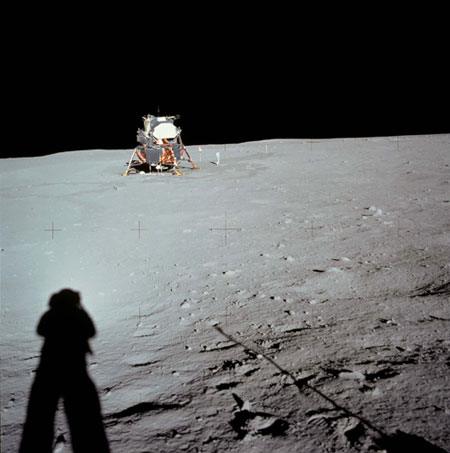
Believer: A low sun and uneven surface can distort the angles of shadows in images. And if there are multiple light sources, why does each object only cast one shadow? Photograph: Nasa
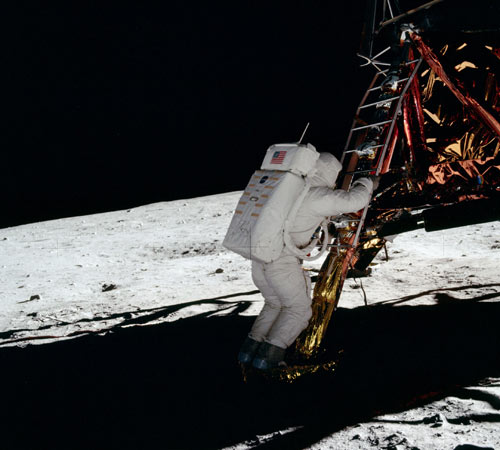
Believer: Footage of Neil Armstrong’s small step was shot by a camera mounted on the outside of the Eagle lander. Pictures of Armstrong’s first step taken from the surface of the moon are actually Buzz Aldrin descending the ladder, snapped by Armstrong. Remote cameras left on the moon could easily record the departure of lunar modules Photograph: Nasa
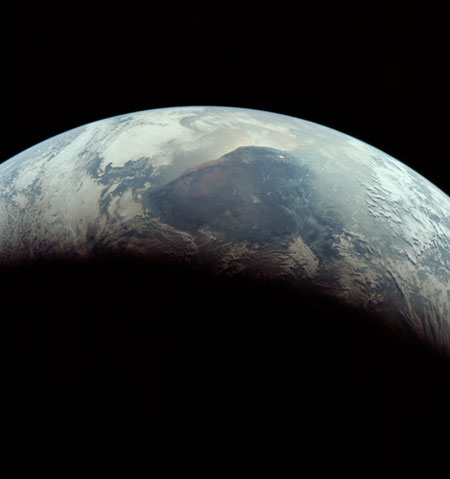
Believer: These 'Van Allen belts', where the Earth’s magnetic field concentrates solar radiation, would be dangerous only if people lingered there for several days. In fact the astronauts whizzed through in a matter of hours, receiving a radiation dose no greater than a medical X-ray Photograph: Nasa

Believer: The C doesn’t appear in the original Nasa negatives or prints. Under close magnification it looks like a hair or fibre that has contaminated a later reproduction Photograph: Nasa

Believer: Particles of moon dust have a different size and shape from sand and don't need moisture to hold a compressed shape. Many powders on Earth can behave in the same way. Try walking in spilt talcum powder Photograph: Nasa

Believer: The Saturn V rocket that carried Apollo into space burnt liquid oxygen and kerosene, creating a dramatically fiery plume. The lunar lander, on the other hand, was propelled by a mixture of nitrogen tetroxide and Aerozine 50, which doesn't. Its exhaust gases were transparent Photograph: Nasa
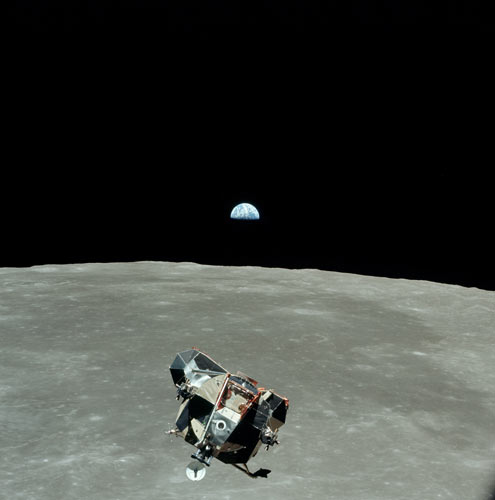
Believer: The astronauts were taking pictures of brightly lit, shiny white objects. Under those conditions photographers shoot with a fast exposure time and small aperture. That makes it impossible to capture faint objects in a dark background, such as stars Photograph: Nasa

Believer: Where to start? Una, if she exists, saw something that the rest of the watching world missed, and of which zero evidence survives. This coke is unlikely to be the real thing Photograph: Nasa
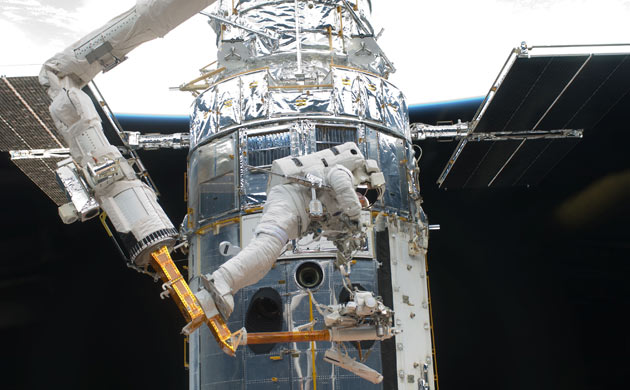
Believer: While Hubble has sent back astonishing images from the ends of the universe, the galaxies, supernovae and nebulae it has revealed all have one thing in common: they are very, very big. The largest piece of man-made rubbish on the moon is what remains of the Eagle lander, about 10m across. That’s just too small for Hubble to see. Still believe the moon landings were faked? Photograph: Nasa